October 17, 2026
Spanish Keyword Research: U.S. Clinics Turn Searches Into

Start with patient-language-first keyword discovery: collect the colloquial Spanish phrases your patients actually use, then map each one to a booking page and a messaging flow. Pull seed phrases from intake notes, reception and WhatsApp threads, and staff interviews. Add them to a seed list you can test. This is how spanish keyword research healthcare teams do it when the goal is appointments, not traffic.
TL;DR:
- Build groups for Spanish speakers born abroad, Spanish speakers born in the United States, and bilingual patients favoring English, using intake records to capture phrasing.
- Prioritize phrases with booking intent, have bilingual reviewers check regional wording rather than trust machine translation, and test pages by tracking bookings and message starts.
- Keep address, phone, and categories consistent across languages, and repeat Spanish wording from website calls to action in WhatsApp replies and booking dialogs.
- Track completed bookings and message starts from Spanish entry points before rankings; if impressions grow while bookings stay flat, fix the page or booking path.
Table of Contents
- Why does Spanish keyword research matter for your practice?
- How should you segment Hispanic patients before researching?
- What is the step-by-step Spanish keyword research process?
- Where do Spanish keywords belong across the patient journey?
- Which KPIs show that Spanish keyword work is paying off?
- What is a practical 30/60/90-day checklist for small practices?
- How does search intent differ between Spanish and English healthcare queries?
- Which tools and methods work best for Spanish healthcare keywords?
- How do you translate medical terminology without losing search value?
- Who should own Spanish keyword work? A view from Francisco
- How does our bilingual front desk put this plan to work?
- FAQ
- Sources
Why does Spanish keyword research matter for your practice?
Language is a trust problem before it is a ranking problem. A cross-sectional assessment of Spanish-preferred patients found they report more difficulty evaluating online health information and are more likely to abandon poorly translated or hard-to-use digital experiences. Language-concordant resources and easy booking tools can make it easier for patients to engage.
A study of patients with limited English proficiency found they are less confident finding health information online and lean on family, friends and media, which means your keywords must sound like everyday speech.
Three reasons this matters for your schedule:
- Poorly localized pages lose patients before they ever call.
- Language access is a quality expectation, and the National CLAS Standards call for understandable services and materials in the languages your community uses.
- Federal guidance under Section 1557 language access provisions expects meaningful access for patients with limited English proficiency.
Judge every keyword by one test: does it move a searcher through the full path of search, find, message and appointment? A phrase that earns clicks but never produces a booking is a vanity term.
How should you segment Hispanic patients before researching?
“Hispanic patients” is not one keyword pool. Research on media use among Latino adults shows U.S.-born and foreign-born groups rely on different media mixes. A survey of Latinx health information seeking found that social media, the internet and family often outrank providers as sources, and U.S.-born adults use more English-language and Latinx-tailored media.
Build three working segments:
- Spanish-preferred, foreign-born: may search in plain, descriptive Spanish, sometimes with formal medical terms.
- Spanish-preferred, U.S.-born: may mix registers and blend English clinical words with Spanish phrasing.
- Bilingual, English-heavy: may search in English or switch mid-query; find out which booking options they prefer by asking patients.
Weight your pages accordingly. Colloquial symptom phrases (“dolor de muela que no me deja dormir”) can help you identify relevant pages for these segments. Clinical terms fit education pages.
Segment from data you already own: intake forms, the language patients select when booking, social listening, and conversations with local community partners such as churches and clinics.
What is the step-by-step Spanish keyword research process?
Run it as seed, expand, validate, prioritize.
- Collect seeds. Mine WhatsApp threads, front desk questions, intake notes and community forums. Keep the patient’s exact words, misspellings included.
- Expand. Test Spanish Autocomplete, Spanish People Also Ask boxes, keyword tools with Spanish modifiers, and your own Search Console queries filtered to Spanish.
- Translate and test with humans. Machine translation may miss regional phrasing, and federal guidance says machine translations of critical documents need qualified human review.
- Prioritize by booking intent. Rank transactional phrases such as “cita con doctor” or “cita dental hoy” first, then volume where available, then ease of implementation (a single page edit beats a full content build).
- Validate with small experiments. Pair a Spanish landing page with a Spanish local post or paid ad, then count bookings and message starts, not just visits.
Pro Tip: Keep a “phrase log” at the front desk. Every time a patient describes a problem in a new way, the receptionist adds it. After a month you will have a better seed list than any tool gives you.
Where do Spanish keywords belong across the patient journey?
Place each phrase where a patient meets you, so the same words appear from search result to booking confirmation.
- Website: Spanish page titles, meta descriptions, H1s and clear Spanish calls to action. Patient education pages should be human-reviewed; the LAS Implementation Workbook includes checklists for translated materials and quality assurance. For more on page content, see our guide to Spanish clinic website content.
- Google Business Profile: Google says complete, accurate information helps businesses rank locally. Keep information consistent across English and Spanish assets. Keep address, phone and categories identical in both languages, and use Spanish posts and Q&A. Our walkthrough on optimizing your Google Business Profile in Spanish covers the fields.
- Messaging and reception: Put the same short phrases in WhatsApp auto-replies, AI receptionist prompts and booking dialogs, so a searcher who typed “cita dental hoy” sees those words again.
- Critical documents: For consent forms and instructions, use qualified human translators or human review of machine output.
Pro Tip: Search your own practice in Spanish on a phone, then tap through to booking. Count the taps. Every extra tap costs you appointments.
Which KPIs show that Spanish keyword work is paying off?
Track outcomes first, rankings second.
- Primary: Spanish organic visits, completed bookings from Spanish forms, WhatsApp and phone conversions that start on Spanish pages or your Business Profile, and time-to-book after the first Spanish touchpoint.
- Supporting: Search Console impressions and clicks for Spanish queries, plus bounce rate and session duration on Spanish pages.
Set the cadence by purpose. Check regularly while an experiment runs so you can fix a broken form or a confusing headline quickly. Build summaries for decisions: which pages earn bookings, which phrases deserve a dedicated page, and where staff time goes next. If bookings from Spanish traffic stay flat while impressions climb, the problem is usually the page or the booking path, not the keyword.
What is a practical 30/60/90-day checklist for small practices?
- First phase (owner: marketer, with front desk): Collect seed phrases, rewrite high-intent pages in Spanish, verify Business Profile language fields, and add a Spanish booking button. Success: the pages are live and you see a Spanish-originated booking request.
- Next phase (owner: marketer): Publish Spanish patient pages, add WhatsApp quick replies and Spanish auto-responses, and test calls to action. Success: message starts rise from Spanish pages.
- Final phase (owner: practice manager): Refine keywords by segment, add Spanish prompts to your AI receptionist, train staff on language assistance notices, and set a regular report. Success: a repeatable report tied to bookings.
| Window | Owner | Success marker |
|---|---|---|
| First phase | Front desk and marketer | Spanish pages live, a Spanish booking request |
| Next phase | Marketer | Message starts from Spanish pages increase |
| Final phase | Practice manager | Booking-based report in place |
Our timeline for medical Spanish SEO at small clinics breaks these tasks down further.
How does search intent differ between Spanish and English healthcare queries?
English healthcare searches often arrive with clinical vocabulary: “periodontal disease treatment” or “primary care physician near me.” Spanish searches more often describe the experience in everyday words, because many Spanish-preferred searchers are less confident evaluating online health content and lean on family and media for guidance, as the LEP information-seeking study found.
Expect these patterns:
- Symptom-first phrasing. Patients describe what hurts before naming the condition.
- Cost and access questions. Searches about price, insurance and whether a clinic speaks Spanish may signal practical concerns. Check your own query and booking data to understand their intent.
- Trust checks. Searchers look for signs that a real Spanish-speaking person will answer.
- Regional variation. The same condition has different everyday names depending on a patient’s origin, so one “correct” Spanish term rarely covers everyone.
The practical consequence: do not copy your English keyword map and translate it. Build the Spanish map from patient speech, and treat “habla español” style reassurance as a conversion element, not decoration. A bilingual page that confirms Spanish-language booking, calls and chat in the first screen answers the intent behind many of these searches.
Which tools and methods work best for Spanish healthcare keywords?
No single tool replaces your own conversations, so combine sources.
- Your own data first: Search Console queries filtered to Spanish, booking language selections and WhatsApp transcripts show real phrasing.
- Search engine suggestions: Spanish Autocomplete and People Also Ask expose how patients ask questions.
- Keyword tools with Spanish databases: Use them to check relative volume, but treat low volume as unreliable for colloquial or regional phrases that tools undercount.
- Social listening and community input: Local groups, community partners and video platforms reveal vocabulary that never shows up in tools. The research on Spanish-speaking respondents notes they are more likely to watch health videos online.
- Human review: Have a bilingual staff member or qualified translator approve each term before it goes on a page.
If you need to scale Spanish content after the research is done, a multilingual SEO content service can help with production, though every page still needs a human read for medical accuracy and local phrasing. For channel decisions, our overview of patient communication tools for Spanish-speaking patients shows where messaging fits.
How do you translate medical terminology without losing search value?
The common problems are predictable, and so are the fixes.
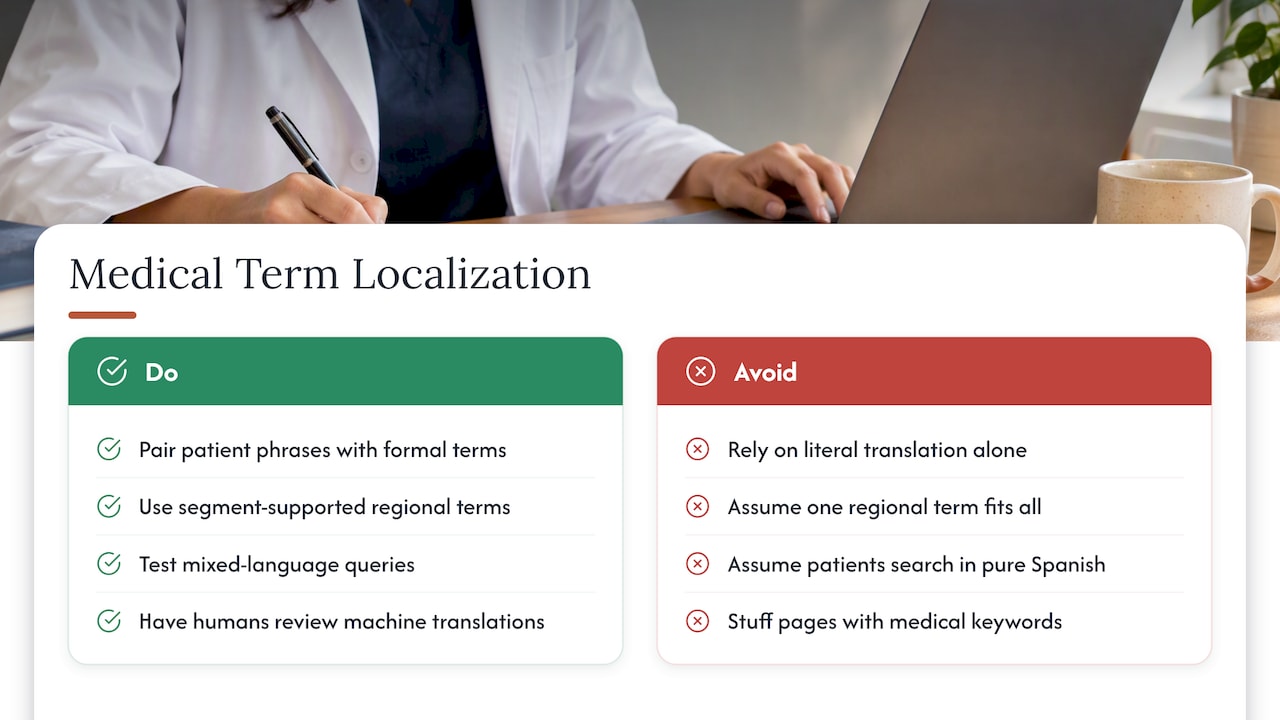
Literal translation misses how people talk. A formally correct term may have almost no search demand because patients use a plainer phrase. Fix it by listing both, using the patient phrase in headings and the formal term in the body for clarity.
Regional differences. A word that is natural for one community can confuse another. Fix it by choosing the term your segment data supports and mentioning common alternatives in the page copy.
English clinical words in Spanish speech. Many U.S.-born and bilingual patients mix languages. Fix it by testing mixed-language queries rather than assuming pure Spanish.
Machine output that reads as untrustworthy. Federal guidance asks for qualified human review of machine translations of critical documents, and the same discipline protects your marketing pages. We explain the workflow in our piece on bilingual healthcare website advantages.
Keyword stuffing medical terms. Google’s guidelines say to avoid using categories as keywords and to keep business information accurate. Write for the patient, then confirm the phrase appears naturally.
Who should own Spanish keyword work? A view from Francisco
The most common mistake I see is treating Spanish as a translation job done once. It is an ongoing listening job. A connected path from search to site to WhatsApp and a receptionist who can answer in Spanish can help practices serve Spanish-speaking patients.
My resourcing advice: give ownership to one person, usually the marketer, and give the front desk the job of feeding phrases back. Bring in an integrated managed service when nobody on staff can review Spanish content or answer after hours. Speed to a reply decides many bookings.
— Francisco
How does our bilingual front desk put this plan to work?
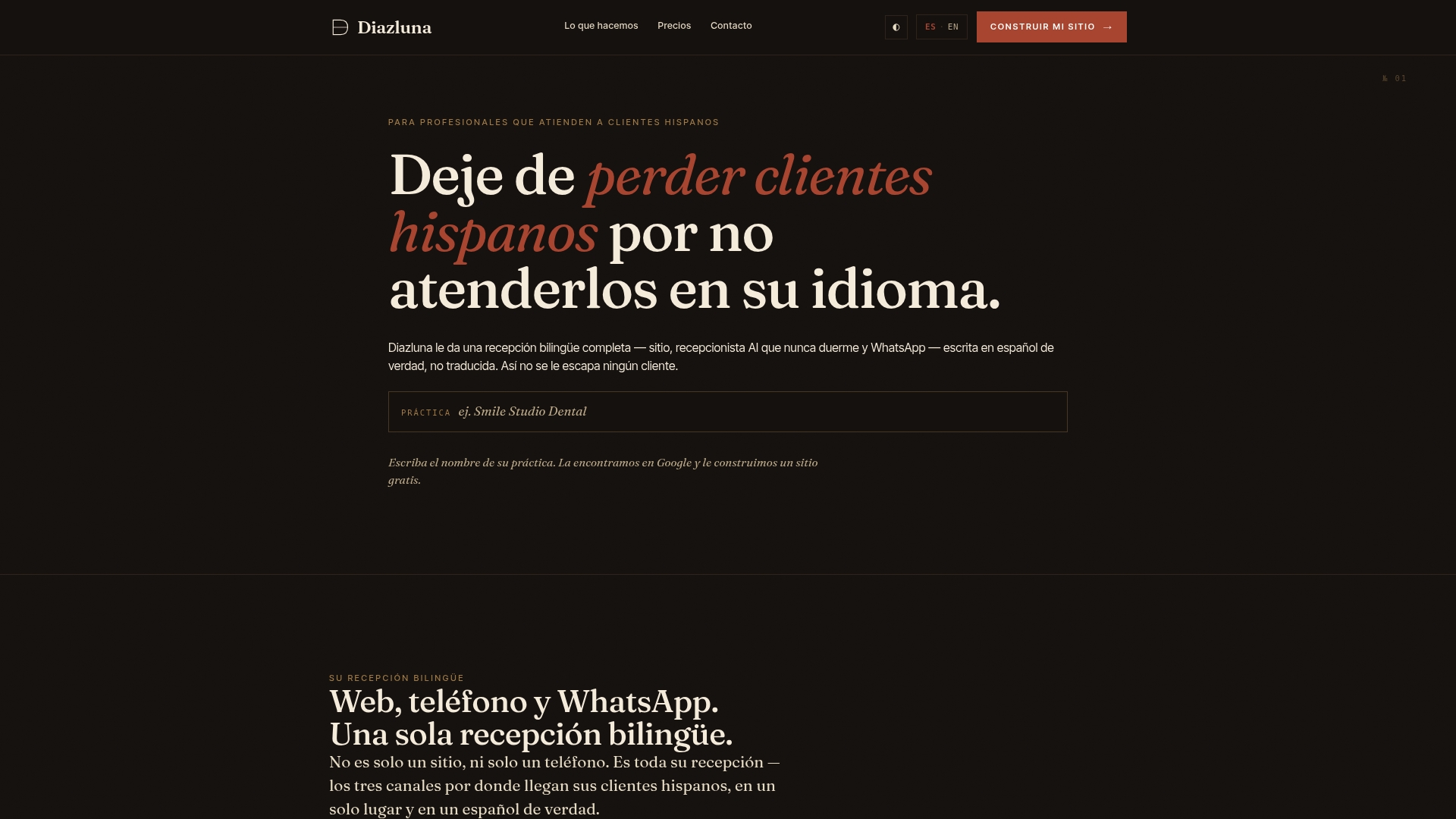
Everything above ends at a booking, and that is where we focus. Our bilingual front desk connects the pieces:
- A bilingual website with human-reviewed, non-translated Spanish pages.
- An AI receptionist that handles calls, messages and scheduling in Spanish and English.
- WhatsApp integration, so patients who search in Spanish can message you the way they prefer.
You can see the plans, from site-only to our full package, on our Diazluna page.
This article is general information, not a substitute for advice from a qualified doctor. Consult a qualified healthcare professional about your own circumstances before acting on anything here.
FAQ
How do I find Spanish keywords patients actually use?
Start with your own records: intake notes, front desk questions and WhatsApp threads. Then confirm them with Spanish Autocomplete and People Also Ask. Always have a bilingual person review each phrase before using it.
Can I just machine-translate my English keywords?
It is risky. Federal guidance on Section 1557 language access expects qualified human review of machine translations of critical documents. Translate, then test with real speakers before publishing.
Does my Google Business Profile need Spanish content too?
Yes. Keep address, phone and categories identical across English and Spanish assets, because inconsistencies can hurt local visibility according to Google’s ranking guidance. Add Spanish posts and Q&A on top of that consistent base.
What should I measure first?
Measure completed bookings and message starts from Spanish pages before rankings. Rankings only matter if they lead to appointments.
Sources
- Tips to improve your local ranking on Google - Google Business Profile Help
- Digital health literacy and use of patient portals among Spanish-preferred patients in the United States: a cross-sectional assessment
- Language Access Provisions of the Final Rule Implementing Section 1557 of the Affordable Care Act
- National Standards for Culturally and Linguistically Appropriate Services (CLAS) in Health and Health Care
- Traditional and Online Health Information Seeking Among Individuals With Limited English Proficiency in the United States: Cross-Sectional Study