October 14, 2026
Bilingual Medical Websites for Clinics
A bilingual medical website is a complete Spanish and English path, not an English site with a translated homepage, and the fastest way to tell if yours qualifies is to audit whether a Spanish-speaking patient can contact you, book a visit, fill out forms, understand insurance and payment, and activate a patient portal account, all without switching to English. If any of those tasks breaks down in Spanish, that’s where to start fixing things, and a ready-built bilingual front desk can close that gap quickly.
TL;DR:
- A 2021 review found that only 22.5% of 40 leading US hospitals offered Spanish translation, and two relied on Google Translate without documented human review.
- Launch booking, contact, and core forms first; use qualified bilingual reviewers, then test the Spanish flow with Spanish preferred patients in sessions of about an hour.
- Scheduling tools should preserve Spanish through appointment selection, confirmations, reminders, and rescheduling, including external widgets that may switch back to English after booking.
- Track Spanish traffic separately and review bookings, portal activations, form abandonment, and helpdesk volume at 30, 60, and 90 days after launch.
- Section 1557 applies only to covered entities; confirm your practice’s status with compliance counsel before posting required language assistance notices online and onsite.
Table of Contents
- Why a full bilingual site matters for access, trust, and outcomes
- Core features checklist: the Spanish user path your site must cover
- Build-and-launch process: practical steps, roles, and a simple timeline
- Operational adoption: staff workflows, escalation rules, and KPIs
- Practical compliance note: Section 1557 and language-assistance notices
- Integration of bilingual appointment scheduling systems
- Tips for bilingual content localization beyond direct translation
- Maintaining consistent bilingual communication across every touchpoint
- Testing and quality assurance before launch
- Analytics and performance tracking for bilingual sites
- What experience building these sites teaches you about common mistakes
- How Diazluna fits into your clinic’s bilingual front desk
- FAQ
- Sources
Why a full bilingual site matters for access, trust, and outcomes
Most hospital and clinic websites still fall short here. A 2021 review of 40 top-ranked US hospitals found that only 22.5% offered Spanish website translation, and among those that did, two relied on Google Translate with no documented human review. That gap is an opportunity for smaller practices willing to do this well.
The stakes are real for patients. A 2024 cross-sectional study found that 73.6% of Spanish-preferred patients reported discomfort reading or writing in English, which means core tasks like scheduling or portal sign-up need to work in Spanish from the first click, not as a fallback option.
Translated interfaces also build confidence beyond simple comprehension. Research on multilingual health tools found that labeling and language choice affect how safe and independent patients feel using a digital tool. A related quality-improvement effort reported that patient portal activations rose after a 2026 redesign targeting Spanish-speaking users, showing that small, targeted fixes move real adoption numbers.
- Spanish website translation remains uncommon among leading US hospitals.
- Discomfort with English is common among Spanish-preferred patients and affects task completion.
- Redesigning activation flows for Spanish speakers has been shown to raise portal sign-ups.
Core features checklist: the Spanish user path your site must cover
Treat this as an audit you can run yourself or hand to a vendor. Each item below covers a point where Spanish-speaking patients typically drop off.
- Direct Spanish access from the homepage. Label the link “En Español,” not a flag icon or generic globe, and route visitors to a dedicated Spanish homepage rather than a pop-up translator. Research on bilingual healthcare communication recommends sending users directly to Spanish pages instead of layering translation widgets over English content.
- Full Spanish coverage of services, insurance, forms, contact, and booking. These five tasks are where most incomplete translations break down, often leaving the homepage translated while appointment forms and portal instructions stay in English.
- Mobile-first layout with plain-language Spanish. Aim for a 6th to 8th grade reading level and use imagery that reflects the patients you serve, both recommended as baseline criteria for acceptable bilingual healthcare sites. Our Spanish readability audit checklist walks through how to check your existing copy against this standard.
- Human-reviewed translation, not machine output alone. Use forward and back-translation with qualified bilingual reviewers, and apply transcreation rather than literal translation for culturally sensitive material like consent language or health education. Formative work on bilingual health sites found that community input and iterative testing catch cultural mismatches that direct translation misses.
- Spanish-language portal flows end to end. Activation emails, password resets, appointment reminders, and automated messages all need Spanish versions, since caregivers often resort to machine translation or family members when portal content stays untranslated.
- Technical SEO for both languages. Use distinct Spanish URLs, proper language tagging, and submit an updated sitemap so search engines index your Spanish pages quickly. Our guide to 30/60/90 day Spanish SEO covers the sequence in more detail.
For ready-to-use copy, our Spanish medical website content guide and bilingual contact form templates give you a starting draft instead of a blank page.
Pro Tip: Start your audit with booking and contact forms. They’re the two tasks most likely to be English-only even on sites that otherwise look bilingual.
Build-and-launch process: practical steps, roles, and a simple timeline
Turning the checklist above into a working site follows a predictable sequence, whether your team builds it in-house or briefs a vendor.
- Map priority tasks and set MVP scope. Booking, contact, and core forms are the non-negotiable minimum for launch.
- Draft English and Spanish content in parallel. Use qualified bilingual reviewers and back-translation rather than translating after the English version is finalized, a sequence recommended in health-website development research.
- Design mobile-first and test with real users. Run short usability sessions, around 60 minutes, with Spanish-preferred patients to catch wording and navigation problems before launch.
- Run the technical launch checklist. Confirm direct Spanish URLs, sitemap submission, correct robots settings, consistent language-switch behavior, and that Spanish pages are indexing properly.
- Monitor for the first 90 days. Track activation rates, completed bookings, and helpdesk tickets at 30, 60, and 90 days, and fix whatever is underperforming.
- Qualified bilingual reviewers should sign off on clinical and legal content before launch.
- Usability sessions with Spanish-preferred patients catch issues that internal review misses.
- Post-launch monitoring should continue past the first month, since adoption patterns shift over time.
If translation quality assurance is outside your team’s expertise, a dedicated service like AD VERBUM’s medical translation checklist outlines what a certified review process should include.
Operational adoption: staff workflows, escalation rules, and KPIs
A well-built bilingual site still fails if no one owns the Spanish channels day to day. Assign a specific person or team to monitor Spanish website messages, WhatsApp, and portal messages, and set clear escalation rules so clinical concerns, scheduling questions, and billing issues each route to the right person.
Automate what’s routine, appointment confirmations and common FAQs, but keep human review for vital documents and clinical translations. Our overview of patient communication tools compares channel options for teams building this out.
- Track Spanish-language portal activation rates separately from your overall numbers.
- Measure completed bookings originating from Spanish pages, not just total form submissions.
- Watch form drop-off rates and helpdesk ticket volume as early warning signs.
Pro Tip: If helpdesk tickets about Spanish forms spike after launch, that’s usually a sign the form itself needs simplifying, not just a translation fix.
Practical compliance note: Section 1557 and language-assistance notices
Section 1557 requires covered healthcare entities to provide meaningful access for patients with limited English proficiency, including posted notices about available language assistance. Whether your practice qualifies as a covered entity depends on your specific circumstances.
- Confirm your covered-entity status and post a language-assistance notice where required, both on your site and at physical locations.
- Review the timeline and requirements in our Section 1557 language-access guide.
- Consult compliance counsel or your compliance officer before finalizing notices, since this article is general information rather than legal advice.
Integration of bilingual appointment scheduling systems
Booking is usually the task patients care about most, and it’s also where language switching tends to break. A scheduling system built for bilingual use should let a patient select Spanish once and stay in that language through confirmation, reminders, and any rescheduling, rather than reverting to English after the initial booking screen.
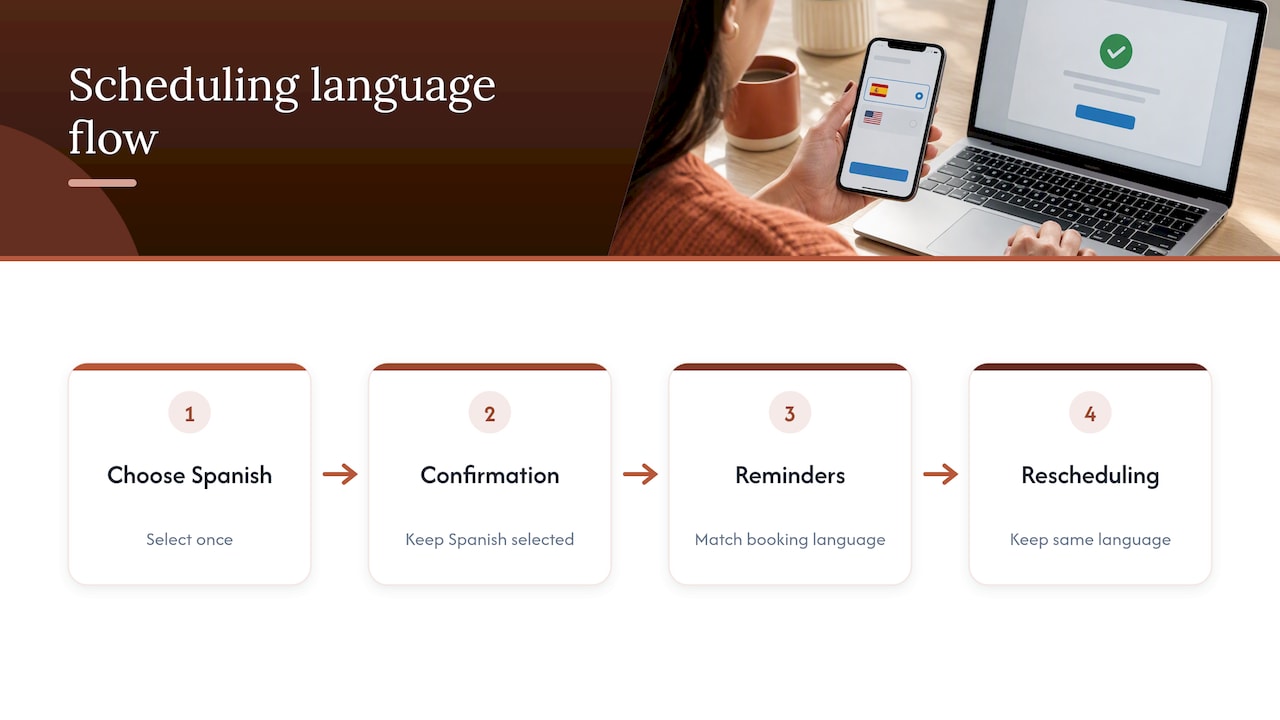
Look for a system that supports Spanish-language appointment types, provider names, and location descriptions, not just the button labels. Confirmation emails and text reminders need to match the language the patient selected at booking, since a Spanish booking followed by an English reminder undermines the trust you built on the booking page itself.
If your practice uses a third-party scheduling widget, check whether it genuinely supports Spanish throughout the flow or only translates the landing screen. Some widgets display a Spanish label but revert to English once a patient clicks through to pick a time slot, which recreates the exact gap research on hospital Spanish translation has documented.
A 24/7 bilingual receptionist handling both website and phone bookings removes this risk entirely, since the same person or system manages the conversation in whichever language the patient starts with, including follow-up calls to confirm or reschedule. That continuity matters more for scheduling than for almost any other task on your site, since a missed or confused appointment is the most visible failure point for a Hispanic patient trying to get care.
Tips for bilingual content localization beyond direct translation
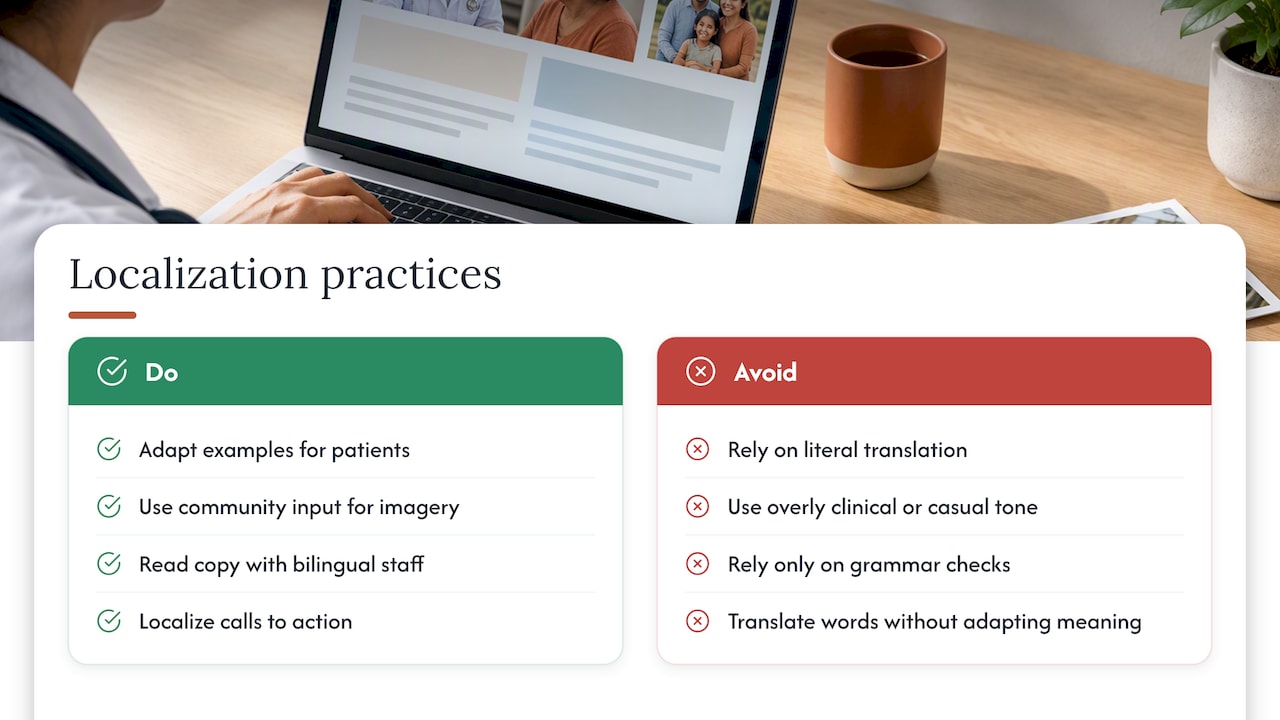
Direct translation gets the words right. Localization gets the meaning right, and for medical content that difference affects whether patients trust and act on what they read. Start by adapting examples, not just vocabulary: a reference to a US-specific insurance term or a mainstream American holiday may need a Spanish-language equivalent your patients recognize, not a literal translation.
Imagery matters as much as text. Formative research on bilingual health websites found that community input through focus groups and advisory boards surfaced naming and imagery choices that a straight translation missed entirely, from how a condition is described colloquially to which photos felt representative to the intended audience.
Tone also needs adjusting. Spanish-language medical communication across Latin American and US Hispanic communities varies in formality, and a translation that sounds overly clinical or overly casual can undermine the warmth that builds trust with a new patient. Reading your Spanish copy aloud with a bilingual staff member, not just running it through a grammar check, catches these mismatches before they reach patients.
Finally, localize your calls to action. “Request an appointment” might translate accurately but still feel stiff compared to how a Spanish-speaking patient would naturally phrase the same request. Small adjustments like this are where transcreation, adapting intent rather than words, pays off most.
Maintaining consistent bilingual communication across every touchpoint
A bilingual website that doesn’t carry through to follow-up messages and forms creates a jarring experience. Once a patient selects Spanish on your site, every subsequent touchpoint, appointment reminders, post-visit instructions, billing statements, and portal notifications, should continue in that language unless the patient changes their preference.
This consistency requires a system that remembers language choice rather than asking patients to re-select Spanish at every interaction. Caregivers managing a patient’s digital health tasks often end up relying on machine translation or family members to bridge gaps precisely because one touchpoint, often the portal or a follow-up message, was left in English while everything else was Spanish.
Audit your automated messages specifically. Appointment confirmations, no-show reminders, lab result notifications, and billing reminders are often generated by separate systems than your main website, which means they’re frequently overlooked during a bilingual website project even when the site itself looks complete.
Digital forms deserve the same scrutiny. A Spanish-language booking form that links to an English-only intake PDF defeats the purpose of translating the booking page at all. Walk through every form a new patient might encounter, intake, consent, insurance verification, and confirm each one has a true Spanish version rather than a translated label sitting above English fields.
Testing and quality assurance before launch
Catching language errors before launch is far cheaper than fixing them after patients notice. Start with linguistic QA: have a qualified bilingual reviewer, separate from whoever wrote the original Spanish content, check for accuracy, tone, and regional word choice, since terms common in one Spanish-speaking country can read oddly or incorrectly in another.
Back-translation adds a useful check. Translating the Spanish content back into English and comparing it to your original draft surfaces meaning shifts that a single-direction review might miss, a method used in health-website development research alongside structured usability testing.
Usability testing with actual Spanish-preferred patients, not just bilingual staff, catches navigation and comprehension issues that a linguistic review alone won’t find. A short session, roughly an hour, walking a handful of patients through booking an appointment or completing a form in Spanish typically surfaces the same two or three friction points across participants.
Technical QA runs in parallel: confirm that language-switch buttons work correctly on every page, that Spanish URLs don’t redirect back to English versions, and that forms submitted in Spanish route to the correct staff workflow. A broken language toggle or a Spanish form that silently defaults to an English confirmation page undoes the trust your content team worked to build.
Analytics and performance tracking for bilingual sites
Measuring a bilingual site requires tracking Spanish and English experiences separately, not just combined site totals. Set up your analytics platform to segment traffic by language path so you can see conversion rates, time on page, and drop-off points for Spanish visitors independent of your English numbers.
Pay particular attention to form completion rates by language. If your Spanish booking form has a noticeably higher abandonment rate than its English counterpart, that’s a signal worth investigating, whether the cause is wording, field length, or a technical issue specific to the Spanish version.
Portal activation is another metric worth isolating. The 2026 JAMIA quality-improvement study that found activation gains after redesigning Spanish-language screens relied on exactly this kind of segmented tracking to measure whether changes were working.
Helpdesk and front-desk call volume round out the picture. A spike in phone calls asking for help with a Spanish-language form or portal step often shows up in your analytics as a quiet drop-off point online, so cross-referencing both sources gives a fuller view of where patients are struggling.
What experience building these sites teaches you about common mistakes
The most common failure isn’t a missing Spanish homepage. It’s a Spanish homepage sitting in front of English-only booking forms, portal instructions, and billing pages, which looks complete on a quick glance but leaves patients stuck at the exact moments that matter most.
The fix is almost always the same: prioritize the booking and contact path first, test it with Spanish-preferred patients before launch, and only then expand to secondary content. Practices that skip testing tend to discover these gaps through patient complaints or quiet drop-off instead of catching them early.
— Francisco
How Diazluna fits into your clinic’s bilingual front desk
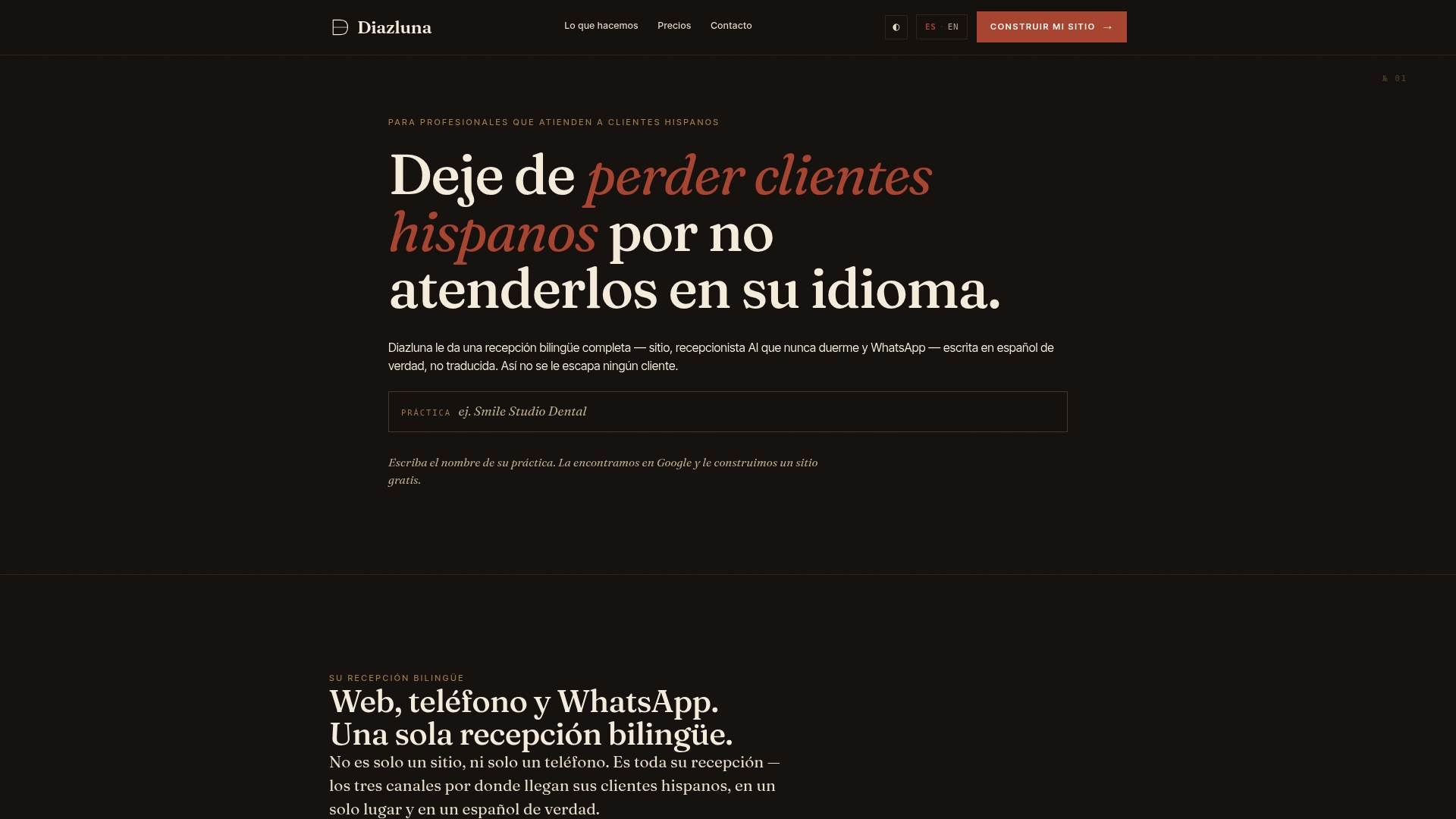
If building and maintaining all of this in-house feels like more than your practice has time for, we built Diazluna specifically to close this gap in one package. The platform combines a fully bilingual website with human-reviewed Spanish content, a 24/7 AI receptionist who handles calls and messages in both Spanish and English, and WhatsApp integration so patients can be reached through their preferred channel.
This setup fits practices that are losing Hispanic patients to language friction but don’t want to manage a website vendor, a translation service, and a phone system separately. Instead of three contracts, you get one bilingual front desk that stays consistent across every touchpoint we covered above.
- The platform offers a Solo Sitio plan for the bilingual website on its own, a Sitio + María plan adding the 24/7 bilingual receptionist, and a Sitio + María Pro plan that expands call capacity and site management. Specific pricing details are available on the official website.
A one-time $399 activation fee applies when you get started. Visit Diazluna to see current plan details and request a demo to check fit for your practice.
This article is general information, not a substitute for advice from a qualified doctor. Consult a qualified healthcare professional about your own circumstances before acting on anything here.
FAQ
What counts as a true bilingual medical website?
A true bilingual medical website lets patients complete every essential task, contact, booking, forms, insurance information, and portal activation, entirely in Spanish, not just view a translated homepage. Research on hospital websites found that even among the small share offering Spanish translation, many lacked documented human review of that content.
How readable should Spanish medical content be?
Aim for a 6th to 8th grade reading level in Spanish, paired with culturally appropriate imagery and direct navigation to Spanish pages rather than a translation pop-up. These are the baseline criteria recommended in research on bilingual healthcare communication.
Does my practice need a language-assistance notice?
If your practice is a covered entity under Section 1557, you’re expected to provide meaningful access for patients with limited English proficiency and post a notice about available language assistance. Confirm your specific status with compliance counsel, since applicability depends on your practice’s circumstances.
How much does a bilingual front desk platform cost?
With Diazluna, our website-only Solo Sitio plan starts at $99 per month, and our Sitio + María plan adding a 24/7 bilingual receptionist starts at $199 per month, both with a one-time $399 activation fee. Full plan and billing details are listed at Diazluna.
What’s the biggest mistake practices make with bilingual sites?
The most common mistake is translating the homepage while leaving booking forms, portal instructions, and automated messages in English only. Caregivers often respond by relying on machine translation or family members to complete these tasks, which is exactly the friction a complete bilingual path is meant to remove.
Sources
- Assessment of Spanish translation of websites at top-ranked US hospitals
- Digital health literacy and use of patient portals among Spanish-preferred patients in the United States
- COVID-19 communication from seven health care institutions in North Texas for English- and Spanish-speaking cancer patients: mixed method website study
- OCR guidance: Section 1557 language access
- Quality-improvement study on portal activation improvements for Spanish-speaking users