October 27, 2026
WhatsApp for Law Firms: Rules, Risks and a Safe Setup
Yes, a U.S. law firm can use WhatsApp to talk with clients, as long as it does so deliberately. No rule bans the app. The duty is to protect confidentiality, keep a record of substantive messages, and tell clients what the channel is and is not for. For firms with Spanish-speaking clients, who often already live in WhatsApp, a controlled setup beats pretending the app does not exist, because clients will use it anyway.
This guide covers what the ethics guidance says, where the real risks sit, a practical setup, and how clients can tell a real firm from a scammer posing as one.
TL;DR
- Using WhatsApp with clients is allowed. Messaging apps can support responsive attorney-client communication if the firm follows protocols and plans for confidentiality and record retention.
- The standard is “reasonable efforts” to prevent unauthorized access, not perfection, and it rises with the sensitivity of the matter.
- The biggest practical gaps are retention (deleted or edited messages), personal phones, and sending documents that should go by email, letter or in person.
- Update your engagement letter, log substantive messages into your case file, and give clients a clear list of what WhatsApp is for.
- Clients should be warned about fake “law firms” on WhatsApp. The FBI has flagged them.
Table of Contents
- What the ethics rules actually require
- The real risks of WhatsApp for law firms
- What belongs on WhatsApp, and what does not
- A safe setup, step by step
- Spanish-speaking clients: clarity and confidentiality together
- Perspective: how we see WhatsApp in a law practice
- How Diazluna fits into a law firm’s WhatsApp setup
- Warn clients about fake law firms on WhatsApp
- FAQ
- Sources
What the ethics rules actually require
There is no WhatsApp-specific rule in the ABA Model Rules. The relevant standard is general. ABA Formal Opinion 477R says a lawyer generally may transmit information relating to a client’s representation over the internet if the lawyer makes reasonable efforts to prevent inadvertent or unauthorized access. It also says stronger safeguards may be required by the client, by law, or by the sensitivity of the information.
That tracks Model Rule 1.6(c), which requires reasonable efforts to prevent inadvertent disclosure of confidential information. The same ABA litigation newsletter tells attorneys to think carefully about content and circumstances before texting a client.
Three things follow in practice:
- The channel is not the issue; the content and the controls are. Scheduling a consultation on WhatsApp is a different risk from discussing settlement strategy there.
- Sensitivity changes the answer. Opinion 477R describes a fact-specific assessment of the threat, how sensitive the information is, how likely disclosure is, which safeguards exist, how hard they are to implement, and what they cost. For highly sensitive matters, reasonable efforts may mean skipping ordinary electronic communication or using enhanced encryption.
- State rules and bar opinions can add to this. Check your own state bar’s guidance. The Michigan Bar Journal, for example, advises end-to-end encryption for communications containing confidences or secrets and stresses defined procedures and preservation duties.
This article is general information, not legal advice for your jurisdiction. Your state bar’s ethics hotline or ethics counsel can confirm local requirements.
The real risks of WhatsApp for law firms
Encryption is not the whole story
WhatsApp and similar apps provide, or claim to provide, end-to-end encryption. That helps in transit. But the same ABA piece points out that deleting or editing features create record-keeping and authentication problems. Encryption does not protect a message sitting on an unlocked phone, a phone shared with family, or a device synced to a laptop in a waiting room.
Retention and spoliation
The ABA’s Law Practice Today warns of inadequate preservation of substantive communications, and of deletion or editing that can lead to spoliation and make later authentication difficult. If a client disputes a fee or files a grievance, the firm needs to produce what was said. A pre-established, regular archiving process, such as periodic printing or automated exports, is critical for malpractice defense or fee disputes.
Privilege waiver
Inadvertent disclosure of attorney-client communications can lead to waiver of privilege, with potentially devastating consequences for the client’s position. The common causes are mundane: a message sent to the wrong contact, a group chat with a relative added, or a lost phone.
Phishing by message
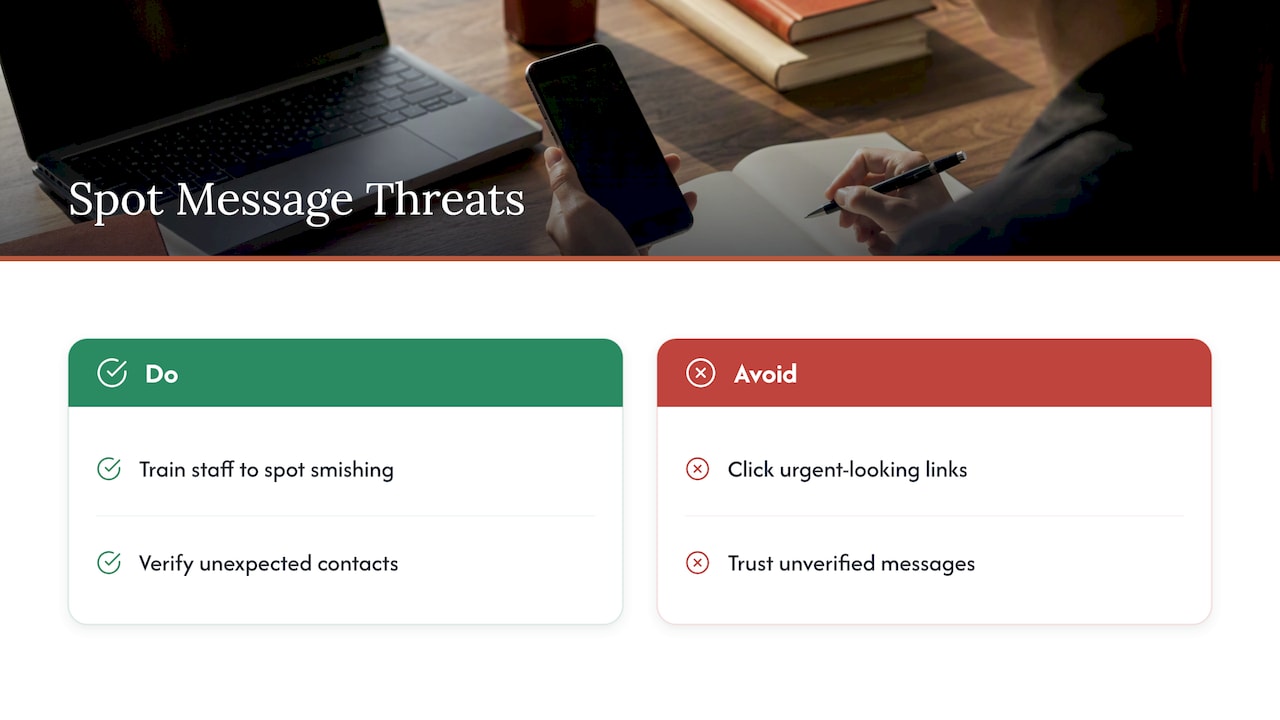
Malicious text messages designed to mimic legitimate contacts, known as smishing, are a threat to firm security, and the Michigan article says staff must be trained to spot them. A messaging channel that staff check all day is exactly where an urgent-looking fake link gets clicked. Solid website security basics on the public side of your practice reinforce the same habit: assume anything unexpected is hostile until verified.
Personal phones
When attorneys answer clients from their own phones, the firm loses control of retention, access and departure. That is why the Michigan guidance recommends reviewing app terms, confirming that lawyers and clients use end-to-end encryption, setting retention policies, and adopting bring-your-own-device policies.
What belongs on WhatsApp, and what does not
A simple sorting rule keeps staff from improvising. The ABA litigation newsletter says engagement letters, final judgments and settlement agreements are not suited for texting and should go by email, letter or in person. Extending that logic to messaging apps, a workable split looks like this:
| Use WhatsApp for | Move off WhatsApp |
|---|---|
| Confirming or rescheduling appointments | Engagement letters and fee agreements |
| ”Please call us when you can” nudges | Settlements, judgments and signed documents |
| Reminders to bring documents | Detailed case strategy or legal advice |
| Short status notices (“your filing was received”) | Sensitive identity, immigration or financial documents |
| Sending a link to a secure portal | Anything the client has asked to keep off the app |
The left column is a suggested policy, not a rule from a bar. Your matter types may justify a stricter version. Immigration, family and criminal practices handle especially sensitive facts, and Opinion 477R says that sensitivity can demand stronger safeguards.
A safe setup, step by step
- Decide the purpose in writing. Write a one-page policy: who may use WhatsApp, for what, and during which hours. Include what happens to messages that arrive outside those hours.
- Use a firm-controlled number. Avoid personal numbers. This keeps messages, contacts and access under firm control when someone leaves.
- Update the engagement letter. The ABA recommends updating engagement letters to detail policies, risks, expectations and client duties for messaging apps. Have the client confirm the channel and its limits. Our guide to WhatsApp consent messages covers how to ask for permission clearly.
- Lock devices. The ABA litigation guidance recommends screen locks, password protection, and removing synchronization with other devices.
- Log what matters. Because some apps allow deletion or editing after sending, the ABA recommends manual logging into practice management systems. If you can automate it, see how WhatsApp CRM integration works for bilingual practices.
- Write a retention policy. Michigan’s guidance says a record retention policy is required and should include text messages.
- Train staff. Cover wrong-recipient mistakes, group chats, and suspicious links.
- Review it yearly. App terms and bar guidance change.
Spanish-speaking clients: clarity and confidentiality together
For many firms, WhatsApp is not a gimmick. It is where Spanish-speaking clients already communicate with family, employers and community. Meeting them there can cut missed calls and no-shows. But language adds its own confidentiality duties.
An ABA GPSolo article on immigration practice says lawyers should explain confidentiality clearly, use translators bound by confidentiality agreements, and use secure document-sharing platforms to transmit confidential data. In practice:
- Explain the channel in Spanish, not just in English. A consent line buried in an English engagement letter does not tell the client much. Put the WhatsApp policy in plain Spanish written by a person, not run through a translator tool. We explain why in authentic bilingual service and why Spanish tone matters for client retention.
- Do not rely on a relative to interpret. Any interpreter who sees client information should be bound by confidentiality, so ask who is helping and who else can see the phone.
- Move documents to a secure platform. Use WhatsApp to say “we sent you a secure link,” not to carry identity papers or case files.
- Keep the follow-up consistent. A bilingual client follow-up routine prevents clients from falling out of contact between hearings.
The website matters too. Many clients first check a firm online before ever messaging it, and a clear bilingual law firm website tells them which number is real and what happens next.
Perspective: how we see WhatsApp in a law practice
We build for professionals whose clients speak Spanish, so we see the same pattern again and again. The client does not call during office hours, does not open email, and answers a WhatsApp message within minutes. A firm that refuses the channel often loses that client to the one that replies. A firm that adopts it without rules creates a record-keeping and confidentiality problem.
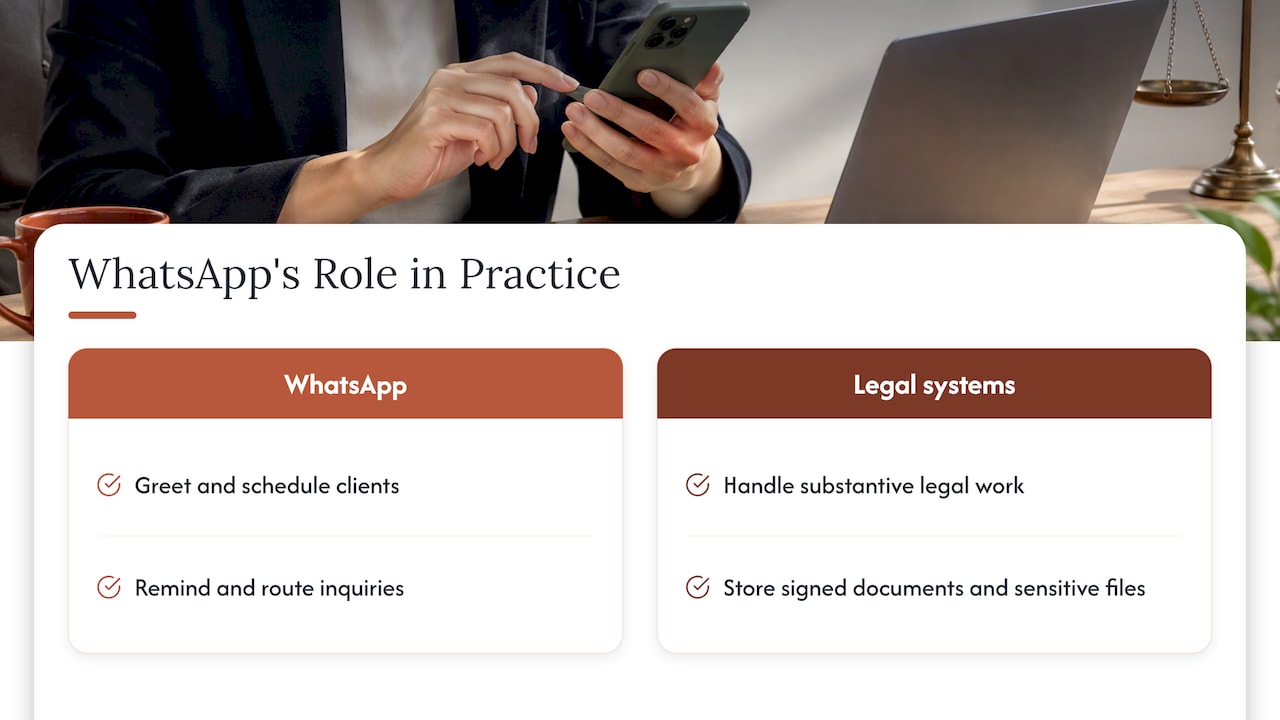
Our view is that WhatsApp should be a front door, not the whole house. It is the place to greet, schedule, remind and route. The substantive legal work, the signed documents and the sensitive files belong in systems built for them. That is why we designed our service around a bilingual website, a 24/7 AI receptionist and WhatsApp working together: the first message gets an answer in the client’s language, urgent cases are passed to a person, and the firm gets summaries instead of scattered chats on personal phones.
We also do not claim a messaging app solves your ethics duties. It does not. Your engagement letter, retention policy and judgment do that work. Our job is to make sure no Spanish-speaking client is lost at the first contact.
— Francisco
How Diazluna fits into a law firm’s WhatsApp setup
If you want the front-desk layer without building it yourself, our attorney page describes a bilingual site, phone and WhatsApp for firms with Spanish-speaking clients. The plans, as published on our site:
| Plan | Monthly | Yearly |
|---|---|---|
| Solo Sitio (bilingual website) | $99 | $990 |
| Sitio + María (website plus AI receptionist) | $199 | $1,990 |
| Sitio + María Pro (managed, with site updates and expanded call capacity) | $349 | $3,490 |
There is also a one-off activation fee of $399. You can see current details on our main page. Whatever front desk you choose, hold it to the same test as any other channel: does it protect confidentiality, does it keep records, and does it escalate urgent matters to a person?
Warn clients about fake law firms on WhatsApp
WhatsApp is also a favorite channel for impostors. The FBI’s August 13, 2025 alert on fictitious law firms targeting cryptocurrency scam victims names red flags: WhatsApp group chats, requests for cryptocurrency or bank-fee payments, an inability to provide a license or do a video verification, and pressure tactics.
The FBI recommends a zero-trust approach: be cautious of unexpected contact, ask for video verification or license documentation, verify any claimed government employment through the relevant local office, and report suspected fraud to an FBI field office or IC3.
Immigration clients are common targets. U.S. immigration-scam guidance from the American Immigration Lawyers Association says to verify the person and organization through vetted sources and to look up the organization independently rather than trusting a link the contact sent.
Firms can help by publishing, in English and Spanish:
- the one WhatsApp number the firm uses, on its website;
- a statement that the firm will never ask for crypto, gift cards or “release fees” over WhatsApp;
- how a client can confirm a lawyer’s bar license;
- who to call if something looks wrong.
FAQ
Is it legal for a lawyer to use WhatsApp with clients?
Yes. No U.S. rule bans it. The duty is to make reasonable efforts to prevent unauthorized access to client information, and the level of care rises with the sensitivity of the matter. Check your state bar’s guidance for local requirements.
Does end-to-end encryption make WhatsApp safe enough?
It helps, but it is not enough alone. Lost phones, shared devices, synced accounts, wrong recipients and deleted or edited messages remain risks. Pair encryption with screen locks, a retention policy and manual or automated logging of substantive messages.
Can I send engagement letters or settlement documents over WhatsApp?
It is better not to. ABA litigation guidance says engagement letters, final judgments and settlement agreements are not suited to texting and should go by email, letter or in person. Use WhatsApp to tell the client a secure link or an email is coming.
How can a client tell whether a WhatsApp message from a law firm is real?
Don’t trust unexpected contact. Ask for video verification or license documentation, look up the firm independently instead of using a link in the message, and be suspicious of any demand for crypto or bank fees. Suspected fraud can be reported to the FBI or IC3.
Sources
- Navigating Modern Communication Tools as a Lawyer (ABA Law Practice Today, 2024)
- ABA Formal Opinion 477R
- Considerations for Communicating with Clients via Text Message (ABA, 2023)
- Texting clients: Is your signal in the dust? (Michigan Bar Journal, 2025)
- How to Text Your Client (ABA Young Lawyers, 2021)
- Ethical Obligations of the Lawyer-Client Relationship in Immigration Law (ABA GPSolo, 2024)
- Fictitious Law Firms Targeting Cryptocurrency Scam Victims (FBI, 2025)
- Protect Yourself from Immigration Scams (AILA, 2026)