August 8, 2026
Why Translation Accuracy Matters for Professionals

Translation accuracy is mission-critical for professionals because a single correspondence error can create legal, safety, financial, or reputational harm. If you commission, review, or rely on translated documents, the first thing to do is to classify each document by risk tier before choosing a workflow.
Three realities frame the stakes:
- A JAMA Network Open study found that AI translation underperformed for several less-prevalent languages in clinical discharge instructions and produced clinically impactful errors that a domain expert would be required to catch.
- ISO 17100 and ISO 18587 define the process and post-editing standards that make a translation defensible in audits, court filings, and regulatory submissions.
- Academic case-study reviews show that translators and clients can both face liability for defective translations in technical and legal contexts.
Your immediate next step: run every document through a risk-tier checklist (low / medium / high stakes) before assigning a workflow. The rest of this guide shows you exactly how.
Table of Contents
- Why translation accuracy matters for professionals: the real consequences
- Which documents and roles carry the highest translation accuracy risk
- How translation accuracy fails: root causes and how to spot them
- How to build a QA workflow that actually holds up
- Standards, certificates, and formal proofs of accuracy
- How to choose a translation vendor: the questions and clauses that matter
- What the research actually says about AI translation limits
- Key Takeaways
- The gap between “bilingual” and “accurate” is where practices get hurt
- Diazluna handles the bilingual front desk so certified translation handles what it must
- Authoritative sources and where to read more
Why translation accuracy matters for professionals: the real consequences
Inaccurate translation is not a stylistic problem. It is a liability event. A misrendered legal clause can shift contractual obligations between parties. A wrong dosage unit in a translated medication guide can injure a patient. An omitted safety warning in a technical manual can expose a manufacturer to OSHA enforcement. These are not hypothetical edge cases; academic reviews of translation error cases document exactly this pattern of legal and financial consequences across technical and legal contexts.
The consequences cluster into four categories:
Legal liability. Courts treat translated documents as legally operative. If a translated contract omits a limitation-of-liability clause that existed in the source, the omission stands. Parties have lost arbitration proceedings because a translated exhibit introduced meaning the original did not contain.
Patient safety. In clinical settings, a fluent-sounding translation that carries the wrong dosage, the wrong frequency, or the wrong contraindication is more dangerous than an obviously broken one, because no one flags it. The JAMA study cited above is specific: clinically impactful errors appeared in AI-translated discharge instructions for patients in less-prevalent language groups, and those errors required domain expertise to detect.
Regulatory rejection. The FDA, USCIS, and state licensing boards all require translated documents to meet accuracy and certification standards. A submission rejected for translation deficiency restarts the clock, sometimes by months.
Reputational harm. For practices and firms serving Hispanic clients, a mistranslated intake form or a garbled consent document signals disrespect, even when the intent was good. Bilingual customer service that is accurate builds trust; inaccurate bilingual content erodes it faster than no translation at all.
Scale of the accuracy problem: Industry benchmarking shows AI translation can reach high headline accuracy in favorable conditions, but the remaining error share concentrates in high-impact segments. Fluent output that misrepresents the source is harder to catch than broken output, which is exactly why verification workflows exist.
The decision logic follows directly: if the harm from an error is measurable, the verification process must be proportionate to that harm. That is the foundation of risk-based tiering.
Which documents and roles carry the highest translation accuracy risk
Not every translated document carries the same exposure. The table below maps sectors to document types, specific accuracy risks, and the minimum verification level each warrants.
| Sector | Typical documents | Accuracy risk | Minimum verification |
|---|---|---|---|
| Legal | Contracts, court filings, immigration petitions, deeds | Clause-level meaning shifts; omissions that alter obligations | Full human translation + Certificate of Accuracy |
| Medical / clinical | Discharge instructions, consent forms, prescriptions, clinical trial protocols | Dosage errors, contraindication omissions, consent invalidity | Full human + bilingual SME review |
| Regulatory filings | FDA submissions, USCIS forms, EPA reports | Rejection, enforcement, resubmission delays | Full human + certification |
| Technical / safety | Equipment manuals, MSDS sheets, product labeling | Safety warning omissions, OSHA exposure | Full human or MTPE with SME sign-off |
| HR and immigration | I-9 documents, employment contracts, benefits summaries | Compliance gaps, employee rights misrepresentation | MTPE with bilingual HR reviewer |
| Business contracts | NDAs, vendor agreements, licensing terms | Financial exposure, IP risk | Full human or MTPE with legal review |
| Customer-facing copy | Websites, intake forms, appointment reminders | Brand trust erosion, consent ambiguity | MTPE with bilingual reviewer |
For practices serving Spanish-speaking patients or clients, the customer-facing row deserves more attention than most teams give it. A mistranslated intake form does not just create a compliance gap; it creates a moment of confusion at the front desk that costs the practice a client. Bilingual front-desk workflows reduce that operational risk by keeping communication accurate at the point of contact, not just in formal documents.
How translation accuracy fails: root causes and how to spot them
Most translation failures trace back to one of six root causes.
Domain unfamiliarity. A general translator working on a cardiology consent form will produce fluent Spanish that a cardiologist would not recognize. Medical, legal, and technical translation requires subject-matter vocabulary that general fluency does not supply.
Terminology gaps. When no agreed termbase exists, translators make individual choices. One document says “plaintiff,” another says “claimant,” a third says “petitioner” — all for the same party. Terminology errors and omissions are among the most commercially consequential error categories in B2B translation, precisely because inconsistency compounds across a document set.
Ambiguous source text. A poorly written source document produces a poorly translated one. Passive constructions, undefined pronouns, and run-on sentences all introduce ambiguity that a translator resolves by guessing, and guesses are not always right.
File and import omissions. Formatted documents (PDFs, InDesign files, structured XML) can drop text segments during extraction. Headers, footers, and text in tables are common casualties. The translated file looks complete until someone reads it carefully.
Inappropriate use of raw AI. AI translation tools produce fluent output quickly. The problem is fluency bias: the output reads naturally even when the meaning is wrong. A bilingual domain expert is often the only person who will catch the error.
Hallucination and correspondence errors. AI models can generate plausible-sounding text that has no basis in the source. In a legal document, an added clause or a dropped negation changes the operative meaning entirely.
Red flags you can spot without knowing the source language:
- Inconsistent terminology for the same concept across pages
- Formatting anomalies (dates in DD/MM/YYYY format in a US document, metric units where imperial is expected)
- Sections that are noticeably shorter or longer than their source equivalents
- Register mismatches (formal legal language suddenly shifting to casual phrasing)
- Proper nouns that appear in the source but disappear in the translation
Pro Tip: Clean the source before you translate. Remove passive constructions, resolve pronoun ambiguity, and define technical terms in a glossary. A one-hour source-text review can eliminate a category of downstream errors entirely.
How to build a QA workflow that actually holds up
The practical framework is a three-tier risk model. Assign every document to a tier before choosing a workflow.
The three-tier model
| Risk level | Document examples | Recommended workflow | Verification steps | Cost driver | Turnaround |
|---|---|---|---|---|---|
| Low | Internal memos, social posts, general FAQs | Raw AI with “Unverified” label | None required; label mandatory | Per-word AI cost | Hours |
| Medium | Customer-facing copy, HR documents, marketing | MTPE with bilingual reviewer | Post-edit review, terminology check | Reviewer hours + PM | 1–3 days |
| High | Legal filings, clinical documents, regulatory submissions | Full human translation + SME review + certification | Bilingual SME sign-off, sampling, Certificate of Accuracy | SME fees + certification | 3–10 days |
The workflow for medium- and high-tier documents follows a defined sequence:
- Intake and source-text QA. Confirm file format, word count, and source-text clarity before any translation begins.
- Termbase and style guide alignment. Provide the translator with a glossary of approved terms and any style constraints.
- Translation or MT/MTPE. For medium-tier work, run machine translation and assign a bilingual post-editor. For high-tier, assign a credentialed human translator with domain specialization.
- Bilingual SME review. A subject-matter expert reads the translation against the source for meaning, not just fluency.
- Sampling and audit trail. Document who reviewed what, when, and against which criteria. This record is your defense in an audit or litigation.
- Signing and certification. For high-stakes documents, the translator or agency signs a Certificate of Translation Accuracy.
Checklist for purchase orders and project specs:
- Target language and regional variant (Mexican Spanish vs. Puerto Rican Spanish, for example)
- Approved termbase or glossary
- Audience description (reading level, professional context)
- Acceptance criteria (error rate tolerance, sampling method)
- Certification requirement (yes/no, and which standard)
- Data security requirements (HIPAA, attorney-client privilege)
Pro Tip: ISO 18587 governs MT post-editing and defines traceable steps for MTPE workflows. Requiring your vendor to document MTPE steps against ISO 18587 gives you an audit trail that holds up in regulatory review.
Standards, certificates, and formal proofs of accuracy
ISO 17100 and ISO 18587
ISO 17100 covers the full translation process: translator qualifications, revision requirements, project management, and final verification. ISO 18587 covers MT post-editing specifically, defining the competences a post-editor must have and the process steps that must be documented. Together, they give procurement teams a concrete checklist to require from vendors.
ASTM International has also published standards for language services, including F2575 for translation quality, which some US-based agencies reference for domestic regulatory submissions.
What a Certificate of Translation Accuracy contains
A properly executed certificate typically includes:
- The translator’s full name, contact information, and credentials
- A statement that the translation is accurate and complete to the best of the translator’s knowledge
- The source and target languages
- A description of the source document (title, date, page count)
- The translator’s signature and date
- Notarization, when required by the receiving authority (USCIS, courts, some state agencies)
When to require a certificate: Any document submitted to a US court, USCIS, a state licensing board, or the FDA should carry a signed Certificate of Translation Accuracy. Many agencies also require one for notarized documents and certified copies. If the receiving authority does not specify, ask before submitting.
Verifier competence
The American Translators Association (ATA) administers a certification program that tests translators in specific language pairs and subject areas. ATA certification is not legally required in most US contexts, but it is a recognized credential that demonstrates tested competence. When you need a named, accountable verifier, asking for ATA-certified translators in the relevant language pair and domain is a defensible standard.
How to choose a translation vendor: the questions and clauses that matter
Vendor vetting checklist
Before signing with any translation provider, verify:
- ISO certification — Can they document compliance with ISO 17100 for human translation or ISO 18587 for MTPE workflows?
Questions to ask during RFPs and sales calls
- What is your post-edit error rate metric, and how do you measure it?
- Who signs the Certificate of Translation Accuracy, and what are their credentials?
- What is your sampling methodology for quality assurance?
- How do you handle terminology disputes between translator and reviewer?
- What is your rework process if a delivered translation fails acceptance criteria?
- What are your liability limits for translation errors, and are they documented in the contract?
- Do you have audit rights provisions for regulatory submissions?
Contract clauses to require
- Service-level commitments for accuracy (error rate tolerance, sampling method, acceptance criteria)
- Rework and remediation process with defined timelines
- Named verifier accountability (the certificate signer is identified in the contract)
- Data security and confidentiality provisions matched to your regulatory environment
- Audit rights for regulatory or legal submissions
Red flags that should disqualify a vendor quickly
- No documented MTPE process for medium-tier work
- Refusal to name the reviewer or provide credentials
- Blanket accuracy guarantees with no supporting evidence or methodology
- No termbase or glossary management for repeat clients
- Certificate of Accuracy signed by someone with no verifiable credentials
Translation accuracy in professional contexts depends on hybrid workflows that combine human expertise with technology. A vendor who cannot articulate that hybrid is not equipped for regulated-sector work.
What the research actually says about AI translation limits
The evidence on AI translation is consistent across multiple independent sources, and the conclusion is not that AI is useless. It is that AI is unreliable for high-stakes content without human oversight.
Key finding from JAMA Network Open: AI translation underperformed for several less-prevalent languages in clinical discharge instructions and produced clinically impactful errors that required domain expertise to detect. Spanish performed better than other languages tested, but the non-Spanish results were a direct patient safety concern.
Industry synthesis of model evaluations shows that top-tier AI models exhibit variable hallucination rates across language pairs, and that the accuracy asymmetry between high-resource and low-resource languages makes fluent errors hard to detect without bilingual domain expertise. The problem is not that AI produces obviously wrong output. The problem is that it produces confidently wrong output.
Benchmarking data shows AI translation can achieve high headline accuracy in favorable conditions, but the remaining error share concentrates in high-impact segments. A small error rate across a 10,000-word legal contract still means dozens of potentially operative errors.
The Tranquality AI Safety Report proposes a label-first governance model: every AI-translated document should carry a clear designation of “Professionally Verified” or “Unverified,” with gating rules that require qualified human review before high-impact content reaches its audience.
Practical tiering rule from the research: Use raw AI only for internal, low-stakes content labeled “Unverified.” Apply MTPE with a bilingual SME reviewer for customer-facing and HR content. Require full human translation with certification for legal, clinical, and regulatory documents. This is not a conservative interpretation of the evidence. It is what the evidence recommends.
Key Takeaways
Translation accuracy for professionals is not a quality preference — it is a risk-management decision that determines legal defensibility, patient safety, and regulatory compliance.
| Point | Details |
|---|---|
| Classify before you translate | Assign every document to a low, medium, or high risk tier before choosing a workflow. |
| Require traceable verification | High-stakes documents need a named, credentialed reviewer and a signed Certificate of Translation Accuracy. |
| Embed terminology control | Provide a glossary and approved termbase to every vendor on every project to prevent inconsistency errors. |
| Budget for SME review | Subject-matter expert review hours are the primary cost driver for high-tier documents and the primary defense against liability. |
| Diazluna complements certified translation | For practices serving Hispanic clients, Diazluna’s bilingual front desk handles operational communication accurately, freeing certified translation resources for formal documents. |
The gap between “bilingual” and “accurate” is where practices get hurt
Most professionals who have dealt with translation problems describe the same experience: the output looked fine. Nobody flagged it. The error surfaced weeks later, in a deposition, a regulatory letter, or a patient complaint.
That is fluency bias at work. Neural translation models are trained to produce natural-sounding output, and they do it well enough that a monolingual reviewer will not catch a semantic error. The only reliable check is a bilingual domain expert who reads the translation against the source with the subject matter in mind.
What I find underappreciated in most discussions of translation quality is the difference between a translation that is linguistically correct and one that is legally or clinically operative. A sentence can be grammatically perfect Spanish and still misrepresent the source document’s meaning. That gap is not a translation problem. It is a verification problem. And verification is a process decision, not a linguistic one.
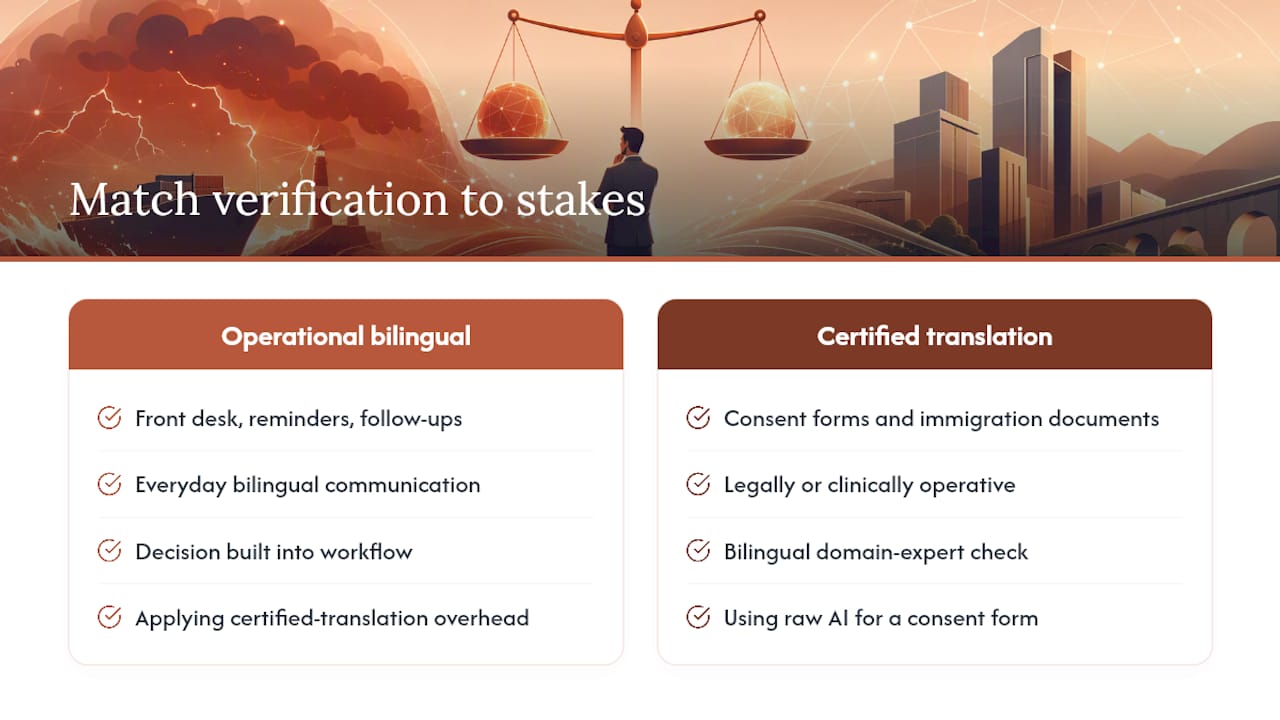
For practices serving Hispanic clients, this distinction matters operationally. The bilingual communication that happens at the front desk, in appointment reminders, and in follow-up messages is not the same category of work as a translated consent form or a court-filed immigration document. Treating them the same way, either by applying certified-translation overhead to every patient text or by using raw AI for a consent form, is where practices get hurt. The right answer is tiering: match the verification level to the stakes, and build that decision into your workflow before the document is ever created.
Authentic bilingual service at the operational level and certified translation for formal documents are two different tools. Using both correctly is what actually protects a practice.
Diazluna handles the bilingual front desk so certified translation handles what it must
Certified translation and operational bilingual communication solve different problems. A certified translator handles the formal documents: court filings, consent forms, regulatory submissions, anything that requires a signed Certificate of Accuracy. What they do not handle is the daily volume of patient calls, appointment confirmations, WhatsApp messages, and intake questions that a practice serving Hispanic clients fields every week.
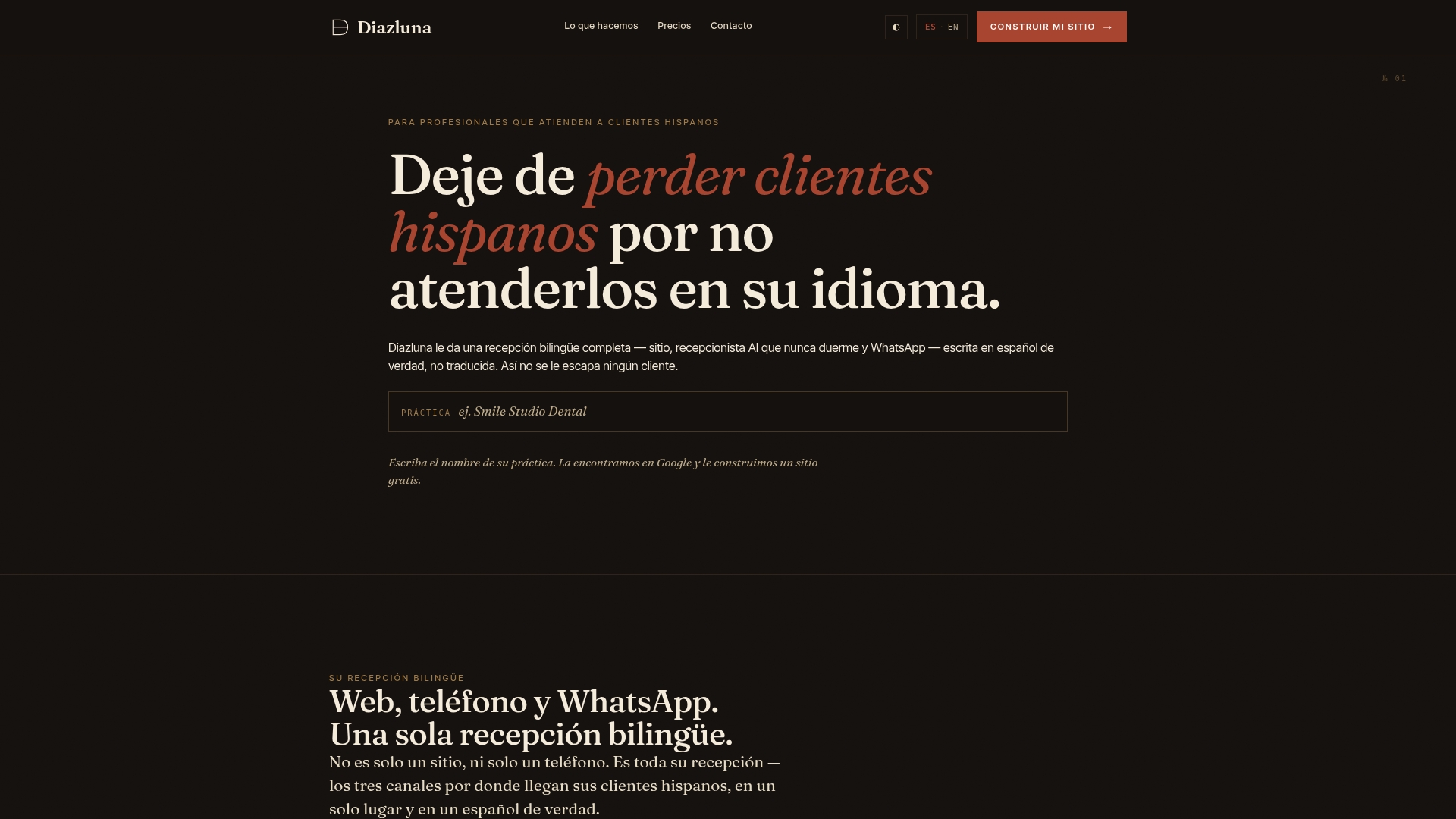
That operational layer is where Diazluna works. The platform gives dental, legal, and healthcare practices a bilingual digital front desk that handles Spanish and English communication accurately, around the clock, without requiring staff to be bilingual or a translation agency to be on retainer.
- A fully optimized bilingual website in Spanish and English, indexed by Google within 24 hours
- A 24/7 AI receptionist that manages calls, messages, and appointment scheduling in both languages
- WhatsApp integration with real-time summaries and transfer of urgent cases to staff
- Triage that flags complex or sensitive communications for human review before they escalate
The result: no Hispanic client lost to a language barrier at the front desk, and your certified translation resources reserved for the documents that actually require them. See how it works for your practice or explore the dental practice package to see the full feature set.
Authoritative sources and where to read more
- Accuracy of Artificial Intelligence vs Professionally Translated Discharge Instructions | JAMA Network Open
- Why AI translation still needs human experts in 2026 — Technology.org
- AI Safety Report: Labeling and governance for translation (Tranquality)
- ISO standard: guidance on translation evaluation (ISO 80701 entry point)
- Translation error consequences and legal liability — JoSTrans
- Translation errors: types, business risks & prevention — CircleTranslations
- Translation accuracy: why does it matter? — US Translation blog
- Is AI translation accurate enough for business? The 2026 guide — Tomedes
- ATA certification — American Translators Association
Diazluna’s blog covers the operational side of bilingual practice management, including bilingual business communication and why bilingual support outperforms traditional agency arrangements. These resources complement the formal translation standards above by addressing the day-to-day communication layer that certified translation does not cover.