October 25, 2026
Bilingual Appointment Policy: A Template for Your Practice

A bilingual appointment policy is a short written set of rules that says how your practice books, confirms, changes and cancels appointments for patients and clients who speak Spanish, and who handles each step. It covers the language of the first call, who may interpret, how long the slot is, how reminders go out and what happens when someone cannot attend. Without it, every front-desk employee improvises, and the patient who calls in Spanish pays for the improvisation.
This guide is for dental, medical and legal practices. It gives you the sections a policy needs, the reasoning behind each, and the legal ground you should know before you write it.
TL;DR
- Put the policy in writing and cover six things: first contact, interpreter rules, slot length, reminders, cancellations and records.
- A receptionist who speaks some Spanish is not automatically a qualified interpreter. Federal guidance for covered health providers treats that gap seriously.
- Spanish-speaking callers book far less often than English-speaking callers in published secret-shopper research, so the first contact is where most of the loss happens.
- Give Spanish-language appointments realistic time and show “Se habla español” on every page, message and voicemail greeting.
- Review the policy twice a year against real call and no-show data.
Table of Contents
- Why the appointment is where language access breaks
- The legal ground you need to know first
- The six sections of a bilingual appointment policy
- A sample policy you can adapt
- Make your language support visible
- Where the policy meets daily operations
- Our perspective
- How Diazluna can carry the first-contact work
- How to roll the policy out in four weeks
- FAQ
- Sources
Why the appointment is where language access breaks
Most practices think about language at the visit: the exam room, the consultation, the signature on a form. The loss happens earlier. A person who cannot get through to schedule never becomes a patient or client, and you never see them in your numbers.
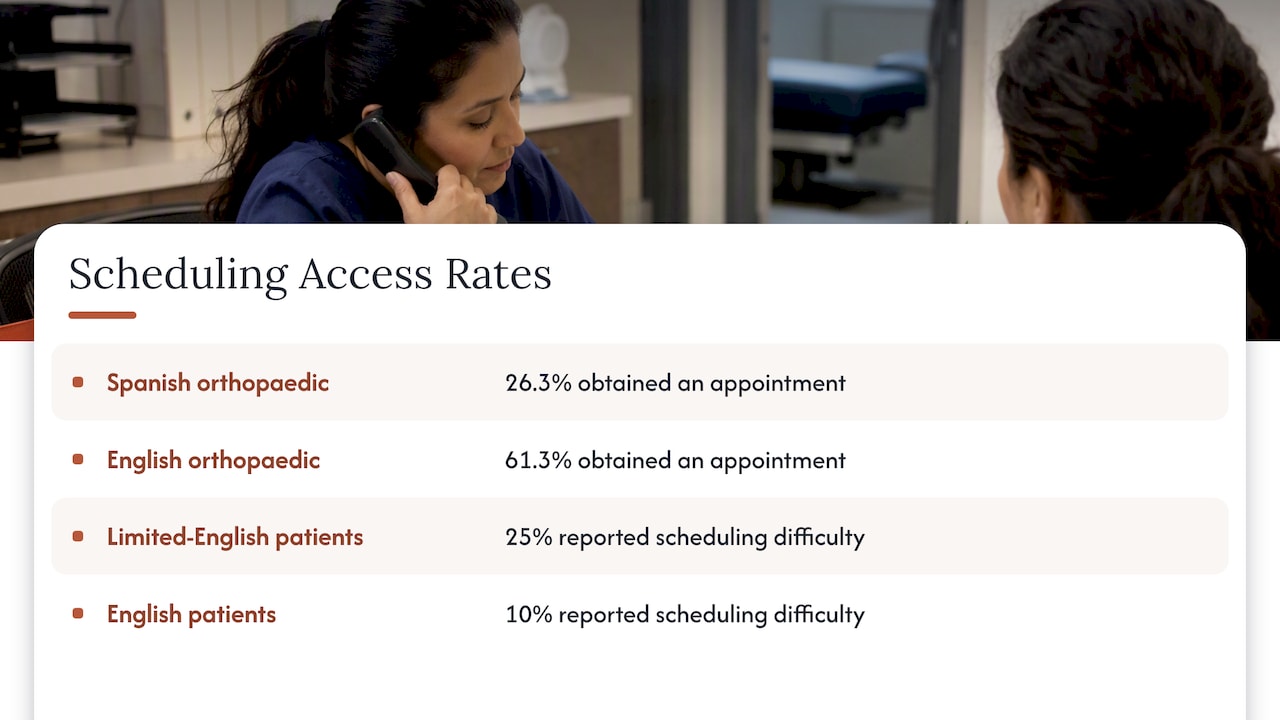
The evidence is stark. In a nationwide study of orthopaedic clinics, callers speaking Spanish obtained an appointment 26.3% of the time, against 61.3% for English-speaking callers. The same source reports that in a public health clinic survey, 25% of patients with limited English proficiency said they had difficulty scheduling, compared with 10% of English speakers.
The pattern is not identical everywhere. A 2025 secret-shopper study of Medicaid managed care found that Spanish speakers in Los Angeles waited 3.73 days longer than English speakers for a first primary-care appointment, while in New York they waited 2.22 days less. The lesson is that access depends on local conditions and on how each office handles the call. That is exactly what a policy controls.
The same literature points to a behavior owners underestimate. When a caller meets silence, a disconnected line or a staff member who clearly struggles, that caller almost never calls back. Your policy has to make the first ninety seconds of contact work every time, including nights and weekends.
The legal ground you need to know first
This is general information, not legal advice. Your obligations depend on whether you receive federal funds and what kind of practice you run. Ask your healthcare compliance counsel or attorney, or your state licensing board, about your specific situation.
Health practices under Section 1557
Under the July 2024 final rule implementing Section 1557 of the Affordable Care Act, covered entities that receive federal financial assistance must give people with limited English proficiency meaningful access, including free, accurate and timely language assistance. That includes many hospitals and many practices that accept Medicaid or Medicare. The rule took effect on July 5, 2024. HHS also publishes a fact sheet on language access under Section 1557 that is worth reading before you draft anything.
Three practical consequences for an appointment policy:
- The language help must be free to the patient. Your policy cannot add an “interpreter fee” line.
- Quality matters, not just availability. HHS guidance stresses qualified interpretation that protects confidentiality and accuracy, and warns that relying on family members or ad hoc staff often leads to errors and legal exposure.
- “Our receptionist speaks a little Spanish” is not a policy. It is a risk.
If you are unsure whether the rule reaches your practice, check with your compliance advisor. If your practice is a private dental office that takes no federal money, other rules and your own professional standards may apply instead.
Refusal and effective communication
Patients sometimes decline an interpreter. The ADA’s effective communication guidance is clear that the provider still has to make sure communication works. If you conclude that the person cannot understand their options without professional help, you need to insist on a qualified interpreter for the clinical or legal part of the visit. Your policy should say who makes that judgment and how it is documented.
Law practices
Legal practices are not covered by Section 1557, but the logic carries over. A client who cannot follow fee terms, deadlines or consent forms cannot give informed consent, and the bar rules you answer to are your first reference. Ask your state bar’s ethics counsel how it treats interpreters and non-lawyer staff, then write the answer into your policy.
The six sections of a bilingual appointment policy
Keep the document to two pages. Staff must be able to find the answer mid-call.
1. First contact and language identification
State the channels you accept (phone, web form, text, WhatsApp) and the rule that a Spanish-language request gets a Spanish-language reply on the same channel. Then decide:
- Who answers a Spanish call? A named bilingual employee, a scheduled interpreter line, or an after-hours system. Name the fallback for when that person is at lunch.
- How you record preferred language. Capture it once, in the chart or client file, and carry it into every reminder and billing message.
- Response time. Set a number, such as same business day for messages, and apply it equally to English and Spanish queues.
This is also the place to say that no Spanish caller is asked to call back later or bring a relative to translate.
2. Interpreter and bilingual staff rules
Distinguish between staff who can book in Spanish and people qualified to interpret clinical or legal content. A bilingual front desk employee can confirm a time, explain parking and take insurance details. Explaining a treatment plan, a diagnosis, a retainer agreement or consent is another job.
Your policy should say:
- Who counts as qualified for interpreting, and how you verify it (training, assessment, a contracted service).
- That family members, and especially children, are not used as interpreters. A patient may still bring a relative for support, but the qualified interpreter does the interpreting.
- How a patient can decline an interpreter, who documents the refusal and when the provider must insist, following the effective-communication guidance above.
- Which scripts and forms are professionally translated rather than machine-translated and left unchecked.
A survey of North Carolina safety-net dental clinics shows how common the need is: all clinics treated patients with limited English proficiency and 93% reported a need for language services. Few small practices have planned for it in writing.
3. Appointment length and template
Adding a language does not add zero minutes. Communication takes longer even with an interpreter, and practices that keep the standard slot tend to run behind, frustrate patients and lose them. Build this into the schedule:
- A longer slot, or a buffer, for first visits and consults that need interpretation. Decide the amount by tracking your own overruns for a month rather than guessing.
- A flag in the scheduling system that blocks the interpreter or bilingual provider at the same time.
- A rule against stacking several interpreted visits back to back without a break.
In a dental office this might mean a longer new-patient exam. In a law office, a longer intake consultation. In a medical practice, a longer first visit and any visit involving consent.
4. Confirmations and reminders
Send reminders in the patient’s recorded language, through the channel they actually use. For many Hispanic patients that is WhatsApp or text rather than email. Your policy should state:
- When reminders go out (for example, a few days before and the day before; set your own rhythm and test it).
- What each reminder contains: date, time, address, how to confirm, how to reschedule and who to ask for in Spanish.
- That a reply in Spanish is read and answered in Spanish, not routed to an English-only inbox.
Read your Spanish templates aloud. If they sound like a literal translation of English, rewrite them. The research on cultural fluency notes that regional dialect and norms around authority shape whether patients feel respected, and that reaches well beyond word-for-word translation. Our own Spanish readability checklist is a good way to audit your templates.
5. Cancellations, late arrivals and no-shows
A cancellation rule that is fair in English can be punitive in Spanish if the patient never understood it. Write the policy so that it is:
- Stated in plain Spanish at booking, and again in the reminder.
- Applied consistently, with the same grace period and fee rules for every patient.
- Paired with an easy way to cancel: a reply to a text, a WhatsApp message or a Spanish-language voicemail option that is checked daily.
- Clear about what happens if an interpreter was booked and the patient cancels late, noting that you do not pass interpreter costs to a patient for whom they are required.
Before you charge a first no-show fee, check whether the person was ever told the rule in a language they read well. If not, treat it as a communication failure and fix the process.
6. Records and review
Record the preferred language, the interpreter used or declined, and the channel. Then review. Every quarter or two, look at the data:
- How many Spanish calls came in, and how many ended in a booked appointment?
- How many were missed after hours?
- Do Spanish-language no-show rates differ from English ones, and why?
- What did staff and patients complain about?
Assign an owner for the policy by name. A document that belongs to everyone belongs to no one.
A sample policy you can adapt
Here is a short version. Edit it to match your practice, then have counsel review it.
Language and appointments. We schedule, confirm and change appointments in English or Spanish, at the patient’s choice. We record each patient’s preferred language at first contact and use it for all messages. Qualified interpreters are provided at no cost for any clinical or legal discussion. We do not ask patients to bring family members to interpret. If a patient declines an interpreter, we document it, and the provider may still require one when needed to ensure understanding. Appointments involving interpretation are scheduled with extra time. Reminders are sent in the patient’s language by their preferred channel. Our cancellation terms are given in the patient’s language at booking.
Make your language support visible
A policy that nobody finds does not help. Research on Hispanic patient access recommends that practices state their language support up front rather than waiting for the patient to ask, with phrases such as “Se habla español” on the website, voicemail greeting, door, forms and reminders.
That also means a Spanish page for booking, not a translated footer. If your site only answers questions in English, people searching in Spanish will not reach you, and that is a discoverability problem as well as a language one. Practices that want help getting found in search can look at healthcare SEO services alongside their bilingual pages. For the website side, see our guides to bilingual medical websites and the advantages of a bilingual healthcare website.
Where the policy meets daily operations
A policy lives or dies at the desk. These are the moments where it usually fails, and the fix for each.
- The bilingual employee is out. Keep a documented backup, such as a contracted interpreter line or an after-hours system, and test it monthly.
- Calls after 5 p.m. Many working patients call in the evening. Decide whether an automated bilingual receptionist, a callback within the next morning, or both covers them.
- Online booking in English only. A Spanish speaker who reaches an English-only form will leave. Our piece on bilingual online scheduling covers what to check before you go live, including privacy agreements.
- Intake forms. A paper form in English undoes a good booking call. See the benefits of bilingual dental patient intake and our overview of bilingual patient onboarding.
- Mixed-language households. A parent may speak Spanish while the child speaks English. Record the language for the person making decisions, not just the person on the chart.
For a fuller walk-through of scheduling by profession, read our practical bilingual scheduling guide for dental, legal and medical practices. If you are checking your language access obligations, our note on Section 1557 language access is the place to start.
Our perspective
We build front desks for practices that serve Hispanic clients, so we see the same failure repeatedly: the practice has a policy in the owner’s head and nothing in the system. The call comes in at 7 p.m., nobody answers, and the caller books with the office down the street that answered in Spanish.
We think the appointment is the most undervalued moment in language access. It is cheap to fix compared with a lost patient, and it does not require rebuilding your practice. It requires three things working together: a website that speaks Spanish as written by a person, not pasted from a translator; a receptionist that answers in both languages at any hour and hands urgent cases to your team; and WhatsApp, where many of your patients already prefer to talk.
We also hold a line on quality. Machine translation that nobody reviewed damages trust faster than silence does. Every Spanish page, script and reminder should be read by a person who speaks the language the way your patients do. And an AI receptionist is for booking and routing, not for interpreting a diagnosis or a legal consultation. Those still need a qualified human interpreter, and your policy should say so.
Write the two pages first. Then pick the tools that make them true at 7 p.m. on a Tuesday.
— Francisco
How Diazluna can carry the first-contact work
If your policy says Spanish callers get a reply at any hour, you need something that does it. Diazluna combines a bilingual website, a 24/7 AI receptionist named María that handles calls, messages and scheduling in Spanish and English, and WhatsApp, with real-time summaries and transfer of urgent cases to your team. Setup is a one-off activation fee of $399.
| Plan | Monthly | Yearly |
|---|---|---|
| Solo Sitio (bilingual website) | $99 | $990 |
| Sitio + María (website plus AI receptionist) | $199 | $1990 |
| Sitio + María Pro (managed, with site updates and expanded call capacity) | $349 | $3490 |
See the plans and request setup on the Diazluna site, or compare the options directly on the pricing page.
How to roll the policy out in four weeks
- Week 1: audit. Listen to a sample of recent calls, check the booking form, and count how many Spanish contacts you received and how many ended in an appointment.
- Week 2: draft. Write the six sections, name the owner, and have counsel or your compliance advisor review.
- Week 3: train. Run through scripts with every person who touches the phone, including part-time staff. Role-play a refusal of an interpreter and a late cancellation.
- Week 4: publish and measure. Add “Se habla español” to every channel, translate the policy summary for patients, and set the first review date.
Treat the first quarter as a test. Compare your booked-appointment rate for Spanish contacts to your English rate. The size of that gap is your own number, and closing it is the goal.
FAQ
Can patients refuse to use interpreter services?
Yes, a patient can decline a professional interpreter, but you still have to ensure effective communication. If the person cannot understand their rights or medical or legal options without help, ADA guidance points to insisting on a qualified interpreter. Document the refusal and who made the decision.
Can I schedule an appointment in Spanish?
At a practice with a bilingual appointment policy, yes, by phone, text, WhatsApp or a Spanish booking page. If you are a patient and cannot get through, ask for an interpreter, since covered health providers must offer free language help. If you run a practice, make sure the Spanish route works outside business hours too.
Is a receptionist who speaks some Spanish enough?
For booking and confirming, often yes. For explaining treatment, consent or legal options, no. HHS guidance on Section 1557 warns against relying on unqualified staff or family members for interpretation. Use a qualified interpreter for those parts.
Should Spanish-language appointments be longer?
Usually, when an interpreter is involved. Research on barriers for Latinx patients notes that practices which do not lengthen these slots tend to fall behind and lose patients. Measure your own overruns before setting the buffer.
Sources
- Spanish-Speaking Patients Have Limited Access Scheduling Outpatient Orthopaedic Appointments (PMC)
- Bridging language barriers: Access to primary care for Medicaid Managed Care patients with limited English proficiency (Health Affairs Scholar)
- Language Access Provisions of the Final Rule Implementing Section 1557 (HHS)
- Section 1557: Ensuring Meaningful Access for Individuals with Limited English Proficiency (HHS)
- ADA Requirements: Effective Communication (ADA.gov)
- Barriers in Healthcare for Latinx Patients with Limited English Proficiency, a Narrative Review (PMC)
- A Survey of North Carolina safety-net dental clinics’ methods for communicating with patients of limited English proficiency (PMC)