November 16, 2026
Call to WhatsApp Deflection: A Practice Owner's Guide
Call to WhatsApp deflection means that when a caller reaches your practice, the call is answered or intercepted and the conversation moves to a WhatsApp chat instead of ending in voicemail or a hold queue. For a dental, legal or medical practice with many Spanish-speaking clients, it works only if the first reply is in the caller’s language, someone or something answers right away, and a person can take over when the matter is urgent. We built our platform around that idea: an AI receptionist that speaks Spanish and English, handles calls, messages and scheduling, and passes urgent cases to your staff.
TL;DR
- Call deflection is not call forwarding. Forwarding sends the same call to another number. Deflection moves the caller to a different channel, here a WhatsApp conversation.
- It pays off for practices that miss calls, or that lose Spanish-speaking callers when nobody on the front desk is comfortable in Spanish.
- Before you send a proactive WhatsApp message, you need the person’s clear opt-in. Displaying your WhatsApp number does not count as consent.
- Keep a human path open: urgent cases, clinical or legal questions and anything sensitive should reach your staff quickly, with a summary of what was said.
- Measure it: track resolution, handoffs to humans, language and failed conversations weekly during the first 30 days.
Table of Contents
- What call deflection to WhatsApp actually is
- Why this matters for practices serving Hispanic clients
- How a U.S. practice can set it up
- Consent: the part you cannot skip
- Keeping a human in the loop
- Measuring whether it works
- A worked example
- Perspective: why the whole front desk matters
- What our plans include
- FAQ
- Sources
What call deflection to WhatsApp actually is
The term comes from large contact centers. There it describes sending customers away from expensive voice lines toward cheaper channels such as chat. A small practice does not run a contact center, but the mechanics are the same, and the problem is more personal. Your front desk has one or two people, they are with patients or clients most of the day, and the phone keeps ringing.
In practice, deflection looks like one of these:
- Missed-call handoff. A call goes unanswered, and the caller is offered a WhatsApp conversation instead of a voicemail box.
- Menu-based handoff. A recorded menu says something like “press 1 to continue on WhatsApp,” and the caller is moved to a chat.
- Answered by an assistant. An AI receptionist picks up, understands the request in Spanish or English, and either resolves it on the call or continues in WhatsApp.
The third version matters most for bilingual practices, because the first few seconds decide whether a Spanish-speaking caller stays on the line.
How it differs from call forwarding and from a voicemail
Call forwarding ties one phone number to another phone. If nobody picks up at the second number, you are back to voicemail. Deflection changes the channel, so the person can type or send a voice note when it suits them, show you a photo of a document or a tooth problem, and receive appointment details in writing that they can reread later.
Voicemail has a different weakness: many callers hang up before it starts. A chat that begins within seconds keeps the conversation alive, and the request is already written down when your staff open it.
Why this matters for practices serving Hispanic clients
A caller who struggles to be understood does not usually complain. They hang up and call the next office. For a dentist, that is a new patient who never books. For a law firm, it is a consultation that goes to a competitor. For a medical practice, it can be a patient who delays care.
WhatsApp helps here for a plain reason: it is a messaging app many Spanish-speaking families already use every day, so moving from a phone call to a chat asks little of them. They do not need a new app, a portal login or a password.
The condition is language quality. A chat that opens with stiff, machine-translated Spanish costs you the trust you were trying to earn. Our site content is human-reviewed Spanish, not translated English, and the same standard applies to how the receptionist speaks to your callers.
Where it helps most
- After-hours and lunch-hour calls. The caller gets an answer and a booking path instead of a recorded greeting.
- Peak times. When your desk is busy with people in the room, the chat absorbs the overflow instead of leaving callers on hold.
- Routine requests. Appointment times, office hours, directions, what to bring, and how to reschedule are all things a bilingual assistant can handle without pulling staff away.
- First contact with a new client. A short intake conversation in the person’s own language, with a summary waiting for your team.
What to plan for
Deflection is the right tool for routine and first-contact conversations. It is not the right place for detailed clinical or legal advice. Plan the boundaries up front: which topics the assistant handles, which ones go straight to a staff member, and how that handoff happens. We cover the privacy side in more detail in our guide explaining why WhatsApp is not HIPAA compliant, which every healthcare practice should read before putting any patient information in a chat.
How a U.S. practice can set it up
There are several ways to get calls into WhatsApp, and they differ in how much work they ask of you. In general, a working setup has five parts.
- A business WhatsApp number. Use a business account rather than a personal one, and set up the profile with your practice name and hours. Our WhatsApp Business setup guide for healthcare walks through this for a U.S. practice.
- A way for the call to reach the chat. This is the deflection itself: a menu option, a missed-call response, or an assistant that answers the call and moves it along.
- A first message in the caller’s language. Language should be detected or asked in the first exchange, never assumed.
- Booking and answers connected to your real schedule. A chat that promises an appointment it cannot book creates more calls, not fewer. See how this works in our piece on starting WhatsApp appointment booking in one hour.
- A handoff to a person. Covered below, because it is where most setups fail.
You can try to stitch these parts together from separate vendors: a phone system, a WhatsApp provider, a chatbot and a website. Each has its own bill, login and support line, and none of them knows what the others said to the caller. That is the cost problem our platform is designed to remove, because the website, the AI receptionist and the WhatsApp channel arrive as one service.
What the caller experiences
A good handoff is short. The caller hears a greeting in the right language, gets a clear choice, and within seconds receives a WhatsApp message from your practice name. The message says who is writing, repeats what the caller needs, and asks one simple question, such as the preferred day for an appointment. There is no form to fill out and no link to a portal.
A bad handoff is the opposite: a long recording, an unfamiliar number sending a message in English, or a chat that asks the caller to repeat everything they just said. Most of the failure comes from not designing the first message.
Consent: the part you cannot skip
This is the section to read twice. WhatsApp is a messaging channel, and sending messages on it carries consent rules.
According to the WhatsApp compliance documentation from a messaging platform provider, a valid opt-in means the person clearly agrees to receive messages, the business name and the types of messages are stated, consent is collected before any proactive message is sent, and the person is told they can opt out at any time. The same page states that merely displaying your WhatsApp number is not consent, and that a phone-menu prompt such as pressing a key to opt in to WhatsApp messages is a supported way to collect it.
That last point fits deflection well. The moment a caller presses a key or says yes to continuing on WhatsApp, you have a natural place to record a clear, specific agreement.
In the United States there is also the Telephone Consumer Protection Act (TCPA), the federal law on automated calls and texts. One 2026 compliance guide explains that the FCC has treated automated text messages as calls under that law, and that statutory damages run from $500 to $1,500 per message. The same guide describes a one-to-one consent rule effective January 2026: consent given to one sender cannot be passed on to another organization, and people must be able to revoke it by any reasonable method. Treat WhatsApp messages the way you would treat any automated text.
Three habits keep you on safe ground:
- Ask first, in the caller’s language. The consent request should be in Spanish for a Spanish-speaking caller, naming your practice and what you will send.
- Keep a record. Save when and how each person agreed.
- Make stopping easy. Honor any reasonable request to stop, in either language.
For specifics, our posts on WhatsApp consent messages and WhatsApp opt-in for healthcare give wording you can adapt. Law firms should read our guide on WhatsApp for law firms, and clinics should see the limits that keep messages out of trouble. For sector rules, such as patient privacy or attorney confidentiality, speak with your own compliance advisor or counsel; those rules apply to your practice whatever channel you use.
Keeping a human in the loop
The fear most owners have is reasonable: “What if the assistant mishandles something important?” The answer is design, not hope. Decide ahead of time which situations always go to a person:
- Pain, swelling, bleeding or any symptom the caller describes as urgent.
- A caller who mentions a deadline, a court date, an arrest or an immigration matter.
- Any request for advice rather than information.
- A caller who asks for a person, at any point.
- A message the assistant does not understand twice in a row.
Our AI receptionist, María, is built to manage calls, messages and appointment scheduling around the clock, send your team real-time summaries, and transfer urgent cases. That means the staff member who picks up the conversation sees what was said and does not start from zero. For a caller who has already explained their situation once in Spanish, that detail is the difference between feeling heard and feeling processed.
If you want the same discipline for chatbots in general, this overview of automated client support and transfer to a staff member covers the principle: automate the routine, route the rest to people.
Measuring whether it works
Deflection can look successful while quietly losing people. A caller moved to WhatsApp who never replies is not a deflected call, it is a lost one. Measure outcomes, not volume.
A 2026 U.S. guide on WhatsApp analytics suggests that during the first 30 days you track resolution, conversion, quality and reliability, split by automation path, language, source and whether a human took over, and that you review failed and escalated conversations every week. It also recommends giving priority to English and Spanish support where your customer base calls for it. Adapted for a practice, a simple weekly scorecard looks like this:
| Measure | What it tells you | What to do with it |
|---|---|---|
| Calls moved to WhatsApp | How many callers accepted the handoff | If low, rewrite the greeting or the prompt |
| Conversations that ended in a booking | Whether the chat converts | Check the booking steps for friction |
| Conversations handed to staff | Where the assistant reaches its limit | Add answers for frequent topics |
| Spanish versus English split | Who is actually calling | Adjust staffing and hours |
| Chats with no reply | Callers lost after the handoff | Shorten the first message |
| Opt-ins recorded | Your compliance footing | Fix any gap before sending more |
Read the failed conversations yourself for the first few weeks. A single transcript will teach you more than a dashboard: you will see the exact words callers use for a toothache, a custody question or a billing problem, and you can build those into the answers.
A worked example
Imagine a three-chair dental office where the two front-desk staff are both in the room with patients at 5:45 p.m., when most working families call. Eight calls come in during that hour. In the old setup, five go to voicemail and some of those callers never leave a message.
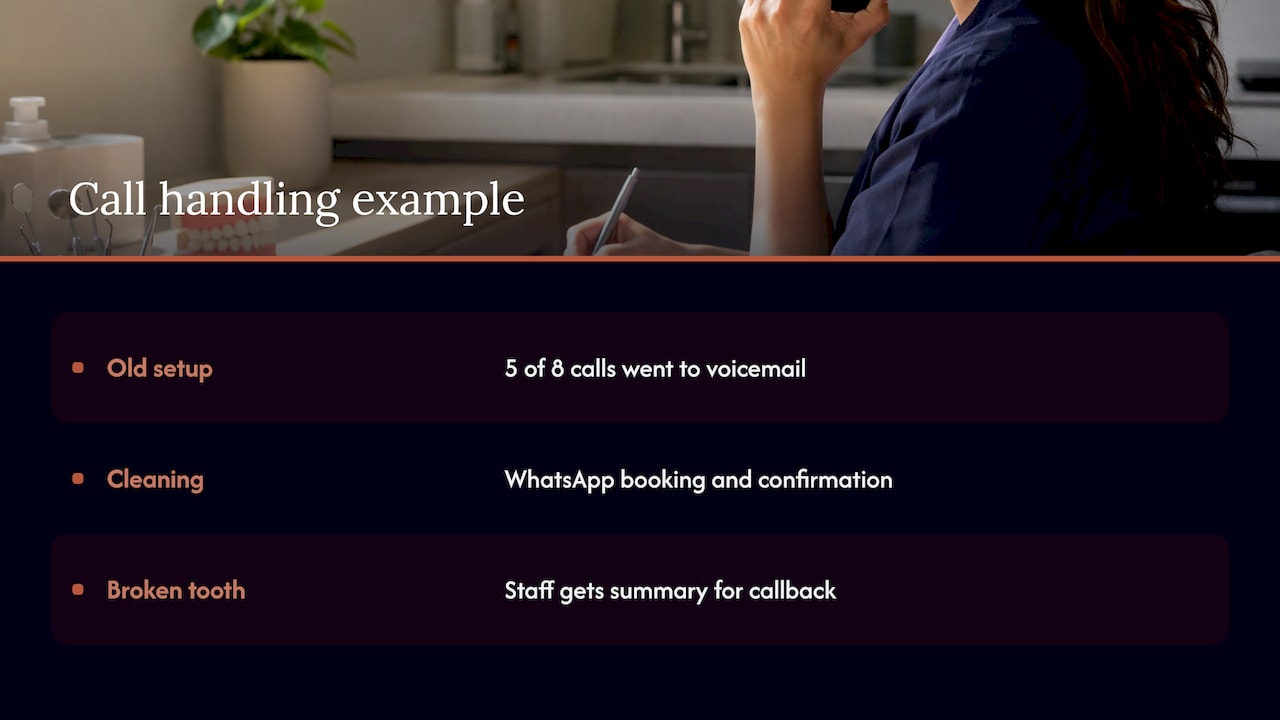
With deflection, each caller hears a greeting in Spanish or English and is offered a WhatsApp conversation. A caller who agrees gets a message in their language, picks a time for a cleaning, and receives a confirmation. One caller describes a broken tooth, and the case is passed to staff with a summary so the office can call back first thing, or sooner if the problem is urgent. The numbers here are illustrative, not a promise of results, but the logic is concrete: no caller is left with only a ringing phone, and no staff member is pulled from a patient to answer a routine question.
Perspective: why the whole front desk matters
Most practice owners come to us asking about one piece: a chatbot, a WhatsApp number, or a translated website. The caller does not experience pieces. They search, find a page, call, and expect to be understood at every step.
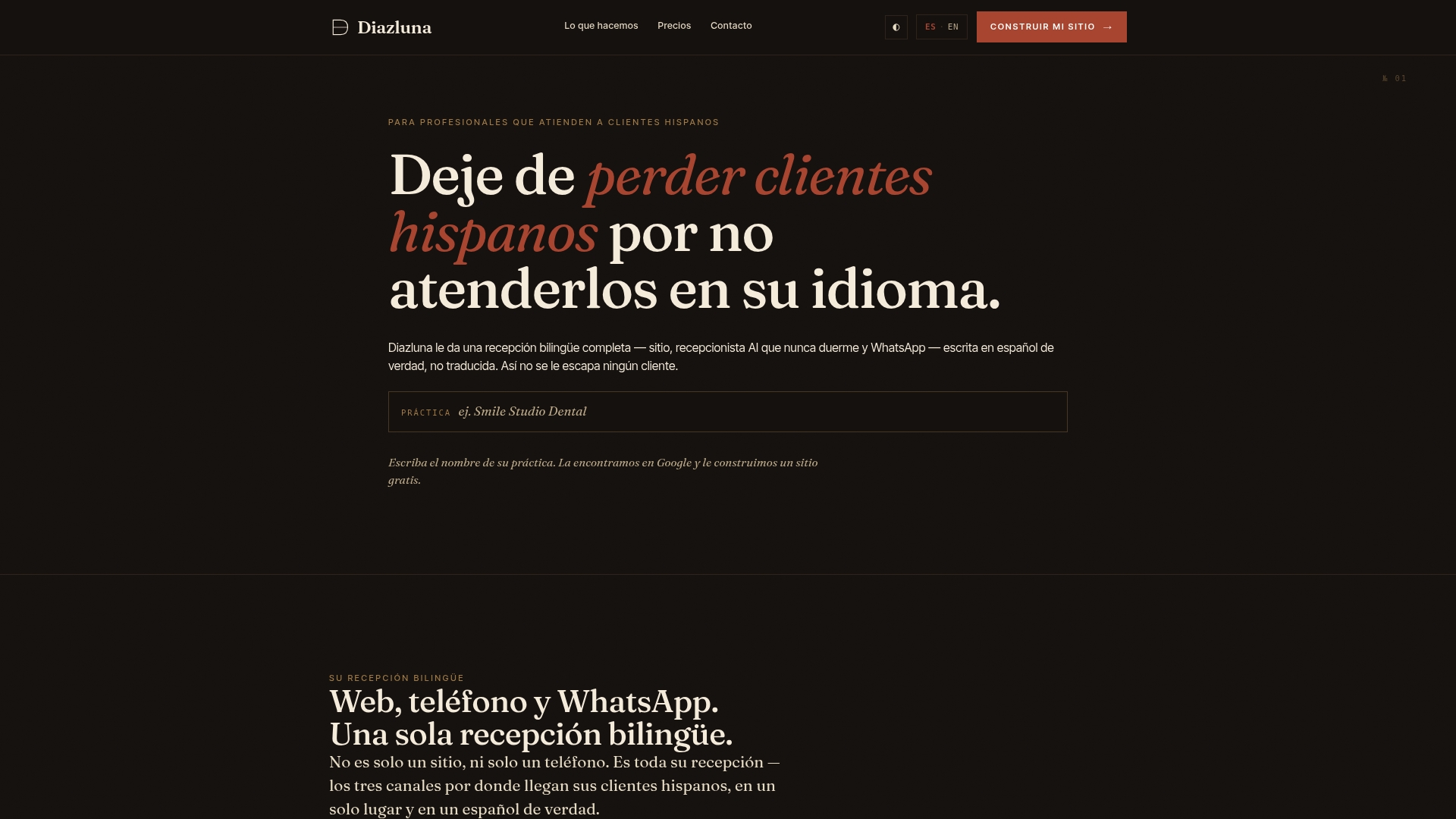
That is why we put the bilingual website, the AI receptionist and WhatsApp in one service. The site is in human-reviewed Spanish, not a translation of the English page. The receptionist answers around the clock in both languages. WhatsApp carries the conversation forward, and your staff step in when it matters, with a summary in hand.
Deflection on its own is a technique. A front desk that speaks your clients’ language from the first search to the booked appointment is a service. We would rather you build the second one.
Francisco
A correction to the line above: the signature belongs on its own final line, which follows.
What our plans include
If you want a bilingual front desk without stitching together vendors, we offer three plans, all billed monthly or yearly after a one-time activation fee of $399:
| Plan | Monthly | Yearly |
|---|---|---|
| Solo Sitio (bilingual website) | $99 | $990 |
| Sitio + María (website and AI receptionist) | $199 | $1,990 |
| Sitio + María Pro (full-service managed package with site updates and expanded call capacity) | $349 | $3,490 |
The site is fully bilingual in Spanish and English, and you can edit it yourself without technical skills. See the plans and get started on the Diazluna bilingual front desk page.
FAQ
Is call deflection to WhatsApp the same as call forwarding?
No. Forwarding sends the same phone call to another number. Deflection moves the caller to a different channel, in this case a WhatsApp conversation, so the exchange can continue by text or voice note, and in writing.
Can I divert my office calls to WhatsApp?
Yes, in the sense that you can offer callers a handoff to a WhatsApp chat, through a menu option, a missed-call response or an assistant that answers the call. The caller needs to agree to receive messages first, so build a clear opt-in into the handoff.
Is it legal to message callers on WhatsApp?
It is lawful when you have the person’s clear consent and respect their right to stop. In the U.S., automated messages fall under the TCPA, so record consent and honor opt-outs. Healthcare and law practices also have privacy and confidentiality duties, so confirm your setup with your compliance advisor or attorney.
Will Spanish-speaking callers accept being moved to a chat?
Most will if the handoff is offered in Spanish, is quick, and feels like a continuation of the call. Natural, human-reviewed Spanish matters more than the channel itself, so test the exact wording callers hear.
How do I keep a real person available?
Define the cases that always go to staff, such as urgent symptoms, deadlines and requests for advice, and make sure the handoff includes a summary. Our AI receptionist transfers urgent cases to your team with real-time summaries.
Sources
- Collect and manage user opt-ins (WhatsApp compliance documentation)
- WhatsApp Business API and TCPA rules (2026 guide)
- WhatsApp Conversation Analytics in USA: Practical 2026 guide