November 4, 2026
Multilingual Citations for Local SEO: A U.S. Practice Guide
A multilingual citation is a mention of your business name, address and phone number (NAP) on a directory, map or website that serves customers in more than one language. For a U.S. dentist, lawyer or clinic with Spanish-speaking clients, the rule is simple: keep the core facts identical everywhere, and localize only the descriptive text around them. Language changes how you describe the business. It never changes who you are or where you are.
This guide covers what to keep consistent, where to list, how citations fit with a bilingual website and hreflang, and how to tell whether the work is paying off.
TL;DR
- Your business name, address and phone number must match across English and Spanish listings. Translate descriptions, never the name or the street address.
- Choose directories by relevance to your patients or clients, not by count. Be where Spanish-speaking customers actually look.
- Citations support your site; they don’t replace it. Pair them with separate, crawlable Spanish pages and correct hreflang.
- Equivalent English and Spanish content is not treated as duplicate content just because the languages mirror each other.
- Measure with calls, direction requests, bookings and Spanish-language inquiries, not only rankings.
Table of Contents
- What multilingual citations are, and what they are not
- Why accurate citations matter for Spanish-speaking customers
- Which details must stay identical in both languages
- Where to build and maintain Spanish-language citations
- Duplicates, outdated listings and translated variants
- How citations work with a bilingual website and hreflang
- A practical sequence for a small practice
- How to tell whether it is working
- Our perspective
- Make your listings land somewhere that answers
- FAQ
- Sources
What multilingual citations are, and what they are not
In local SEO, a citation is any online reference to your business details. Some sit on directories, some on chamber of commerce pages, some on news or association sites. A “multilingual” citation is simply one that appears in, or serves, a second language. In the U.S., that is almost always Spanish.
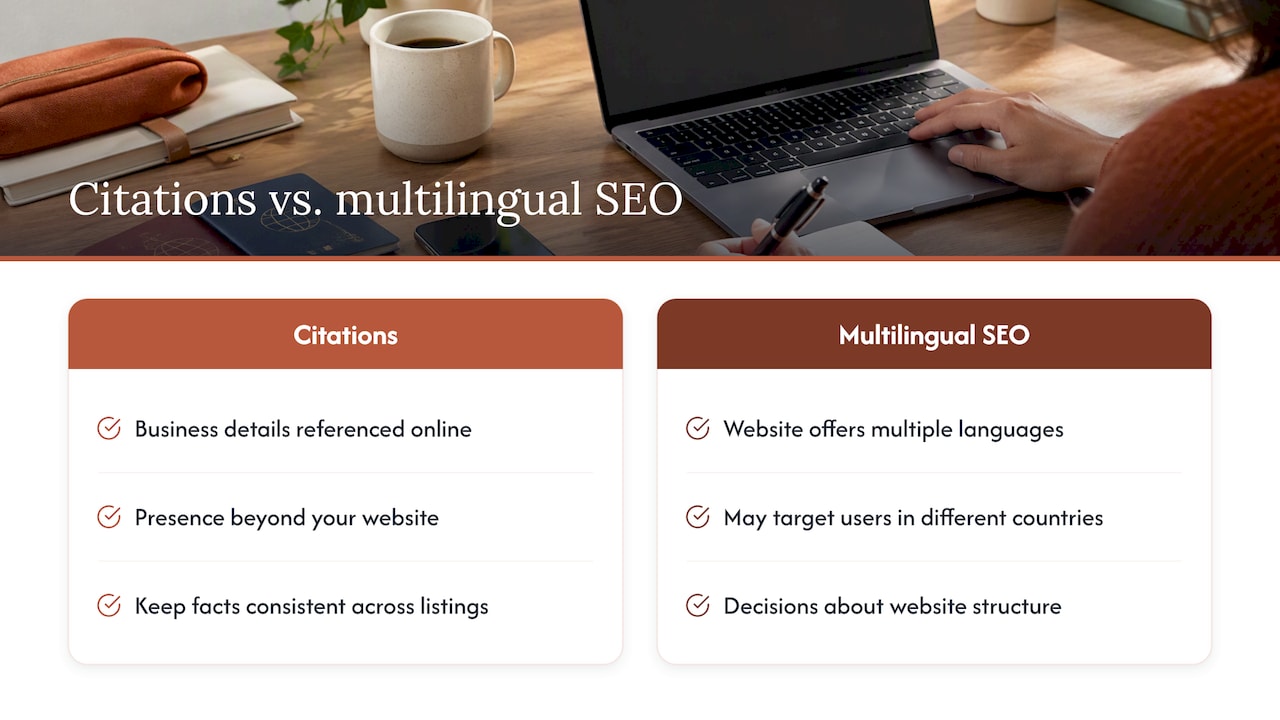
This is different from general multilingual SEO. Google describes a multilingual website as one offering content in more than one language, and a multi-regional site as one explicitly targeting users in different countries. Those are decisions about your website’s structure. Citations are about your presence elsewhere on the web and about the consistency of the facts you publish there.
Most of the pages ranking for this topic treat it as a global-expansion problem: country domains, regional search engines, translated product pages. A practice in Houston or Miami has a narrower problem. You serve one country, one metro area and two languages. That makes the work smaller and more manageable, but it also makes inconsistency more visible, because the same patient may find you in English on one directory and in Spanish on another.
Why accurate citations matter for Spanish-speaking customers
Google’s guidance on local ranking says that complete and accurate business information makes a business more likely to appear in local results, and that inaccurate information may prevent a profile from showing for relevant searches. Google also lists prominence as a factor, influenced by signals such as how many websites link to a business and how many reviews it has.
One perspective from the SEO industry is that citations work like a digital thumbprint: consistent, reputable NAP references give search engines more confidence that separate mentions refer to the same local business. This is one company’s view, not a Google rule, but it matches the practical logic. If your Spanish listing shows an old suite number and your English listing shows the new one, a search engine has to guess which is right. A patient might too.
For Spanish-speaking customers there is an extra layer. Many search for a “dentista cerca de mí” or “abogado de inmigración” and then compare you on a map listing, a review site and your website. If the phone number differs between those places, or the Spanish version of your listing is missing hours, the customer often moves on to the next result. That is a lost appointment that never shows up in your analytics.
Which details must stay identical in both languages
Think of two layers. The first is fixed. The second is translatable.
The fixed layer
- Business name. Google requires the name to match your real-world name and discourages unnecessary additions such as slogans, phone numbers, URLs, services or location details, as set out in its business name guidelines. Do not add “Dentista en Español” to your name on a Spanish listing. That is a description, not a name.
- Address. Write it exactly as it appears on your signage and mail. Do not translate “Street” to “Calle” or “Suite” to “Oficina”. The postal service, map data and every other directory use the English form.
- Phone number. Use the same number, formatted the same way. If you have a dedicated Spanish line, list it as an additional number where the platform allows, and keep the main number identical everywhere.
- Website URL. Point each listing to the most relevant page. A Spanish-language listing can link to your Spanish homepage; the English one to your English homepage. Keep that choice deliberate and consistent.
- Hours. Google recommends supplying hours including special hours, along with a full address when customers can visit, your business category and relevant attributes. Holiday hours should be updated in every listing at once.
The translatable layer
Descriptions, service lists, FAQs, posts and review replies are where Spanish belongs. Write them as a Spanish speaker would, not as a literal translation. If you serve a mostly Mexican, Cuban or Central American community, local vocabulary matters. We cover why in our piece on Spanish SEO for lawyers, where the principle is to adapt the message first and let the keywords follow.
A quick consistency table
| Detail | English listing | Spanish listing | Rule |
|---|---|---|---|
| Business name | Real-world name | Same real-world name | Never translate or add keywords |
| Street address | As on signage | Same | Never translate street terms |
| Phone | Main number | Same main number | Add a Spanish line as secondary only |
| Category | Closest official category | Same category | Categories are set by the platform |
| Description | English text | Natural Spanish text | Write, don’t machine-translate |
| Hours | Current | Current | Update both together |
Where to build and maintain Spanish-language citations
Start with the sources that matter in your field and city, then add a few broad ones. The SEO industry guidance suggests seeking citations from major consumer directories such as Foursquare, Yelp or YP.com, plus industry-relevant and local directories, such as chamber of commerce or neighborhood business association listings. The same source makes the point that quality matters more than quantity, and that you should be where your customers expect you.
How to judge whether a directory is worth it
Ask five questions before you claim any listing:
- Would a Spanish-speaking patient or client plausibly look here?
- Does the site accept or display Spanish-language descriptions, or at least a Spanish-language profile?
- Is it specific to your profession, such as a dental society, a state or local bar association’s referral service, or a medical provider directory?
- Is it tied to your area, such as a Hispanic chamber of commerce or a neighborhood association?
- Does it let you control and correct the listing without paying to remove errors?
A Hispanic chamber of commerce directory in your metro is often more useful than the twentieth generic listing site. A professional association profile carries relevance that a generic directory cannot.
Start with the profile you control most
Your Google Business Profile is the anchor citation. Everything else should match it. A practical walkthrough of Business Profile optimization covers the fields worth filling in, and it is a good checklist to hold next to your own profile. Once that profile is accurate, copy its exact NAP into every other listing instead of retyping from memory.
Duplicates, outdated listings and translated variants
Three problems come up repeatedly.
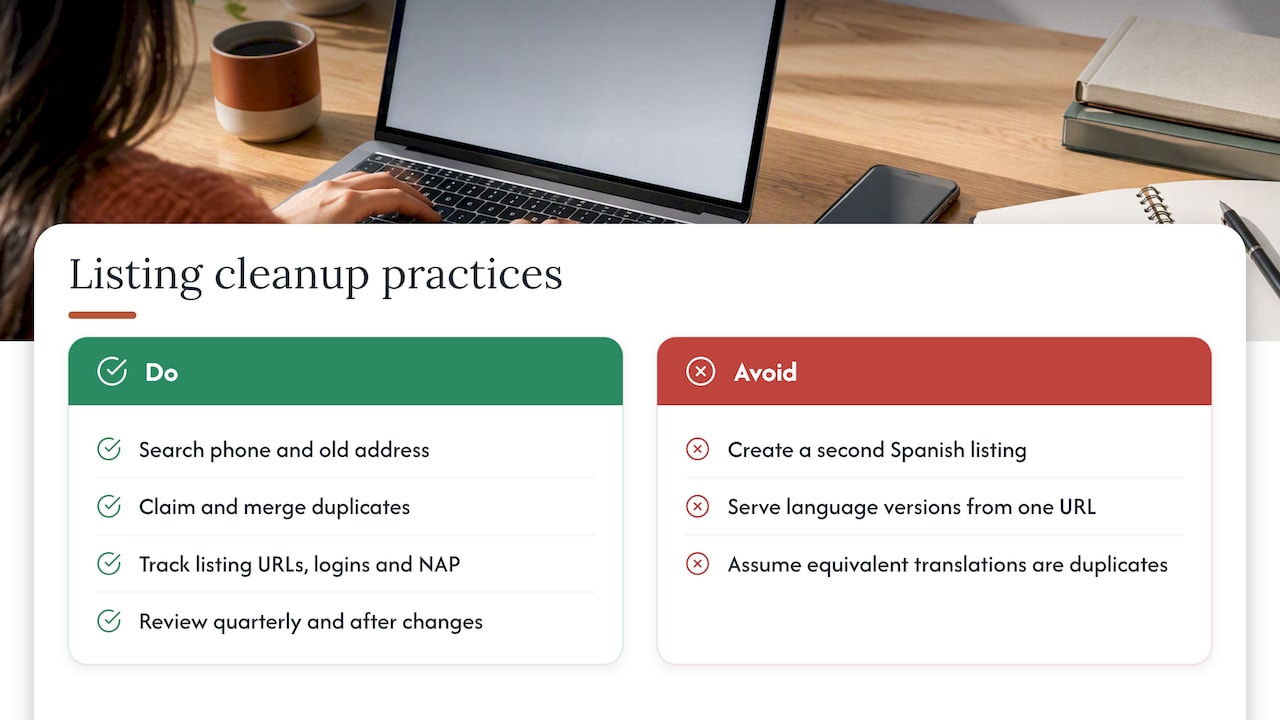
Duplicate listings. These occur when a directory pulled your data years ago, or when an old office address was never retired. Search for your phone number and your old address, not just your name. Claim and merge, or request removal. Do not create a second “Spanish” version of a listing on a platform that already has one for you; add the Spanish text to the existing profile where possible.
Outdated listings. A move, a new phone system or a new practice name leaves stale data scattered across directories. Keep a simple spreadsheet of every listing, its URL, the login, the date last checked and the NAP as shown. Review it every quarter and after any change.
Translated variants. Here is the worry that stops many owners from publishing in Spanish: will matching English and Spanish content count as duplicate? Search Engine Journal’s report on Google’s explanation says that localized content is not treated as duplicate merely because language versions share equivalent material. The same article’s local-SEO examples indicate that consistent NAP across language versions, directories and location pages is not itself problematic duplication. In other words, repeating your address in both languages is fine. Duplication problems usually come from technical errors, such as two language versions served from the same URL. Our walkthrough on stopping duplicate content on bilingual sites shows the audit order we use.
How citations work with a bilingual website and hreflang
Citations point people and search engines toward your site. If that site is a single English page with a Spanish paragraph at the bottom, the Spanish citations lead nowhere useful. The site needs to carry the same promise.
Google’s documentation recommends separate, crawlable URLs for each language version and says reciprocal hreflang annotations can identify the right alternate page. It also notes that Google determines a page’s language primarily from its visible content, not from hreflang or the HTML lang attribute. Separately, Google advises against switching language through cookies or browser settings, and recommends keeping one language per page instead of side-by-side translations.
That has direct consequences for citations:
- Link your Spanish listings to Spanish URLs, such as
/es/, and your English listings to English URLs. - Put your full NAP in the visible content of both versions, in the same format as your listings. Bing’s international guidance tells local businesses to include location signals such as a phone number with area code, a physical address, city, state and country in page content.
- Keep each language in a coherent structure, such as a subfolder, and avoid mixing markets on one page, which Bing says can hurt search and user experience.
- Don’t rely on the lang attribute to do the work. Write the Spanish page in real Spanish.
If your team manages many pages or locations, automating hreflang generation can keep the annotations from drifting as pages change. For a small practice with a handful of pages, a manual setup works. Our three-tag hreflang setup for English and Spanish and the 20-minute bilingual hreflang audit walk through both.
For law firms, aligning location and language signals is especially important when the practice area differs by audience. A resource on law firm local SEO shows how firms think about structuring that. Our own Spanish law firm website guide covers the Spanish side.
A practical sequence for a small practice
You don’t need to do everything at once. This order gets the largest gains first.
- Write your canonical NAP. One approved version of name, address, phone, URL, hours and category. Save it in a shared document.
- Fix Google Business Profile. Make it complete and accurate. Add a natural Spanish description and Spanish service terms where the platform lets you.
- Audit existing listings. Search your name, phone and past addresses. Log every mention.
- Correct and claim the major directories. Start with those your customers use, then your professional association.
- Add local and community listings. A chamber, a neighborhood association or a Hispanic business group. These add relevance as well as links.
- Check the destination pages. Every Spanish listing should land on a Spanish page that repeats the same NAP.
- Ask for reviews in both languages. Google counts review volume and ratings as prominence signals. Invite Spanish-speaking clients to write in the language they prefer.
- Recheck quarterly. Directories change data on their own. Look again.
Profession-specific details are in our guides to Spanish dental SEO, medical Spanish SEO on a 30/60/90 day plan and Spanish local SEO for U.S. practices.
How to tell whether it is working
Citation work is slow, and the outcome is rarely a single jump in rankings. Judge it on what a front desk would notice.
- Calls and call language. Track calls by number and note how many arrive in Spanish. If you use call tracking, keep the tracking number as a secondary number only, so your main NAP stays consistent.
- Profile actions. Compare monthly direction requests, website clicks and calls shown in your Google Business Profile, before and after cleanup.
- Spanish page traffic. In your analytics, segment sessions to your Spanish URLs and see whether they grow, and where they come from.
- Bookings and inquiries. Add a simple question on the intake form: “How did you find us?” with a Spanish option.
- Listing accuracy. Count how many of your listings match your canonical NAP. Aim for all of them; this is a number you control.
- Reviews. Track the number and language of new reviews and the average rating.
Give changes several weeks before you judge them, and change one thing at a time where you can. If actions rise but bookings don’t, the problem is probably after the click: a slow phone line, an English-only voicemail, or a form that ignores Spanish. That is a front desk problem, not a citation problem.
Our perspective
We see the same pattern in practices that come to us. They have spent money on a listing here and a translated page there, and the pieces never quite agree with each other. The Spanish page has one phone number, the directory has another, and the call goes to voicemail in English.
Our view is that citations are only the first handshake. What a Spanish-speaking patient or client finds after clicking has to be just as authentic: a Spanish page written by people, reviewed by people, and not run through a translator. It also has to answer when someone calls or messages at 9 p.m.
That is why we built Diazluna as one front desk instead of three separate services. The bilingual website, the AI receptionist and WhatsApp share the same business details, so the facts your listings promise are the facts your clients get. We believe a practice shouldn’t have to coordinate an agency, a phone service and a messaging tool just to say the same thing in two languages.
Francisco
Make your listings land somewhere that answers
Citations bring Spanish-speaking clients to your door. Diazluna is built to meet them there: a fully bilingual website with human-reviewed Spanish, a 24/7 AI receptionist that handles calls, messages and scheduling in Spanish and English, and WhatsApp integration. Plans start at $99 per month for the website alone (Solo Sitio), $199 per month with the receptionist (Sitio + María), and $349 per month for Sitio + María Pro. Annual billing is $990, $1,990 and $3,490 respectively, and there is a one-off activation fee of $399.
See how the plans fit your practice on the Diazluna plans page, or read the overview of the bilingual front desk.
FAQ
Do I need a separate Spanish listing for each directory?
Usually not. Most directories keep one profile per business location, so add Spanish text to your existing profile where the platform allows it. Creating a second profile risks a duplicate listing, which can split reviews and confuse search engines.
Should I translate my business name or address into Spanish?
No. Google asks that your name match your real-world name, and your street address should match signage and postal records. Translate the description and service details only, so every listing still points to the same business.
Will English and Spanish versions of my content count as duplicate content?
Not by default. Reporting on Google’s explanation says localized content isn’t treated as duplicate merely because language versions share equivalent material. Problems come from technical mistakes, such as serving both languages from one URL or missing hreflang.
How many directories should I list on?
There is no magic number. Quality and relevance matter more than volume. Begin with Google Business Profile, a few major consumer directories, your professional association and one or two local or community directories your Spanish-speaking clients trust.
How long before I see results?
Cleaning up inconsistent data can show in your profile actions within weeks, but ranking shifts are slower and depend on competition in your area. Track calls, direction requests and Spanish page visits over a few months rather than checking rank daily.
Sources
- Managing Multi-Regional and Multilingual Sites, Google Search Central
- Localized Versions of your Pages, Google Search Central
- Tips to improve your local ranking on Google, Google Business Profile Help
- Google business name guidelines, Google Business Profile Help
- Local search and local SEO: the ultimate guide, Yoast
- When Is Duplicate Content Acceptable For Local SEO?, Search Engine Journal
- Going international: considerations for your global website, Bing Webmaster Blog
- Google Business Profile Optimization: Your Complete Guide
- Automate Hreflang in CI/CD
- Law firm local SEO