October 29, 2026
Spanish Review Request Messages: Templates That Work

A good Spanish review request is short, thanks the person first, uses the same register (tú or usted) they heard during service, and includes one direct link to your Google profile. Below you will find copy-ready templates for text, WhatsApp and email, the timing that keeps the ask from feeling pushy, and the U.S. rules that matter if you run a dental, medical or law practice.
TL;DR
- Send the request in Spanish when the service happened in Spanish, and match the tú or usted the person has been hearing from your team.
- Keep it to two to four sentences: thanks, a one-line reason, one direct link, no pressure.
- Ask within hours or a day or two of the visit, and send at most one gentle reminder.
- Never offer anything in exchange for a specific rating, never ask only happy customers, and never put health or case details in the message.
- Healthcare and law practices should say “thank you for visiting us” and nothing more specific.
Table of Contents
- Why the language of the ask matters
- Tú or usted: choose before you copy a template
- Ready-to-use Spanish review request templates
- What every request should include
- When to send it
- The U.S. rules for asking for reviews
- Dental and medical practices: leave health details out
- Law firms: confidentiality and state advertising rules
- Our perspective
- Put the whole flow on autopilot
- Frequently asked questions
- Sources
Why the language of the ask matters
If a patient or client booked, checked in and was treated in Spanish, an English review request breaks the experience at the last step. It also lowers the odds of a reply. The person who felt understood at your front desk is the one most likely to write a warm review, and a message in their language is how you invite it.
The same logic applies to tone. A request that sounds like a literal translation of an English template reads as a mass mailing. We cover why this affects loyalty in why Spanish tone matters for client retention. Here we focus on the specific words.
Tú or usted: choose before you copy a template
The biggest decision in any Spanish message is the form of address. Academic research on online-store discourse finds that tú and vos convey familiarity, while usted conveys politeness and formality. Neither is wrong. What matters is consistency with how your staff speaks.
A practical rule for U.S. practices:
- Usted for older patients, new clients, legal matters, and any practice whose front desk uses it. It is the safe default when you are unsure.
- Tú for younger patients, long-term relationships, and casual businesses where staff already use first names and tú in person.
For a mixed or unknown audience, use Latin American Spanish and skip vosotros, the form used in Spain. Progressive’s published Spanish guidelines say to avoid literal translation and use Latin American Spanish for a national audience, and they reserve usted for transactional, policy and legal copy while using tú for friendly copy. A review request is friendly but still transactional, so both can work. Pick one and stay with it across the whole message.
If your audience is concentrated in one community, such as Mexican, Puerto Rican or Colombian families, keep vocabulary simple and neutral. Avoid slang that belongs to one country.
Ready-to-use Spanish review request templates
Replace the brackets with your details. Every template has one link, because a second link or a long paragraph lowers the chance anyone taps it.
Text message (SMS), informal
Hola [Nombre], gracias por tu visita a [negocio]. ¿Nos dejarías una reseña en Google? Solo toma un minuto: [enlace corto]. ¡Gracias!
This is short enough to leave room for the link, which matters because SMS length limits can split a message.
Text message (SMS), formal
Hola [Nombre], fue un placer atenderle. Si tiene un momento, ¿nos podría dejar una reseña en Google? Su opinión ayuda a otras personas de la comunidad a encontrarnos. [enlace]
The second sentence gives a reason that is about the community, not about you. That small shift makes the ask feel generous rather than self-serving.
WhatsApp, warm and personal
Hola [Nombre], gracias por venir hoy. Si tienes un minuto, me ayudaría mucho que compartieras tu experiencia en Google: [enlace directo]. Si prefieres no hacerlo, no hay ningún problema. ¡Muchas gracias!
WhatsApp works well for Spanish-speaking customers, but a business that starts the conversation must follow the platform’s template and consent rules. Our guide to WhatsApp consent messages explains how to get permission before you send anything like this.
An email has more parts, so keep each one tight.
Asunto: [Nombre], ¿nos cuenta cómo le fue?
Hola [Nombre]:
Gracias por elegir [negocio]. Su opinión nos ayuda a mejorar y ayuda a otras familias de la comunidad a encontrarnos.
Si tiene un minuto, puede compartir su experiencia aquí: [botón: Dejar mi reseña]
Si ahora no es buen momento, no se preocupe. Gracias de todos modos.
[Nombre del remitente], [negocio]
A complete email needs a subject line, message body, sender name, a reply address and button text. Use a person’s name as the sender, not “no-reply”.
In person, with a QR card
For the front desk, frame the ask as an invitation, not a favor. A direct favor request can make saying no feel socially awkward, and a card lets the person decide later.
Si le gustó la atención, aquí tiene una tarjeta con un código QR. Cuando tenga un momento, puede contarnos su experiencia en Google. Gracias por venir.
One gentle reminder
Hola [Nombre], le escribo una sola vez más por si se le pasó nuestro mensaje. Si desea compartir su opinión, aquí está el enlace: [enlace]. Si no es buen momento, no hay problema. ¡Gracias!
Then stop. A second reminder turns a courtesy into pressure.
Optional English line for bilingual households
Many households mix languages. If you know the person is comfortable in both, add one English line under the Spanish text:
Thank you for visiting us. If you have a minute, we’d appreciate your honest feedback: [link]
Do not send two full messages. One short line is enough, and the Spanish stays first when the visit was in Spanish.
What every request should include
- A greeting with the name. First name only, plus a title (Sr., Sra., Dr.) if your formal register calls for it.
- Thanks first. Gratitude before the ask, never after.
- A brief reason. One clause: it helps other people find a trustworthy practice.
- One direct link. Link straight to the review form on your Google profile, not to your homepage. If you have not yet cleaned up your profile in Spanish, start with how to optimize your Google Business Profile in Spanish, because the review link lands people there.
- An easy out. A phrase like “si no es buen momento, no hay problema” keeps the ask optional.
- No rating language. Never write “déjanos 5 estrellas”. Ask for an honest opinion.
When to send it
The best moment is when the experience is still fresh. Spanish-language guidance on review requests generally points to the same day or the next day, and U.S. healthcare marketing guidance ranges from a few hours to 48 hours after an appointment. Our working rule:
| Situation | When to send | Follow-up |
|---|---|---|
| Dental cleaning or simple visit | 2 to 24 hours after | One reminder after 3 to 5 days |
| Medical visit | Within 24 to 48 hours | One reminder, then stop |
| Ongoing treatment (orthodontics, therapy) | After treatment is complete, not every visit | One reminder |
| Legal matter | After the matter is resolved | Usually none |
| Spontaneous thanks from the client | Same day, while they are happy | None |
If someone has already thanked your team warmly in person or by message, that is the best opening. Reply with thanks and then ask whether they would share it publicly.
The request should also come from a real person. Messages that mention the patient’s first name, the location or the care team feel like a direct note from staff, not a campaign.
Timed messages are easier to run when your front desk already sends reminders. Our Spanish appointment confirmation text templates use the same tone, so the review request feels like the end of one conversation.
The U.S. rules for asking for reviews
The rules are simple to follow once you know them, and a few mistakes can cost you the reviews you worked for.
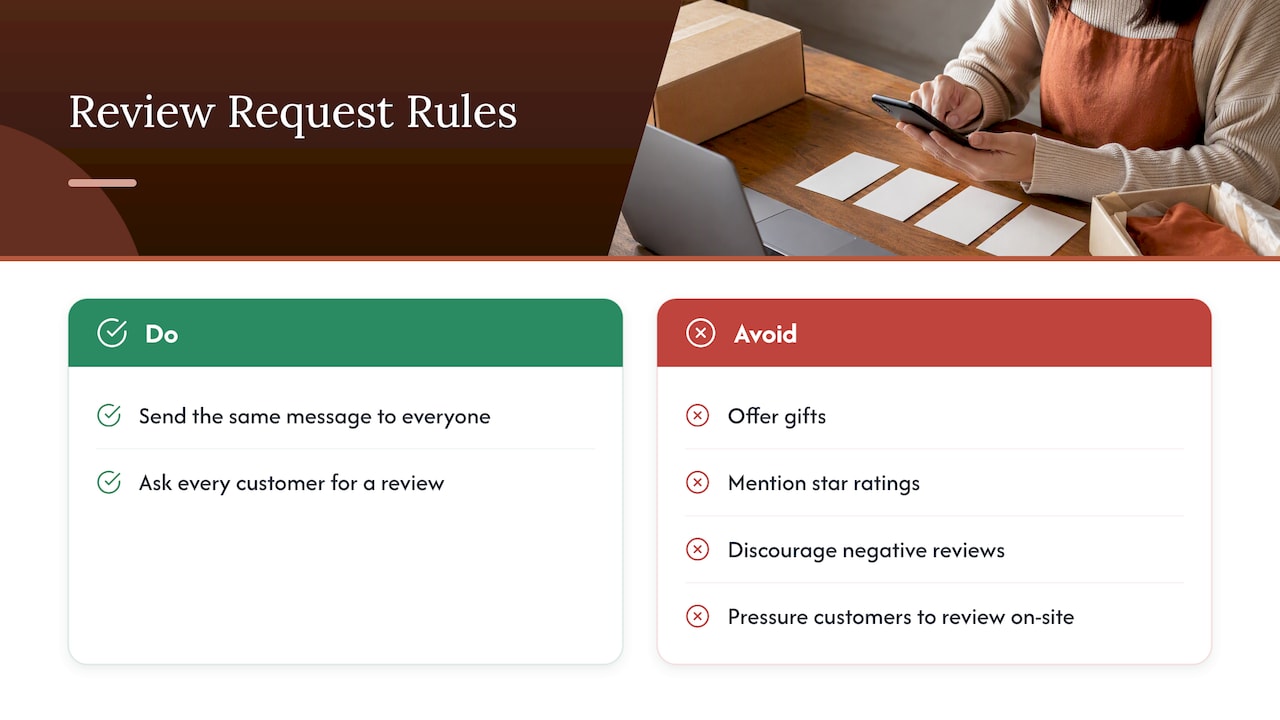
Ask everyone, not just the happy ones. The FTC’s guidance for platforms says businesses should not solicit only likely-positive reviewers or discourage negative reviews. Sending the link only to people you think were satisfied is selective solicitation.
Don’t pay for sentiment. The FTC’s rule on consumer reviews and testimonials allows generalized requests for reviews but prohibits compensation tied to a particular sentiment, such as paying for a five-star review. Incentives of any kind may also require clear disclosure.
Follow Google’s own policy. Google’s Maps content policy prohibits paid or incentivized reviews, selective solicitation, discouraging negative reviews, and requesting particular ratings. It also bars pressuring people to review on your premises, so avoid a tablet pushed across the counter. Google can respond by removing reviews, pausing new reviews, or placing a warning on the profile.
If you want a deeper walkthrough of staying inside these lines, these Google review guides cover ethical, policy-compliant requests.
A simple internal rule covers most of this: send the same message to every customer, do not offer gifts, and never mention stars.
Dental and medical practices: leave health details out
The request itself can create a privacy problem if it reveals more than it should. Keep it to a thank-you and a link.
What goes wrong is usually the reply, not the request. HHS OCR reported that a California dental practice paid $23,000 and adopted a corrective plan after disclosing patient health information in responses to reviews, and a New Jersey psychiatric provider paid $30,000 over a response to a negative online review. The American Dental Association warns that even confirming the person was a patient may create a problem, and that name, insurance, treatment or cost details are risky.
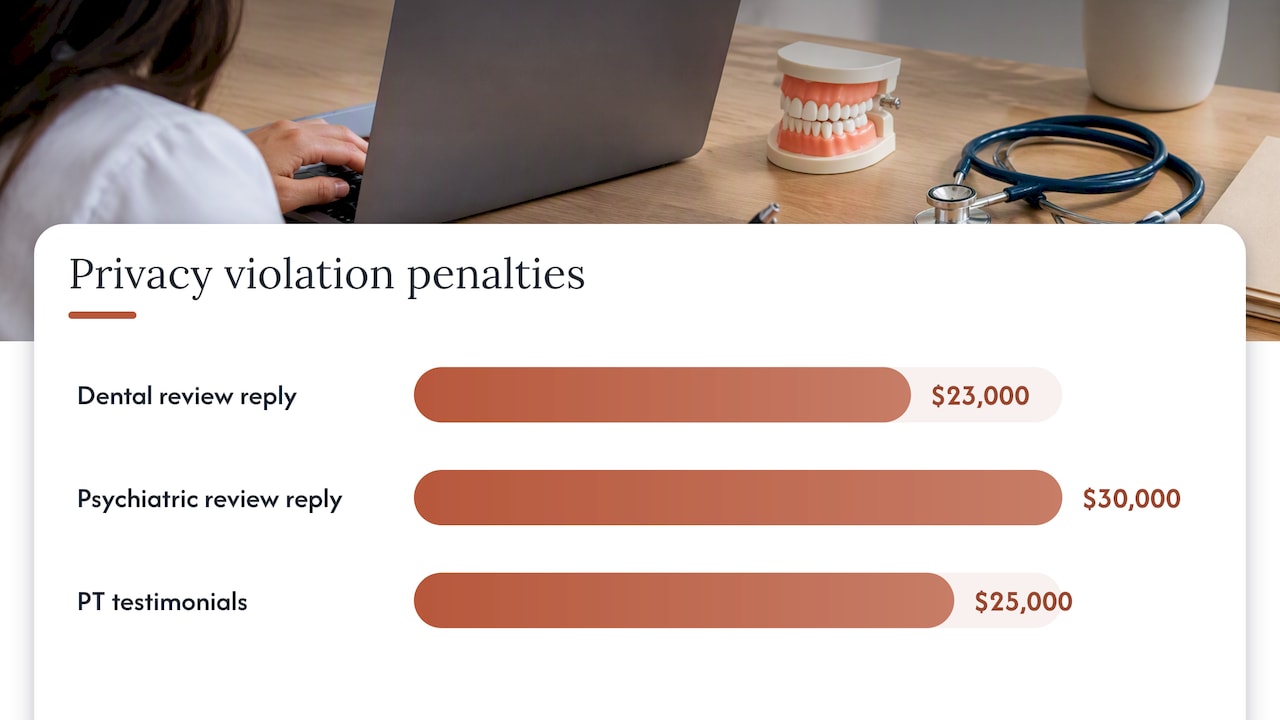
Testimonials are a separate matter. OCR said a physical therapy provider paid $25,000 after posting patient testimonials with names and photos without valid authorizations, and that written authorization is generally required for marketing uses. Collecting a review on Google is different from reposting it on your own site. Get authorization before you republish anyone’s words or face.
For your Spanish messages, this means:
- Say “gracias por visitarnos”, not “gracias por su limpieza dental de ayer” or “gracias por su consulta de ortodoncia”.
- Never mention the treatment, the provider’s specialty if it reveals a condition, or the cost.
- Reply to public reviews with generalities only, in Spanish if the review is in Spanish: “Gracias por sus comentarios. Nos importa la experiencia de todos y lo invitamos a comunicarse con nuestra oficina.”
Dentists can find more about serving Spanish-speaking patients on our dental practice page.
Law firms: confidentiality and state advertising rules
Lawyers face a different set of limits. ABA guidance says lawyers must keep all information about a representation confidential, and that when responding to a review they should avoid revealing anything that could harm the client, and consider saying nothing if the matter is ongoing. The same guidance means your request text should never mention the case type.
Also check your state bar. The ABA notes that state advertising rules vary, including rules on testimonials, websites and email, so confirm what your state allows before you start a review campaign. A client review on Google is not the same as a testimonial you place on your own site.
A safe Spanish request for a law firm:
Estimado/a [Nombre], gracias por confiar en [despacho]. Si lo desea, puede compartir su opinión sobre su experiencia con nuestra oficina en Google: [enlace]. Es totalmente voluntario.
For more on reaching Spanish-speaking clients, see Spanish SEO for lawyers and our page for firms.
Our perspective
We build bilingual front desks for practices that serve Hispanic clients, and we see the same pattern again and again: the review request is treated as an afterthought, translated by the nearest bilingual employee or a free tool, and sent in a rush. It shows. The Spanish sounds like a form letter, the register does not match the front desk, and the message arrives days later.
Our view is that a review request is part of the service, not marketing added on top. If a person called, booked and was greeted in Spanish, the last message they receive should sound like the same practice. That means human-reviewed Spanish, not a translated English template, and a register chosen deliberately.
It also means respecting the limits. The practices we admire ask everyone, ask gently, and say less rather than more. A thank-you and a link is enough.
— Francisco
Put the whole flow on autopilot
Writing good templates is the easy part. Sending them at the right time, in the right language, to every person, is where practices fall behind. Diazluna gives practices a bilingual website, an AI receptionist that handles calls, messages and scheduling in Spanish and English around the clock, and WhatsApp integration, so Spanish-speaking clients get the same warm, authentic tone from first contact to follow-up.
Plans start at $99 per month for the website alone (Solo Sitio), $199 per month with the AI receptionist (Sitio + María), and $349 per month for the expanded Sitio + María Pro package. Annual billing is $990, $1990 and $3490, and there is a one-time $399 activation fee. See the plans or start at our homepage.
Frequently asked questions
Should I send a Spanish review request in English if the review will be public in English?
No. Send it in the language of the service. Customers can write their review in Spanish, and Spanish reviews help other Spanish speakers decide to call you. If you know the person is fully bilingual, add one short English line under the Spanish text.
Is it okay to offer a discount for a review?
Not in exchange for a review. Google’s policy prohibits paid or incentivized reviews, and the FTC bars compensation tied to a particular sentiment and expects incentives to be disclosed. The safest approach is to thank people sincerely and offer nothing.
How many reminders can I send?
One. Send the first request within a day or two of the visit, one gentle reminder after about three to five days, and then stop. The reminder should repeat that there is no obligation.
Can a dental office thank a patient by name in a public reply?
It is safer not to. The ADA warns that even confirming someone was a patient can create a privacy problem. Use a general reply that thanks people for their feedback and invites them to contact the office directly.
Sources
- La elección de las formas de tratamiento en las páginas de tiendas en línea (academic study)
- Progressive Spanish Language Guidelines
- FTC: Featuring Online Customer Reviews, A Guide for Platforms
- FTC: The Consumer Reviews and Testimonials Rule, Questions and Answers
- Google Maps prohibited and restricted content policy
- Google Business Profile restrictions for policy violations
- HHS OCR: New Vision Dental settlement
- HHS OCR: Manasa Health Center agreement
- HHS OCR: Complete P.T. agreement
- American Dental Association: Managing dental practice online reviews
- ABA: How to Text Your Client
- ABA: 10 Practical Tips for Newly Admitted Lawyers