November 17, 2026
Bilingual Analytics and Segmentation for Your Practice
Bilingual analytics means tagging every contact, whether a call, a web visit, a WhatsApp message or an appointment request, with the language that person prefers, then comparing how each language group behaves. For a dental, law or medical practice, the useful version is simple: record a preferred language once, answer in it everywhere, and track whether Spanish-speaking clients book, show up and come back at the same rate as English-speaking ones. The cleanest way to get there is to put both languages at every point of contact, so routing is the exception and not the daily workaround.
TL;DR
- Segment by preferred language, asked directly and kept separate from nationality or ethnicity. Never guess it from a name or an accent.
- Capture language at every point of contact (phone, website, messaging, paperwork), as federal language access guidance recommends.
- Route automatically only when you are confident. When you are not, offer a visible language choice and start in a language you can support.
- Measure by language: booking rate, missed calls, no-shows, satisfaction and first-contact resolution.
- A front desk that works fully in Spanish and English on every channel removes most of the routing problem. That is what we build at Diazluna.
Table of Contents
- What language-based segmentation means for a practice
- Ask for preferred language, do not infer it
- Where language data comes from
- Routing calls by language: what federal guidance says
- When detection is uncertain
- Metrics that show whether it is working
- Privacy and recording: a point to check
- Why one bilingual front desk beats stitched-together tools
- Diazluna plans and pricing
- A simple rollout in four steps
- FAQ
- Sources
What language-based segmentation means for a practice
In marketing analytics, segmentation means splitting a dataset into smaller groups so you can see how each behaves. The most common splits are age, income or location. Language is one more split, and for a practice serving Hispanic clients it is often the most revealing one, because it shows where people drop out.
The search results for this topic are a mix of web analytics tutorials, job listings and linguistics papers. What a practice owner needs is narrower: who is calling, in which language, and what happened next.
The need is common. A multilanguage support research report found that 86% of contact centers serve non-English-speaking customers, yet only 66% had formal support options in another language. In the same survey, 71.5% said native-language support raised customer satisfaction and 58.4% said it raised brand loyalty. Those are contact centers, not dental offices, and the survey dates from 2014. But the pattern holds for any front desk: the demand is there, and the service often lags behind it.
For a small practice, the questions are practical:
- How many of the people contacting us prefer Spanish?
- Do they reach us through different channels than English speakers?
- Do they book, confirm and return at the same rate?
You cannot answer any of these until language is recorded as data and not left to whoever picked up the phone.
Ask for preferred language, do not infer it
The most common mistake is treating language as something you can read off a person. It is not. A Google and Ipsos study of 4,533 U.S. Hispanic adults found that 28% were Spanish-dominant at home, but only 16% used Spanish most or all of the time online, while 52% used English most or all of the time online. The study dates from December 2014, but the lesson is durable: the same person may speak Spanish with family, read in English online and want a Spanish reply from their doctor. One signal does not settle it.
So ask. Federal guidance gives you good models:
- The U.S. Web Design System recommends listing languages in their own spelling, such as Español, allowing more than one choice, adding an “other” option, and avoiding flags. It also advises not assuming that the language someone speaks is the language they want to read.
- The same page recommends telling people there is no penalty for choosing a language other than English, because some fear stigma or immigration consequences. That reassurance matters for law and health practices.
- A patient questionnaire from the Agency for Healthcare Research and Quality asks separately about spoken and written language, includes an “another language” line, and frames the questions as confidential and optional.
The practical wording for a phone or desk script is the one a language-services toolkit suggests: ask what spoken and written language the person prefers, so you can communicate most effectively with them, then record the answer in your system. That toolkit also lists phone cues that may signal limited English, such as very short answers or trouble communicating. Treat these as a reason to offer a language choice, never as proof of a language.
What to store
Keep the field narrow. Language preference is not nationality, ethnicity or country of residence. A good record has three parts:
| Field | Example | Why it matters |
|---|---|---|
| Preferred spoken language | Español | Decides who or what answers the phone |
| Preferred written language | English | Decides reminders, forms and email |
| How you know | Client chose it / assumed from first call | Tells the next person whether to trust it |
The third row is the one most practices skip, and it is the one that prevents a wrong guess from hardening into a fact.
Where language data comes from
A practice has four natural sources of language signals. Use all of them, and let an explicit answer always override the others.
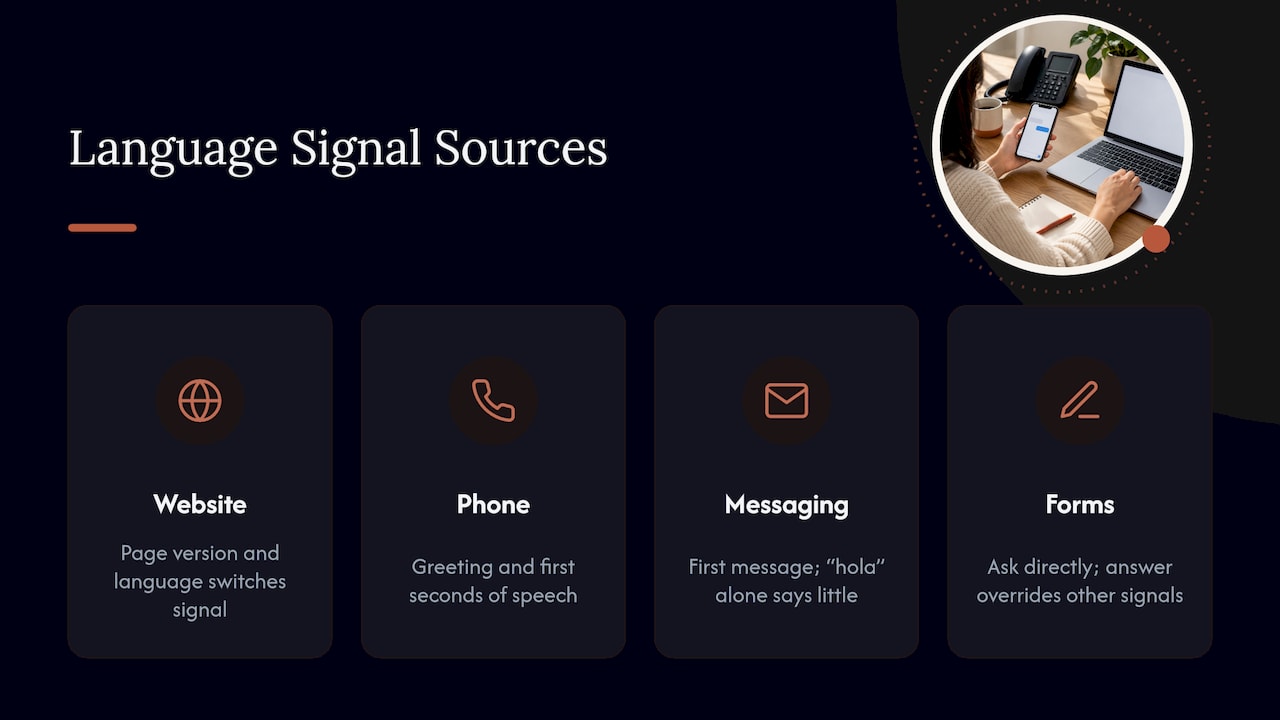
The website. Which language version a visitor lands on, and which they switch to, is a signal. It is a weak one alone, for the reasons above. If you publish pages in both languages, your analytics tool can show how visitors to each version behave: how long they stay, whether they reach the appointment page and whether they call. If you want to plan that content around what each language audience searches for, multilingual SEO content is a place to start thinking about it.
The phone. Language shows up in the greeting choice and in the first few seconds of speech. It is the channel where mistakes are most costly, because a caller who cannot be understood often hangs up without leaving a message.
Messaging. Many Spanish-speaking clients prefer WhatsApp for quick questions. The language of the first message is a signal, but an opening “hola” from someone who writes the rest in English tells you little.
Forms and intake. This is where you can ask directly and store the answer. A single question on the new-client form, worded as in the section above, does more for your data than any detection tool.
Routing calls by language: what federal guidance says
The Centers for Medicare & Medicaid Services’ language access guide says organizations should identify language needs at every point of contact: call center, reception, paperwork and billing. It names two simple tools. The first is an automated menu such as “for English, press 1; for Spanish, press 2.” The second is an “I speak” card that a person can point to in order to show which language they understand. It also says staff should be trained to capture language needs and preferences.
That guidance is written for health programs, but the logic transfers to any practice. Routing by language is worth doing, and call-routing research from a customer-experience consultancy reports that routing callers by language preference, location or value can improve first-contact resolution and satisfaction by up to 5%. That figure comes from contact centers with many agents, so treat it as an indication, not a promise for a three-chair office.
The small-practice problem with routing
Routing assumes you have somewhere to route to. A large call center has a Spanish queue staffed by Spanish speakers. A dental office with one front desk employee has a person who may or may not be bilingual, who is sometimes at lunch, sometimes on another line, and never there at 9 p.m.
That is why detection and routing, the other things people search for in this area, only half solve the problem for a practice. Detecting Spanish and sending the call to a voicemail box that nobody checks until tomorrow is a recorded loss, not a solution.
When detection is uncertain
Some calls and messages will not give you a clean signal. Short messages, mixed-language messages and calls with poor audio all fall here. A sensible fallback order is:
- An explicit choice wins. If the client has said Spanish, use Spanish, on every channel.
- Otherwise, follow the language of the substantive opening, if you can serve it.
- Otherwise, start in a language you can fully support and make switching a single step, with a visible option in both languages.
- Never route on one weak signal. A name, a phone area code or a single word is not enough. Require agreement between at least two signals before sending anyone down a language-specific path automatically, and show a quick language picker when they disagree.
The design principle is the same one the federal guidance applies: avoid making the client prove anything. Offer the choice, honor it, and record it.
Metrics that show whether it is working
Segmentation only pays off if you compare the groups. The multilanguage support report found that 91% of contact centers with formal multilingual support measure experience quality, mostly through satisfaction surveys (56.5%), internal quality scores (52.5%) and first-contact resolution (31.1%). Among centers without formal support, 20.4% did not measure these interactions at all. If you do not measure Spanish-language contacts separately, you are in that second group by default.
For a practice, a short dashboard is enough. Split each of these by preferred language:
| Metric | What it tells you |
|---|---|
| Calls answered vs. missed, by language | Whether Spanish callers reach someone |
| Call-to-appointment rate | Whether the conversation ends in a booking |
| After-hours contacts handled | Whether evening and weekend inquiries are lost |
| Appointment confirmations and no-shows | Whether reminders reach people in their language |
| Website visit to contact rate, by language version | Whether the Spanish pages convert |
| Satisfaction score or review sentiment | Whether service feels equal across groups |
A gap in any row is a specific, fixable problem. If Spanish callers book at half the rate, look at who answers. If Spanish website visitors do not contact you, look at the page. If no-shows are higher among Spanish speakers, check whether reminders go out in Spanish.
Privacy and recording: a point to check
Call analytics often relies on recording and transcribing calls. Law firm commentary on California privacy rules notes that wiretapping consent and any CCPA risk-assessment requirements are separate questions from the profiling that speech analytics can do. Rules on call recording differ by state, and health and legal practices carry confidentiality duties on top. Before you record or analyze calls, confirm your state’s consent rules with your attorney or compliance adviser, and have your notice of recording say so in both languages.
Why one bilingual front desk beats stitched-together tools
Here is the honest shape of the problem. To do language-based analytics the traditional way, you would need a language-aware phone menu, a call analytics tool, a bilingual website, a messaging inbox, a scheduling system and someone to keep the language field consistent across all of them. Each piece comes from a different vendor, and each has its own idea of what “Spanish” means.
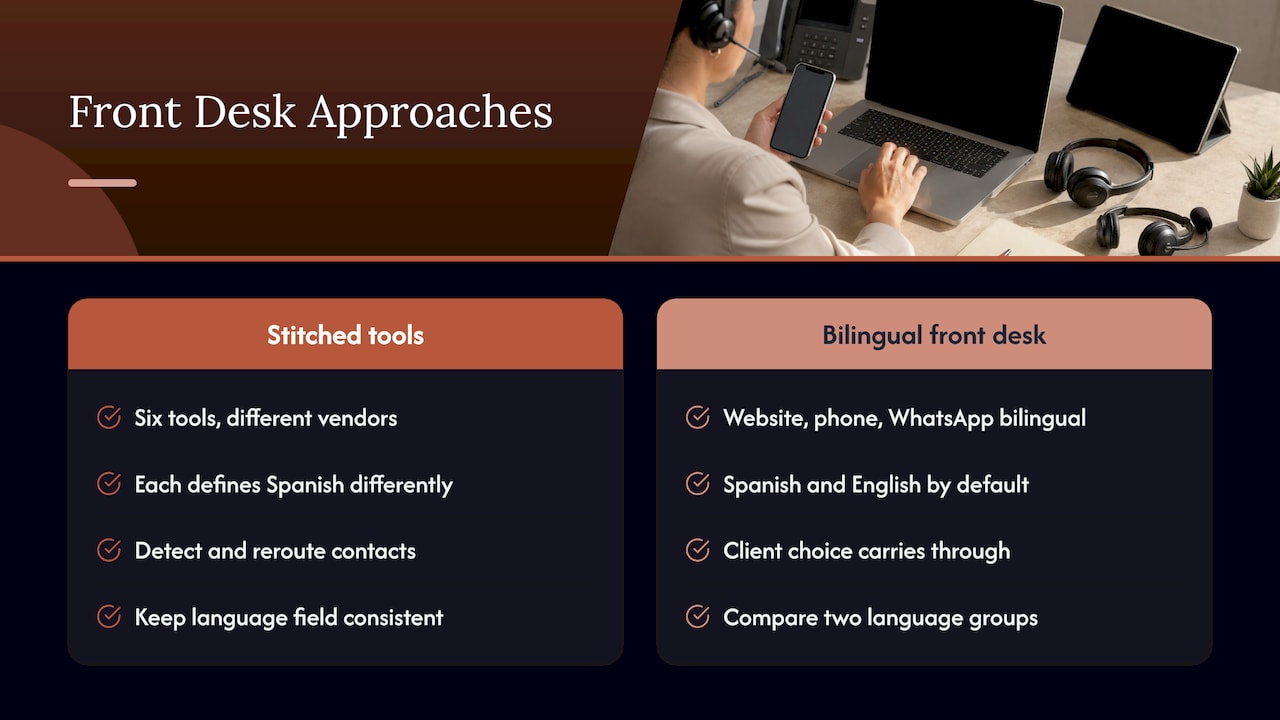
The alternative is to make language a non-issue at the front. If the website, the phone and WhatsApp all work in Spanish and English by default, you do not need to detect and re-route most contacts. The client’s own choice of language carries through, and your analytics become a simple comparison of two groups instead of a detection project.
We have written more on this approach, including why bilingual support beats traditional agencies and what a bilingual service package includes. If your biggest leak is the phone, the advantages of a bilingual AI receptionist are a good next read.
Our point of view
Practices ask us about detection and routing because they have seen the problem: a Spanish-speaking caller hits a wall and disappears. The instinct is to add a smarter layer on top, a detector, a queue, a report.
We think the better answer sits underneath. If the front desk itself speaks both languages, on the website, on the phone and on WhatsApp, there is much less to detect and nothing to hand off. Our platform pairs a fully bilingual website with a 24/7 AI receptionist, María, who handles calls, messages and appointment scheduling in Spanish and English. She sends real-time summaries and transfers urgent cases to your team.
The Spanish matters as much as the technology. We use human-reviewed Spanish content, not machine translation, because clients can tell the difference, and because trust is the whole point of a first contact.
Measure your results by language. Ask for preferences, respect them, and compare the groups. That is the entire discipline.
Francisco
Diazluna plans and pricing
Diazluna puts the bilingual website, the AI receptionist and WhatsApp in one subscription. The owner can edit the site without technical skills. There is a one-time Activación fee of $399, and three plans:
| Plan | Monthly | Yearly |
|---|---|---|
| Solo Sitio (bilingual website) | $99 | $990 |
| Sitio + María (website and AI receptionist) | $199 | $1,990 |
| Sitio + María Pro (full-service managed package with site updates and expanded call capacity) | $349 | $3,490 |
To see which plan fits your practice, start at Diazluna’s plans page.
A simple rollout in four steps
- Add the question. Put a preferred spoken and written language question on your intake form and your phone script, worded as the federal examples are.
- Make every channel answer in both languages. Website, phone, messaging and reminders. Add a visible language switch in the native spelling, Español and English.
- Tag every contact. Store preferred language and how you learned it, so the next person does not have to guess.
- Review monthly. Compare booking rate, missed calls, no-shows and satisfaction by language, and fix the largest gap first.
For reminders and recalls, see our guide to bilingual client follow-up. For the effect on loyalty, see bilingual content’s role in client loyalty.
FAQ
What is language-based segmentation?
It is splitting your clients, prospects and contacts into groups by the language they prefer, so you can compare how each group books, responds and returns. It works best when the language comes from the client’s own answer, not from a guess.
How do I know which language a caller prefers?
Ask. A short menu or a direct question at the start of the call is the most reliable method, and federal guidance recommends identifying language needs at every point of contact. Record the answer and use it on every later contact.
Should I route Spanish callers to a separate queue?
Only if someone can answer in Spanish when the call arrives. For a small practice, a front desk that answers in both languages at all hours avoids the handoff entirely, and it means no caller waits for a callback.
Which metrics should I track by language?
Start with answered versus missed calls, call-to-appointment rate, after-hours contacts, no-shows and satisfaction. A gap between the Spanish and English groups shows where to fix your process first.
Sources
- The Growing Need for Multilanguage Customer Support (research report)
- How do U.S. Hispanics consume digital content and ads? (Google/Ipsos)
- Preferred language, U.S. Web Design System
- Patient Demographics Questionnaire, AHRQ
- Better Communication, Better Care: language services provider toolkit, 2024
- Guide to Developing a Language Access Plan, CMS
- Call Routing to Get the Customer to the Right Agent
- Is a CCPA Risk Assessment Required When Recording Customer Calls?