November 12, 2026
Bilingual Receptionist Salary in 2026: What It Really Costs
A bilingual receptionist in the United States typically earns between about $18 and $20 an hour, or roughly $38,000 to $43,000 a year, depending on which data source you read. The wage is only part of what you pay. Payroll taxes, benefits and hiring costs push the real annual cost of one full-time employee well above the salary on the job post. This guide gives you the numbers, shows where they come from, and walks through a worked example so you can budget with confidence.
TL;DR
- Salary estimates for a bilingual receptionist cluster around $18.64 to $20 per hour, or about $40,918 a year on one widely used salary database.
- Entry-level pay starts near $34,352 a year and top earners reach about $48,172, so experience and market matter a lot.
- Benefits add roughly a third on top of wages for office and administrative workers, so a $20 hourly wage can cost an employer close to $30 an hour in total compensation.
- Healthcare and professional offices pay receptionists more than personal care businesses, and city matters as much as industry.
- If one desk can’t cover evenings, weekends and overflow calls, a bilingual AI front desk is a lower-cost way to add coverage. Plans start at $99 a month.
Table of Contents
- How much does a bilingual receptionist earn?
- Salary range: entry level to experienced
- Do bilingual receptionists earn more than English-only receptionists?
- What the job pays by industry and city
- The real cost: salary is not the whole bill
- What a bilingual receptionist cost looks like for a small practice
- Ways to staff bilingual coverage
- Diazluna plans and pricing
- How to set a fair bilingual receptionist wage
- When Spanish calls go unanswered
- FAQ
- Sources
How much does a bilingual receptionist earn?
Every source gives a slightly different number, because each counts different people. Here is what the main ones report:
| Source | Figure | Period |
|---|---|---|
| Salary.com | $40,918 a year, about $20 an hour | June 1, 2026 |
| Glassdoor | $43,000 median total pay, range $36K to $50K | 2026 |
| Indeed | $18.64 an hour average base, low $14.71, high $23.62 | Updated October 11, 2026 |
| U.S. Bureau of Labor Statistics | $18.27 an hour, $38,010 a year (all receptionists, not only bilingual) | May 2025 |
The differences are easy to explain. Indeed averages base pay from job postings over 36 months, so it leans lower. Glassdoor’s figure is total pay, including bonuses and other pay, and it is built from 125 anonymous submissions. Salary.com models a “bilingual front desk receptionist” and lands in the middle.
For budgeting, a sensible planning range is $18 to $21 an hour for a full-time hire in an average market. Plan higher in expensive cities and in healthcare or legal offices.
Salary range: entry level to experienced
Pay spreads widely around the average. On Salary.com, the entry-level end (10th percentile) is $34,352 a year, while the top earners (90th percentile) reach $48,172. That is a gap of nearly $14,000 between a new hire and a seasoned one.
What moves someone up that ladder? BLS says receptionist earnings vary with experience, responsibility, performance, tenure and geographic area. For a bilingual role, the responsibility part is often the key. A person who only greets walk-ins and answers a few calls sits near the bottom. A person who handles intake, scheduling, insurance or retainer questions in two languages, and who can calm an anxious caller, sits near the top.
Do bilingual receptionists earn more than English-only receptionists?
Usually a little more, though the size of the premium is not fixed. The sources above point the same way: BLS puts the median for all receptionists at $18.27 an hour, while Salary.com’s bilingual figure is about $20. Those two numbers come from different methods, so treat the gap of roughly $1 to $2 an hour as a signal, not a precise premium.
Employers that formalize the premium often do it as a percentage. Public-sector labor agreements in California, for example, set bilingual pay differentials of 2% to 5% of base pay for employees who must use a second language on the job. Private practices set their own rates, and in a market where many callers speak Spanish first, the language skill is often what the hire is for. That tends to justify paying toward the upper half of the range.
Two cautions when you set the number. First, “bilingual” on a résumé is not the same as fluent, professional Spanish on the phone. Ask candidates to handle a mock call about scheduling and fees in both languages. Second, native-level written Spanish matters if the person will also text or email clients.
What the job pays by industry and city
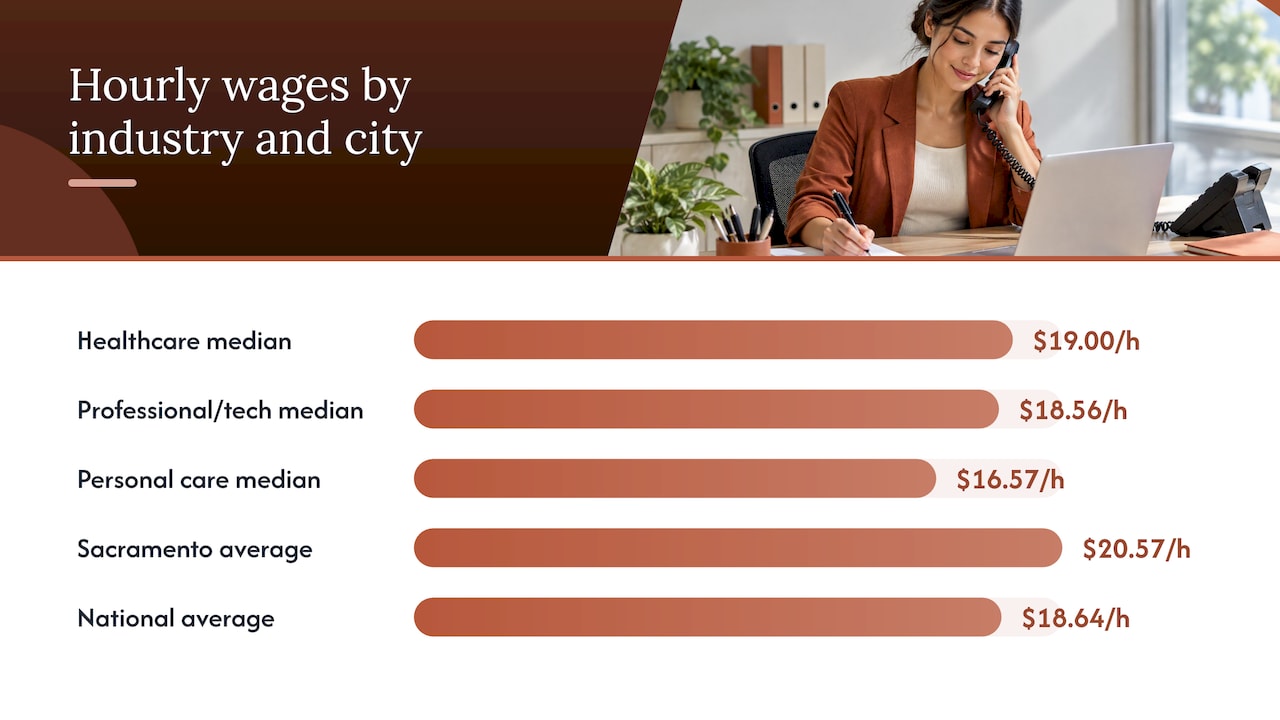
Industry changes the baseline. BLS reports May 2025 median hourly wages for receptionists of $19.00 in healthcare and social assistance, $18.56 in professional, scientific and technical services, and $16.57 in personal care services. Dental and medical offices and law firms, the businesses that most often need Spanish at the front desk, sit in the higher two groups. Expect to pay at or above those medians.
Location shifts it again. Job-posting data shows the spread:
- Sacramento, CA: $20.57 an hour on average, with a range from $18.89 to $22.40, based on 10 salaries from postings over the past 36 months (updated June 29, 2026).
- National average: $18.64 an hour from 3,100 postings.
The pattern holds for most metros. High-cost coastal cities and large Texas, Florida and California markets with big Spanish-speaking populations compete harder for bilingual staff. Smaller markets pay closer to the national figure, but good bilingual candidates can be harder to find there, so a longer search is part of the cost. Teams that also hire remote support abroad will find that remote worker salary benchmarks differ sharply by country, which is a reminder to benchmark each role in its own market.
The real cost: salary is not the whole bill
The hourly wage is the number candidates see. The number you pay is higher. BLS’s June 2026 Employer Costs for Employee Compensation data shows that for private industry overall, total compensation is $46.89 an hour: $32.82 in wages (70.0%) and $14.07 in benefits (30.0%). Of that, $3.40 an hour is legally required benefits: Social Security, Medicare, unemployment insurance and workers’ compensation.
For the occupational group that includes receptionists, the load is heavier. In office and administrative support, total compensation is $38.27 an hour, with benefits at $12.80, or 33.5%.
A worked example
Take the Salary.com figure of $40,918 a year, about $20 an hour. If benefits make up 33.5% of total compensation, wages are the other 66.5%. Dividing $20 by 0.665 gives about $30 an hour in total cost. Across a standard 2,080-hour year, that is roughly $61,500 for one full-time employee.
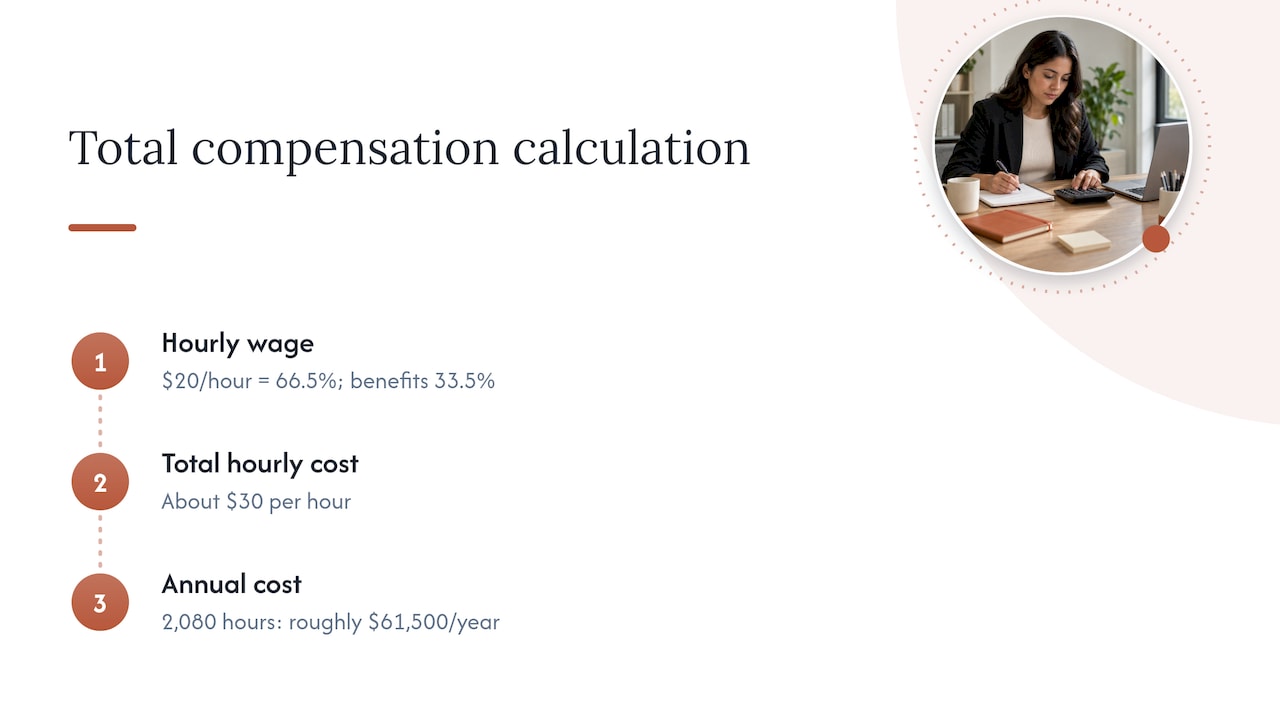
That is an illustration built from the published national ratio, not a quote. Your actual figure depends on your health plan, paid time off, retirement match and state payroll taxes. For the health insurance piece, one benefits analysis of the KFF 2024 Employer Health Benefits Survey puts the average annual premium for single coverage at $8,951, with workers paying $1,368 and employers about $7,583.
Costs that come before the first paycheck
Add recruiting and onboarding. A 2025 SHRM benchmarking survey of 2,371 members, as summarized by a research page, reports an average cost per hire of $5,475 for nonexecutive roles. A bilingual search often takes longer than an English-only one, so your own cost may sit above that.
Then there is coverage. One receptionist works about 40 hours of the 168 hours in a week. Lunch, vacation, sick days and turnover leave more gaps. Calls that arrive at 7 p.m. or on Saturday, often when working Spanish-speaking clients can finally phone, go unanswered unless you pay for a second person or a service.
What a bilingual receptionist cost looks like for a small practice
Here is how the pieces stack up for a single full-time hire, using the figures above:
| Cost item | Typical figure | Source |
|---|---|---|
| Base wage | $18 to $21 an hour | Indeed, Salary.com, BLS |
| Benefits and employer taxes | About a third of total compensation | BLS ECEC, June 2026 |
| Total compensation at $20 an hour | About $30 an hour, about $61,500 a year | Calculated from BLS ratio |
| Cost per hire | $5,475 average, nonexecutive roles | SHRM survey summary |
| Hours covered | About 40 of 168 a week | Standard full-time schedule |
That is a fair price for a good in-person person, especially at a dental or medical office where patients are physically at the desk. The question for most owners is not whether to have one, but how to keep every Spanish-speaking caller covered the rest of the time.
Our view on bilingual front desk costs
We built Diazluna after seeing how often practices lose Hispanic clients before the first appointment. The caller phones at 6:30 p.m., reaches voicemail in English, and calls the next office. That lost client never shows up in any payroll report.
Our view is that the front desk is a system, not a single seat. A strong bilingual receptionist is valuable in the room. But a Spanish-speaking client also finds you on Google, texts on WhatsApp, and calls after hours. We designed our platform to cover those moments: a fully optimized bilingual website, a 24/7 AI receptionist that handles calls, messages and scheduling in Spanish and English, and WhatsApp in one place.
We also care about how the Spanish sounds. Our content is human-reviewed rather than machine-translated, because clients notice the difference and they trust practices that speak to them naturally. Urgent cases are summarized in real time and transferred to your team, so staff spend time on people instead of on voicemail.
For the price of a few hours of a full-time hire’s total compensation each week, a practice can have this coverage running around the clock.
Francisco
Ways to staff bilingual coverage
Owners generally choose among a few models. Each has a different cost shape.
- Full-time in-house hire. Highest cost, about $61,500 a year in our example, but a physical presence for walk-ins and in-office tasks.
- Part-time in-house hire. Lower payroll, but fewer covered hours and the same recruiting effort.
- Outsourced answering or virtual receptionist. A bilingual virtual receptionist answers remotely; pricing varies by provider and call volume.
- AI receptionist plus bilingual website. Always on, handles volume without added headcount, and works alongside in-office staff. See how an AI receptionist fits a small bilingual practice.
Most practices end up combining two: a person at the desk during the day and automated coverage for everything else. If you want a wider look at the options, our overview of the types of bilingual support services lays them out. Law firms in particular can read about the bilingual legal receptionist role and after-hours Spanish coverage.
Diazluna plans and pricing
We publish our prices so you can compare them to a payroll line. There is a one-time activation fee of $399, and then you choose a plan:
| Plan | Monthly | Yearly |
|---|---|---|
| Solo Sitio (bilingual website) | $99 | $990 |
| Sitio + María (website plus 24/7 AI receptionist) | $199 | $1,990 |
| Sitio + María Pro (managed package with site updates and expanded call capacity) | $349 | $3,490 |
In the first year, Sitio + María on the yearly plan comes to $1,990 plus the $399 activation fee, or $2,389. Sitio + María Pro comes to $3,490 plus $399, or $3,889. These plans are built to extend your front desk, with the website bringing in Spanish-speaking clients, the AI receptionist answering them at any hour, and WhatsApp keeping the conversation going.
If you want to see how the pieces fit together, start at Diazluna’s bilingual front desk page, where you can review each plan.
How to set a fair bilingual receptionist wage
Use a simple process instead of guessing:
- Start with your local market. Check current job postings in your city for bilingual front desk roles and note the range. Compare it with the national figures above.
- Match the role to the pay band. Greeting and phones sits low in the range. Intake, scheduling, insurance or billing questions, and written Spanish, sit higher.
- Test the language, not the label. A short role-play call in Spanish tells you more than a checkbox.
- Add the full load. Multiply the wage by roughly 1.5 to cover benefits at the BLS ratio, then add recruiting and training.
- Plan the gaps. Decide who answers during lunch, vacations, evenings and weekends before you hire, so the salary buys the coverage you expect.
The multiplier in step four comes from the same ratio as the worked example: with benefits at 33.5% of total compensation, total cost is about 1.5 times wages.
When Spanish calls go unanswered
The cost of a missed call is hard to measure but easy to imagine. A caller who speaks Spanish reaches an English-only voicemail, hangs up, and dials the next practice. Training staff helps. Our guide to handling Spanish calls covers what to practice. Coverage that never closes helps more, which is why many practices pair staff with a bilingual AI receptionist. For law firms, a bilingual law firm website is the other half, because that is where many Spanish-speaking clients first look for you.
FAQ
How much does a bilingual receptionist make per hour?
Most estimates fall between about $18 and $20 an hour. Indeed’s average base pay is $18.64 an hour, and Salary.com’s yearly figure works out to about $20. Expect higher in large metros and in healthcare or legal offices.
How much does it cost to hire a Spanish-speaking receptionist?
Wages are only part of it. For office and administrative workers, benefits are about 33.5% of total compensation, so a $20 hourly wage costs roughly $30 an hour in total, or about $61,500 a year full time. Recruiting and training add to the first-year cost.
Do bilingual receptionists get paid more than regular receptionists?
Generally yes, by a modest margin. BLS reports a $18.27 median for all receptionists, while bilingual-specific estimates run closer to $18.64 to $20. Some employers set a formal differential, often a small percentage of base pay.
What is the highest pay for a bilingual receptionist?
On Salary.com, the top 10% earn about $48,172 a year. Glassdoor shows a range up to about $50,000 in total pay. Those at the top usually handle intake, scheduling and client questions, not just greeting.
Can software cover a bilingual front desk?
It can cover calls, messages and scheduling at all hours. Our plans start at $99 a month for the website and $199 a month with the 24/7 AI receptionist, plus a one-time $399 activation. Many practices keep in-office staff and add this for after-hours and overflow.
Sources
- Bilingual Front Desk Receptionist Salary (Salary.com)
- Bilingual Receptionist salaries (Glassdoor)
- Bilingual receptionist salary in United States (Indeed)
- Bilingual receptionist salary in Sacramento, CA (Indeed)
- Receptionists: Occupational Outlook Handbook (BLS)
- Employer Costs for Employee Compensation, Table 1 (BLS)
- Employer Costs for Employee Compensation, Table 2 (BLS)
- Employee benefits benchmarking for employers
- True cost of a bad hire: data and benchmarks
- Bilingual premium pay clause samples
- Salary benchmarks for remote workers