August 6, 2026
How Culturally Accurate Content Converts Clients

Culturally accurate content converts clients reliably and measurably. Research indicates that a strong preference exists among online shoppers to purchase in their native language, and brands that go beyond basic translation to full cultural adaptation achieve substantially higher conversion rates. That gap is not a rounding error. It is the difference between a practice that fills its appointment calendar and one that watches leads go quiet.
The fastest way to see this for yourself: run a short pilot. Audit your highest-traffic contact point, swap in culturally adapted copy, and A/B test it against your current version. If you serve Hispanic clients, a bilingual front desk like Diazluna gives you a ready-made test environment with site, AI receptionist, and WhatsApp already integrated.
What the evidence points to:
- Language preference alone drives purchase intent for 76% of non-English-dominant consumers.
- Cultural adaptation (tone, formality, imagery, microcopy) compounds that effect beyond what language alone achieves.
- Professional services — dentistry, law, healthcare — are high-stakes decisions where trust signals matter most, and cultural accuracy is one of the clearest trust signals available.
Table of Contents
- How culturally accurate content converts clients: the core mechanisms
- What does culturally accurate content actually look like?
- How do you measure conversion uplift from cultural adaptation?
- What does a realistic implementation roadmap look like?
- What are the biggest pitfalls in culturally accurate content?
- How Diazluna’s bilingual front desk improves client conversion
- Key Takeaways
- Cultural accuracy is not a nice-to-have in professional services
- Diazluna gives your practice a bilingual front desk from day one
- Authoritative sources and further reading
How culturally accurate content converts clients: the core mechanisms
The short answer: cultural accuracy removes the friction that kills decisions before they start.
Research from Stanford Graduate School of Business shows cultural cues are most influential during rapid, cursory judgments — exactly the moment a prospect lands on your site, reads a text reminder, or hears a phone greeting. In those first few seconds, a mismatch between the client’s cultural frame and your content registers as unfamiliarity, and unfamiliarity reads as risk.

Three mechanisms drive the conversion effect:
Trust signaling. Industry analyses show many consumers are loyal to brands that treat them as individuals. Cultural accuracy is one direct way to demonstrate that you see the client as a person, not a demographic. In professional services, where the stakes involve health, legal status, or finances, that signal carries extra weight.
Reduced cognitive load. When copy uses the exact words and frames a client uses to describe their own needs, they spend less mental energy decoding your message and more energy deciding. Cultural fluency — blending language, etiquette, visuals, and local norms — reduces friction in immediate-contact channels like calls and messaging more than in any other touchpoint.
Clearer decision paths. Culturally adapted UX removes ambiguity from the booking or intake flow. When date formats, payment options, and reminder language match what the client expects, the path to “yes” shortens.
Three scenarios where cultural mismatch kills conversions:
- Appointment booking: A dental practice sends automated reminders in formal, grammatically correct Spanish that sounds like a government notice. Patients ignore it. The same reminder rewritten in warm, conversational Spanish with the patient’s first name and a WhatsApp reply option gets a measurably higher confirmation rate.
- Pricing presentation: A law firm lists fees using U.S. formatting conventions without context. A Spanish-dominant client, accustomed to different norms around discussing money, reads the page as cold and transactional. A culturally adapted fee explanation that acknowledges the client’s situation and uses familiar framing converts at a higher rate.
- Phone greetings: A healthcare clinic’s English-only phone script forces a Spanish-speaking caller to switch languages mid-sentence. The caller hangs up. A bilingual greeting that opens in both languages removes that barrier entirely.
What does culturally accurate content actually look like?
Culturally accurate content is language plus socio-pragmatic alignment plus contextual UX. Grammar is the floor, not the ceiling.

Practitioner research suggests 49% of content failures stem from socio-pragmatic mismatch — tone, formality, and honorifics — rather than outright linguistic error. A sentence can be grammatically correct and still feel wrong to a native speaker, which means your content can pass a proofreader and still lose the client.
Here is what the checklist actually covers:
- Native phrasing and search terms: Use the words clients type into Google, not the clinical or legal terms your staff uses internally. A Spanish-speaking patient searching for a dentist near them uses different vocabulary than the term in your intake form.
- Tone and formality register: Spanish has formal and informal registers (usted vs. tú) that carry social meaning. Using the wrong one in a professional context signals either disrespect or excessive distance. Match the register to the relationship and the service type.
- Imagery and representation: Stock photos of people who do not reflect your client community create subtle distance. Representation in visuals is not a diversity checkbox; it is a trust signal.
- Calendar and reminder language: Date formats, time expressions, and reminder phrasing all carry cultural weight. “Your appointment is 03/04” reads differently across cultures. Spell it out.
- Payment and address formats: Localized payment methods and address formats reduce checkout friction — a point that applies equally to intake forms and scheduling flows.
- Platform-specific messaging: WhatsApp is the primary communication channel for many Hispanic clients in the U.S. A phone-only or email-only contact strategy misses where the conversation is already happening.
- Honorifics and expectations: In many Latin American cultures, professional titles carry social weight. Addressing a client as Señor García rather than just Juan in a first contact can shift the entire tone of the relationship.
Pro Tip: The socio-pragmatic layer is where most practices lose clients without knowing it. Have a native speaker who is also familiar with your service category review your scripts and microcopy — not just for grammar, but for whether the tone matches what a client would expect from a trusted professional in that community. This is different from a standard translation review.
For a deeper look at what authentic bilingual service covers across channels, the distinction between linguistic accuracy and cultural authenticity is worth examining before you build your content checklist.
How do you measure conversion uplift from cultural adaptation?
You can and should measure uplift using A/B testing and conversion-lift metrics. The key is isolating the cultural variable from UX and pricing changes so you know what is actually driving the result.
Test design should keep UX and pricing identical across variants — run a culturally adapted version against your current content with everything else held constant. That isolation is what gives you a defensible number.
A/B testing checklist:
- Define one primary variable per test (language variant, tone register, or imagery — not all three at once).
- Calculate minimum sample size before launching. For a booking-rate test with a 5% baseline and a target of detecting a 20% relative lift, you need several hundred conversions per variant to reach statistical confidence.
- Run the test for at least two full business cycles (typically 4–6 weeks for a professional practice) to account for day-of-week and scheduling patterns.
- Track both micro-conversions (form fills, WhatsApp initiations) and macro-conversions (booked appointments, signed retainers).
- After the test, segment results by channel — phone, web, WhatsApp — because cultural adaptation often has uneven effects across touchpoints.
Suggested KPIs and benchmark reference:
| KPI | Baseline (translation-only) | Target after cultural adaptation |
|---|---|---|
| Website booking rate | 2–4% | 5% |
| Call-to-book ratio | 30% | 50% |
| No-show rate | 20–30% | 12% |
| Lead quality score | Moderate | High (fewer unqualified inquiries) |
| Time to first appointment | 5–7 days | 2–4 days |
These ranges reflect the 2–3x conversion lift that comprehensive localization consistently produces relative to translation-only approaches, applied to professional-services booking flows. Treat them as directional benchmarks, not guarantees.
Timeline guidance: expect 4–6 weeks to accumulate meaningful data for a single-channel test. Multi-channel tests need 8–12 weeks. Do not call a test early because early results look good — booking patterns in professional services are seasonal and week-dependent.
What does a realistic implementation roadmap look like?
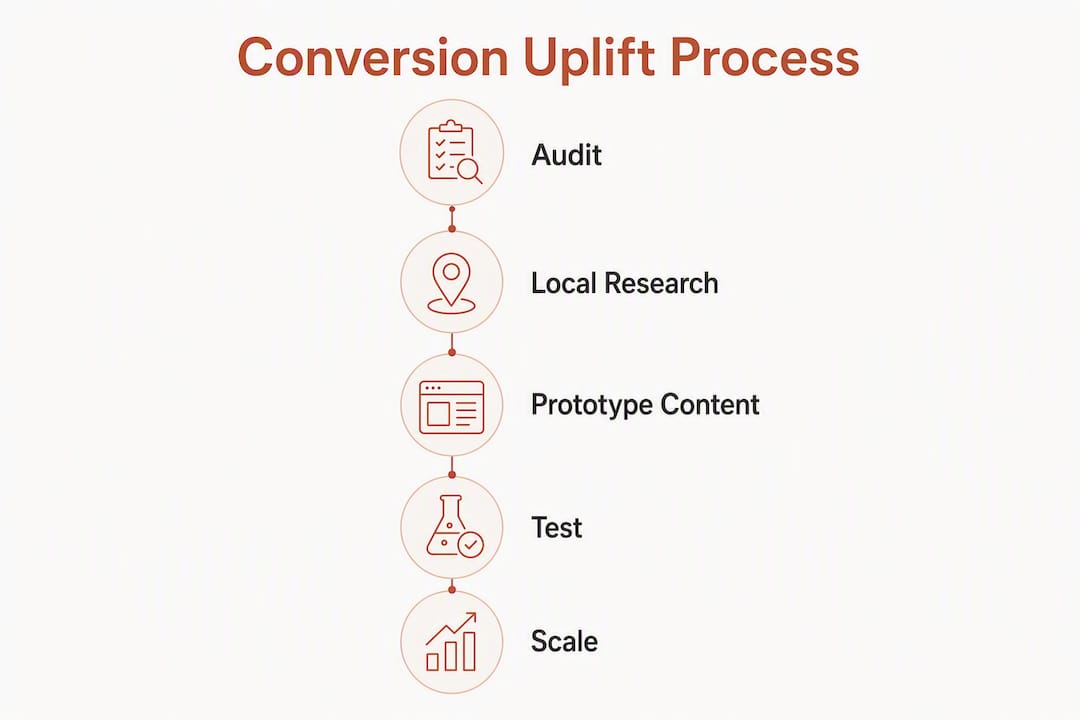
A repeatable five-step process covers the full cycle: audit, local research, prototype content, test, and scale. Each step has clear deliverables and a realistic time estimate.
Step 1: Audit (Week 1–2) Map every client-facing touchpoint: website, intake forms, phone scripts, appointment reminders, WhatsApp messages, and social profiles. Flag every point where language, tone, or UX deviates from what your target community expects. Deliverable: a touchpoint inventory with a gap rating for each.
Step 2: Local research (Week 2–3) Interview 5–10 current clients from your target community. Ask them to walk through your booking flow and describe what felt natural and what felt off. Supplement with keyword research in the target language to find the exact search terms clients use. Deliverable: a cultural style guide covering tone, formality, preferred terms, and imagery direction.
Step 3: Prototype content (Week 3–5) Rewrite your highest-traffic touchpoints using the style guide. Prioritize the booking page, phone greeting, and first-contact WhatsApp message. Have a native speaker with professional-services experience review each piece for socio-pragmatic accuracy, not just grammar. Deliverable: adapted copy for 3–5 priority touchpoints.
Step 4: Test (Week 5–10) Run A/B tests as described in the measurement section. Track KPIs weekly. Deliverable: a test report with lift data per touchpoint and a recommendation on which variants to scale.
Step 5: Scale (Week 10 onward) Roll out winning variants across all touchpoints. Integrate adapted scripts into your front-desk system and WhatsApp flows. Set a quarterly review cadence to update content as community language and norms evolve. Deliverable: a live bilingual content system with a maintenance schedule.
Cost tiers:
- Lean/internal: Staff-led with a native-speaker reviewer on contract. Lower cost, slower pace, works for practices with a bilingual team member who can own the project.
- Mixed/external: Internal project lead plus a specialized bilingual content agency for copy and a UX consultant for form and flow adaptation. Faster and more thorough, appropriate for practices with 3+ client-facing channels.
- Fully managed: A platform like Diazluna that delivers the bilingual website, AI receptionist, and WhatsApp integration as a single package. Fastest time to live, lowest internal resource requirement, and built-in cultural accuracy from day one.
Pro Tip: WhatsApp integration is often the last item on implementation lists and the first thing clients notice. Build it into Step 3, not Step 5. A culturally adapted WhatsApp greeting that goes out within minutes of a missed call recovers more leads than almost any other single change.
For a detailed breakdown of what each bilingual support model covers and what it costs, the differences between website-only, receptionist-only, and fully managed packages are worth reviewing before you set your budget.
What are the biggest pitfalls in culturally accurate content?
The biggest risk is performing culture instead of participating in it. Tokenization — dropping a few Spanish phrases into otherwise English content, or using a stock photo of a Latino family without any other cultural adaptation — signals effort without substance. Clients notice.
Common errors that cost conversions:
- Literal translation without cultural review: Grammatically correct copy that uses the wrong register, the wrong idioms, or the wrong level of formality. This is the most common failure mode and the hardest to catch without a native reviewer.
- Wrong imagery: Using visuals that do not reflect the client community, or that reflect a generic “Hispanic” aesthetic rather than the specific regional or national backgrounds of your actual clients.
- Mismatched formality: Opening a first-contact email with Hola when the client’s community expects Estimado/a — or the reverse. Both signal that you do not really know the community.
- Ignoring local payment and scheduling expectations: Assuming all clients prefer the same payment methods or scheduling formats as your English-dominant client base.
- One-and-done campaigns: Cultural accuracy is not a project with a completion date. Language and norms evolve, and a style guide written in 2023 may already be dated.
Mitigation checklist:
- Involve native speakers who know your service category in every review cycle, not just at launch.
- Test adapted content with real users from the target community before publishing.
- Build a feedback loop: track which touchpoints generate the most drop-off or complaints and treat that as a cultural accuracy signal.
- Preserve human escalation for sensitive cases. An AI receptionist handles volume; a human handles the conversation where a client is distressed, confused, or making a high-stakes decision.
- Audit imagery and visual content on the same cycle as copy.
Pro Tip: Research on implicit cultural expectations shows that nearly half of content failures come from tone and formality mismatches, not grammar. Build your review checklist around socio-pragmatic questions (“Does this sound like a trusted professional in this community?”) rather than linguistic ones (“Is this grammatically correct?”).
The line between authentic cultural participation and false authenticity is thin. Industry commentary on cultural relevance argues that brands need to shift from top-down messaging to genuine cultural participation — which means ongoing community engagement, not a one-time translation project.
How Diazluna’s bilingual front desk improves client conversion
Diazluna’s bilingual front desk reduces client loss at the first point of contact by making every interaction feel native from the first word.
The implementation covers three integrated layers: a fully optimized bilingual website in Spanish and English, a 24/7 AI receptionist that handles calls, messages, and appointment scheduling in both languages, and WhatsApp integration that delivers real-time summaries and routes urgent cases to a human. Together, they address the three most common conversion failure points for practices serving Hispanic clients: the language barrier at first contact, the drop-off during scheduling, and the no-show rate driven by impersonal reminders.
Practices using Diazluna’s bilingual front desk report a significant decrease in client loss due to language barriers, with Google indexing the bilingual site within 24 hours of launch — giving practices immediate visibility to Spanish-language searches that their previous English-only site was invisible to.
The operational changes required are minimal. The bilingual site replaces or supplements the existing practice website. The AI receptionist integrates with existing scheduling systems. WhatsApp is configured with native-scripted reply flows that match the tone and formality of the practice’s target community. A hybrid model — AI for volume, human escalation for sensitive cases — balances 24/7 availability with the cultural warmth that professional-service clients expect.
Integration checklist for teams considering this approach:
- Confirm your scheduling system has an API or webhook that the AI receptionist can connect to.
- Define escalation rules before launch: which call types go to a human, and at what point in the conversation.
- Review the WhatsApp reply scripts with a native speaker from your client community before going live.
- Set up conversion tracking on the bilingual site from day one so you have a pre/post baseline.
- Plan a 30-day check-in to review call logs, booking rates, and no-show data against your pre-launch baseline.
For dental practices specifically, bilingual patient intake is one of the highest-leverage points for conversion improvement — the intake form is often where Spanish-dominant patients abandon the process.
Key Takeaways
Culturally accurate content converts clients by removing friction, building trust, and aligning every touchpoint with the exact language and expectations of the client community you serve.
| Point | Details |
|---|---|
| Cultural adaptation outperforms translation | Brands using full cultural adaptation consistently achieve conversion rates 2–3 times higher than those relying on translation only. |
| Socio-pragmatic mismatch is the main failure mode | Nearly half of content failures come from tone and formality errors, not grammar — review for register, not just accuracy. |
| Measure with isolated A/B tests | Hold UX and pricing constant; test one cultural variable at a time over 4–6 weeks for reliable lift data. |
| WhatsApp is a priority channel | For Hispanic clients in the U.S., WhatsApp integration with native-scripted replies recovers leads that phone-only or email-only systems miss. |
| Diazluna as a fully managed option | Diazluna delivers a bilingual site, AI receptionist, and WhatsApp integration as a single package, with Google indexing within 24 hours of launch. |
Cultural accuracy is not a nice-to-have in professional services
Most practices treat cultural adaptation as a marketing add-on. That framing is wrong, and it costs them clients they never know they lost.
When a Spanish-dominant patient calls a dental office and hears an English-only greeting, they do not leave a voicemail. They call the next practice on the list. The conversion failure is invisible in your analytics because the lead never made it into your CRM. That is the specific problem cultural accuracy solves — not engagement metrics, not brand perception, but the raw number of clients who decide in the first ten seconds whether you are for them.
The trust equation in professional services is built on demonstrated understanding. A bilingual website is a signal. A bilingual phone greeting is a stronger one. A WhatsApp message in the client’s register, using the right honorifics, arriving within minutes of a missed call — that is the signal that converts. Not because it is clever marketing, but because it tells the client that you actually know who they are.
The practitioners who see the biggest lift are not the ones who ran a translation project. They are the ones who treated cultural accuracy as an operational standard, built it into every client-facing touchpoint, and measured it the same way they measure any other conversion variable. That is the shift worth making.
Diazluna gives your practice a bilingual front desk from day one
Every Hispanic client your practice loses to a language barrier is a client who wanted your service and could not get through the door. Diazluna closes that gap with a single package: a fully optimized bilingual website, a 24/7 AI receptionist fluent in Spanish and English, and WhatsApp integration with native-scripted reply flows.
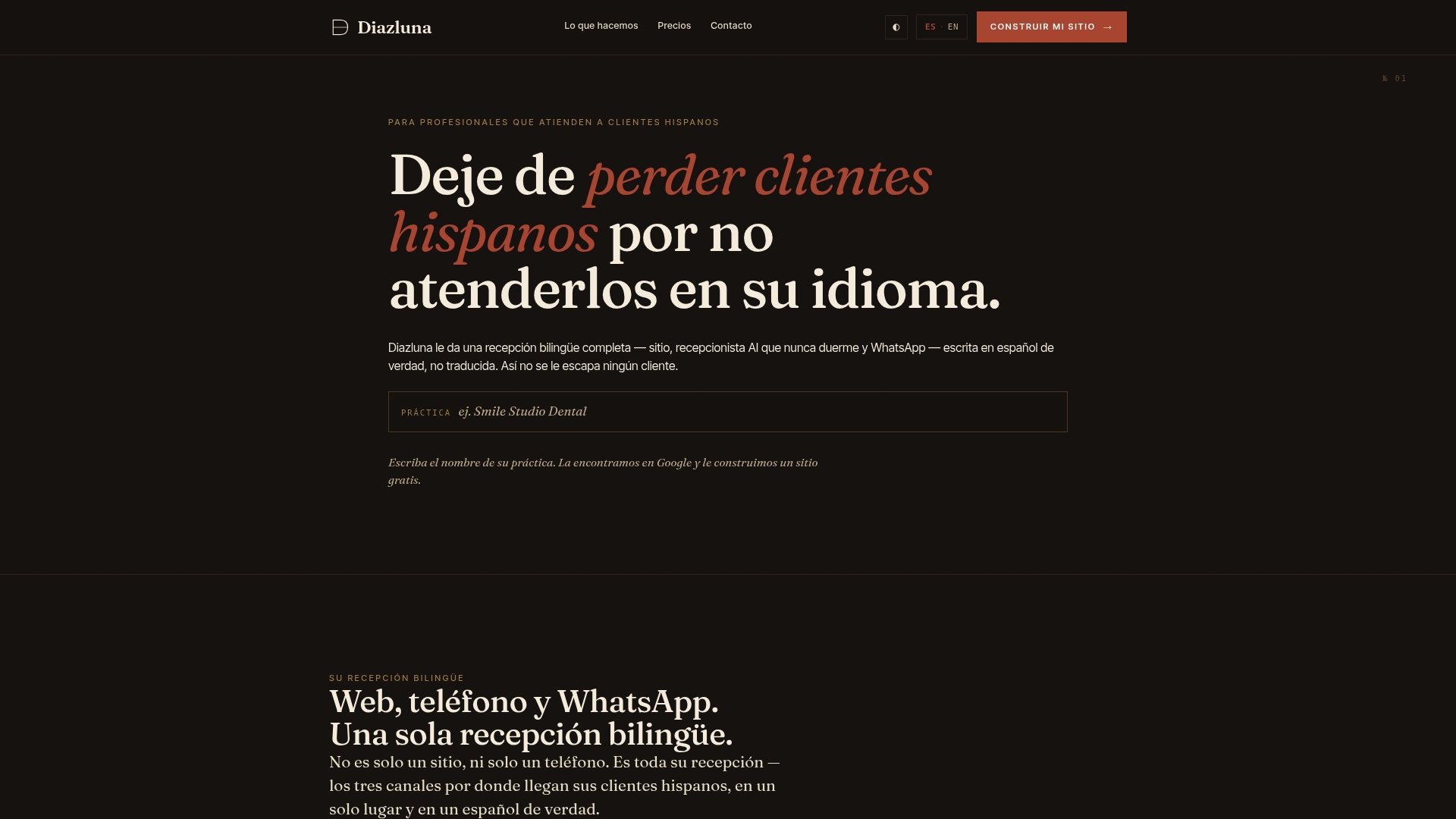
Most practices are live within days, not months. In the first 30 days, the bilingual site gets indexed by Google and starts appearing in Spanish-language searches your previous site was invisible to. By day 60, the AI receptionist is handling after-hours calls and appointment scheduling in both languages. By day 90, you have a baseline dataset on booking rates, no-show rates, and lead quality that you can compare directly to your pre-launch numbers.
The cost is a fraction of what a traditional agency charges for a bilingual website alone — and the AI receptionist and WhatsApp integration are included, not billed separately. See what the full package covers for dental practices, or start with the main platform overview to see how it fits your practice type.
Authoritative sources and further reading
These sources support the measurement, localization, and behavioral research claims in this article. Use them to build a business case or deepen your implementation planning.
For measurement and conversion benchmarks:
- When Does Culture Matter in Marketing? (Stanford GSB) — behavioral research on when cultural cues influence decisions most
For localization practice and cultural fluency:
For behavioral and socio-pragmatic research:
- Implicit Cultural Expectations and Content Failure (EMNLP 2025, ACL Anthology) — research on the 49% of content failures driven by tone and formality mismatches
- Cultural Alignment of Multilingual LLMs in Workplace Scenarios (PLOS One) — academic research on socio-pragmatic alignment across cultures
For Diazluna implementation resources:
- What a bilingual service package includes — current feature list and packaging details
- Bilingual digital marketing strategies for practices — tactical marketing steps for bilingual campaigns