November 6, 2026
Spanish SEO for Dentists: How to Reach Patients Who Search
Spanish SEO for a dental practice means building real Spanish pages, a Spanish-aware Google Business Profile and Spanish reviews, so that people typing “dentista cerca de mí” find you. It is not a translated copy of your English site. Patients who search in Spanish use different words, ask different questions and see different competitors than patients who search in English. A practice that only shows up in English is invisible to them.
This guide covers what Spanish-speaking patients search for, the pages to publish first, how to handle your Google profile and reviews, how to keep the Spanish accurate, the U.S. rules to respect, and how to tell whether it is working.
TL;DR
- Spanish-speaking patients run separate searches such as “dentista que habla español” or “implantes dentales costo” plus a city. Your English pages do not answer them.
- Publish dedicated Spanish pages on their own URLs (for example /es/), starting with your highest-value treatments, and write them from real Spanish queries, not a translated keyword list.
- Describe your practice in Spanish on your Google Business Profile and answer Spanish reviews in Spanish.
- Keep patient photos and testimonials behind a signed authorization, and back every advertising claim with evidence.
- Track calls, direction requests, booking clicks and cost per booked appointment each month.
Table of Contents
- Why Spanish SEO is a separate project from English SEO
- What Spanish-speaking patients actually search for
- How to research Spanish keywords for your own patients
- The Spanish pages to publish first
- Google Business Profile and Spanish reviews
- Write Spanish that patients trust
- Perspective: why we built the front desk around language
- Respect the rules: privacy and advertising
- Measure whether it is working
- A realistic first 30 days
- What Diazluna offers dental practices
- FAQ
- Sources
Why Spanish SEO is a separate project from English SEO
The audience is large. In 2021, 41.2 million people aged 5 or older in the United States spoke Spanish at home, which made it the most-spoken non-English language in the country. Many of those people are looking for a dentist right now, in the language they are most comfortable with.
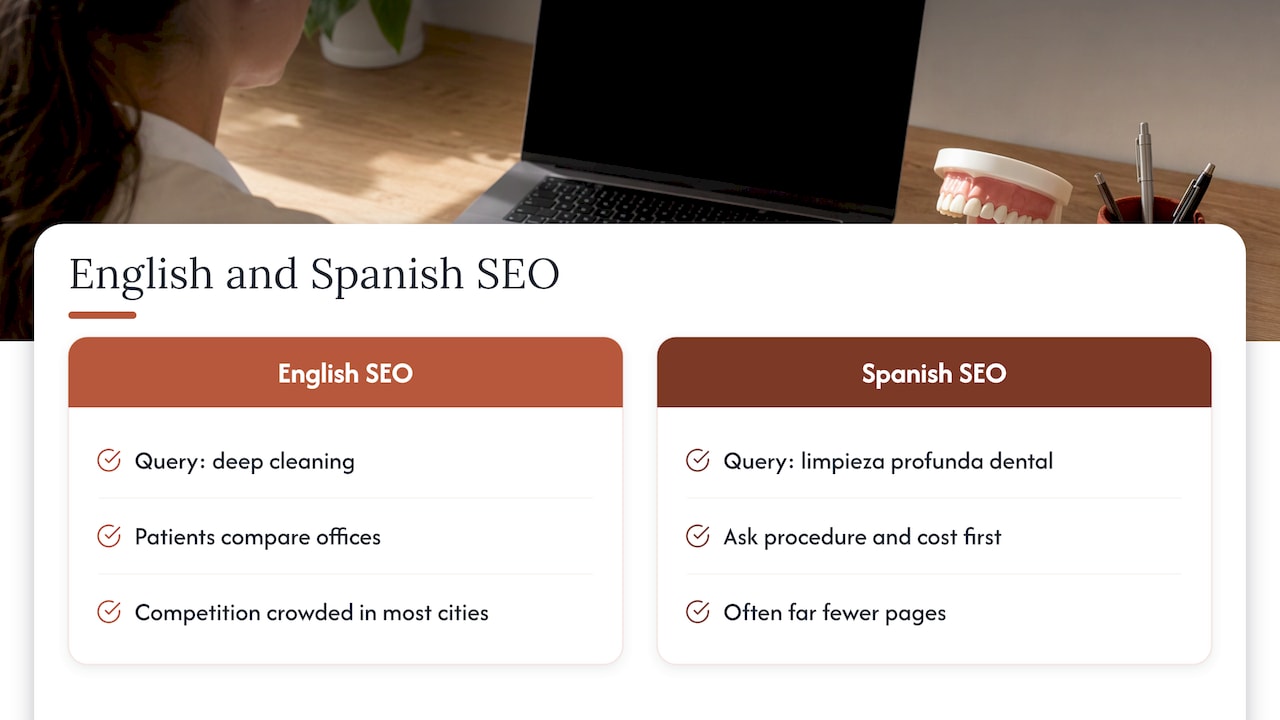
Search engines treat a query in Spanish as its own query. The results page for “limpieza profunda dental” is not the page for “deep cleaning”. Different sites rank, and the people searching often want something different. In English, patients tend to compare one office with another. In Spanish, a common first question is what a procedure involves and what it will cost. Your Spanish content needs to answer that question first.
There is also a competition angle. Dental SEO in English is crowded in most U.S. cities. In Spanish, many practices have either no Spanish pages or a machine-translated page that says little. A practice with well-written Spanish pages is often competing against far fewer pages.
If you want the broader picture before the details, our guide to healthcare Spanish SEO for U.S. practices covers the fundamentals across specialties.
What Spanish-speaking patients actually search for
Patients rarely search by treatment name alone. They combine a need, a place and often a worry about money. These are the patterns that show up again and again in Spanish dental searches:
| Intent | English query | Spanish query a patient types |
|---|---|---|
| Find care nearby | dentist near me | dentista cerca de mí |
| Language fit | Spanish-speaking dentist | dentista que habla español |
| Urgent need | emergency dentist near me | dentista de emergencia cerca de mí |
| Price research | dental implants cost | costo de implantes dentales |
| Cosmetic | teeth whitening | blanqueamiento dental |
| Children | pediatric dentist | dentista pediátrico |
| Coverage | dentist that accepts Medicaid | dentista que acepta Medicaid |
| Adults and braces | adult orthodontics | ortodoncia para adultos |
Two things stand out. First, a city or neighborhood often rides along: “implantes dentales” plus the town name, or a neighborhood name plus “dentista que habla español”. Second, insurance and payment questions come up much earlier than in English searches. A patient asking about Medicaid or a payment plan is close to booking.
The exact phrases vary by region and country of origin. A Mexican American family in Texas, a Cuban American family in Miami and a Puerto Rican family in Florida or Pennsylvania do not always choose the same words. Local wording matters, which is why a literal translation of an English keyword list tends to miss. Our article on Spanish dental keywords lists chairside terms and the website phrasing that goes with them.
How to research Spanish keywords for your own patients
You do not need an expensive tool to start. You need to listen to your own patients and check what Google already tells you.
- Read your front desk’s notes. What do Spanish-speaking callers ask in their first thirty seconds? Write down the exact words: “cuánto cuesta una corona”, “tienen plan de pagos”, “me duele una muela”. Those are your page topics.
- Use Google’s autocomplete. Type the start of a phrase in Spanish, such as “dentista que acepta” or “implantes dentales en”, and note the suggestions. They reflect what people really type.
- Open Google Search Console. Look at the queries that already earn impressions on your site. If some are in Spanish, you have a head start and a clear signal about where to build pages.
- Check the results yourself. Search your target phrase from a phone near your office. Who ranks? Are they Spanish pages, English pages, or directories? If no practice has a good Spanish page for that query, that is your opening.
- Group by intent. Sort phrases into urgent care, price questions, trust and language questions, and insurance. Each group suggests a different page.
For a fuller walkthrough, see our guide on Spanish keyword research for U.S. clinics.
The Spanish pages to publish first
Do not translate your whole site on day one. Start with the pages that match the most valuable searches and add from there. Our guide to publishing three Spanish dental pages follows the same logic.
1. A Spanish home page
It should say, in natural Spanish, who you are, where you are, which services you offer, and that your team speaks Spanish if it does. Put the phone number and a clear way to book near the top.
2. Service pages for high-intent treatments
Pick the two or three treatments that matter most to your revenue, often implants, orthodontics, emergency care or dentures. For each, answer what the treatment is, what the steps are, how long it takes, what affects the cost, and how patients can pay. Write for someone who has never had the procedure.
3. An insurance and payment page
If you accept Medicaid, a state program, a discount plan or in-house financing, say so in Spanish, with the specific names of plans. This page often attracts patients who are ready to call.
4. A contact and location page
Include your address, neighborhoods you serve, hours, parking or transit notes and a Spanish-language booking route. If patients message you on WhatsApp, say that here.
Technical basics
Use a separate URL path for the Spanish version, such as /es/, rather than a widget that swaps text in the browser. Add hreflang tags so Google knows which version to show to which user. Give each Spanish page its own title and meta description written in Spanish. Pages that exist only as a translation overlay cannot be indexed as separate pages.
Google Business Profile and Spanish reviews
For “dentista cerca de mí” searches, the map results often matter more than the organic listings. Google weighs relevance, distance and prominence, and reviews feed prominence.
A few practical moves:
- Add a Spanish description to your profile that mentions the neighborhoods you serve and your main services, written the way a neighbor would say it.
- State plainly that you offer care in Spanish, if you do.
- Make sure your name, address and phone number match across directories and your website.
- Reply to Spanish reviews in Spanish. It shows the reviewer and future readers that Spanish speakers are welcome, and it can signal relevance to Google.
- Ask happy Spanish-speaking patients for reviews in the language they are comfortable writing in. Never offer rewards for reviews.
Our walkthrough on optimizing your Google Business Profile in Spanish goes field by field, and the Spanish local SEO guide shows how the profile, citations and website fit together.
Write Spanish that patients trust
The fastest way to lose a Spanish-speaking patient is a page that reads like software wrote it. Machine translation can mistranslate clinical terms, produce stiff phrasing and tell the reader that Spanish was an afterthought.
Some guidelines:
- Start from the Spanish, not the English. Rewrite for a Spanish reader instead of converting sentences one by one. Terms for the same procedure can differ by region, so choose the one your patients use.
- Use plain words. Say “empaste” or “relleno” depending on your community, and explain the term once. Avoid heavy clinical language when a simple word works.
- Expect mixed language. 63% of U.S. Latinos say they use Spanglish at least sometimes, according to Pew Research Center. Your tone can be warm and conversational without being sloppy.
- Do not assume every Latino patient reads Spanish. The same Pew report finds that 75% of U.S. Latinos can carry on a conversation in Spanish, but proficiency declines across generations. A bilingual site that lets people switch language easily serves both groups.
- Have a fluent person review everything, ideally someone who knows dental vocabulary and your local community.
Our piece on Spanish clinic website content shows what well-written pages look like.
Perspective: why we built the front desk around language
Most practices come to us after the same experience. They paid for a Spanish page, or turned on a translation plugin, and the phone still did not ring from Spanish speakers. When we look at what happened, the page was usually the smaller problem. The bigger one is what happens after the search.
A patient finds you by typing “dentista que habla español”. If the website reads like a translation, they leave. If they call after hours and reach voicemail in English, they call the next office. If they prefer to send a WhatsApp message and you have no way to answer it, that is another lost patient. Visibility, first response and follow-up are one chain, and any weak link breaks it.
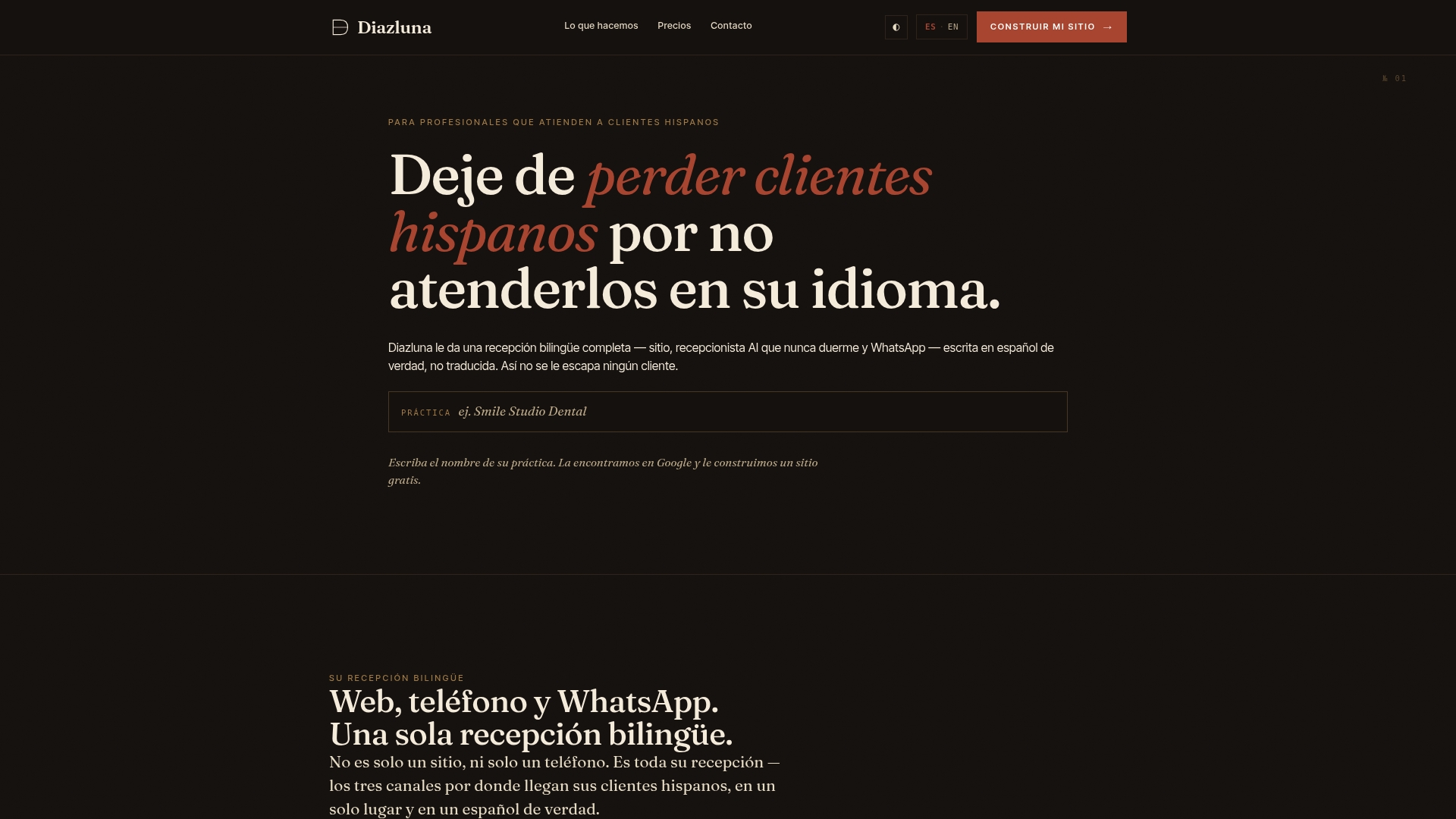
That is why we put the three pieces together: a bilingual website with Spanish content that is reviewed by people instead of simply translated, an AI receptionist that answers calls and messages in Spanish and English around the clock, and WhatsApp in the same flow. Our goal is that no Hispanic patient is lost to a language barrier, whatever the hour and whichever channel they choose.
We also think the owner should be able to edit the site without a developer. Your fees, your insurance plans and your hours change. The Spanish should change with them.
Francisco
Respect the rules: privacy and advertising
Spanish-language marketing falls under the same U.S. rules as English-language marketing. Two areas deserve attention.
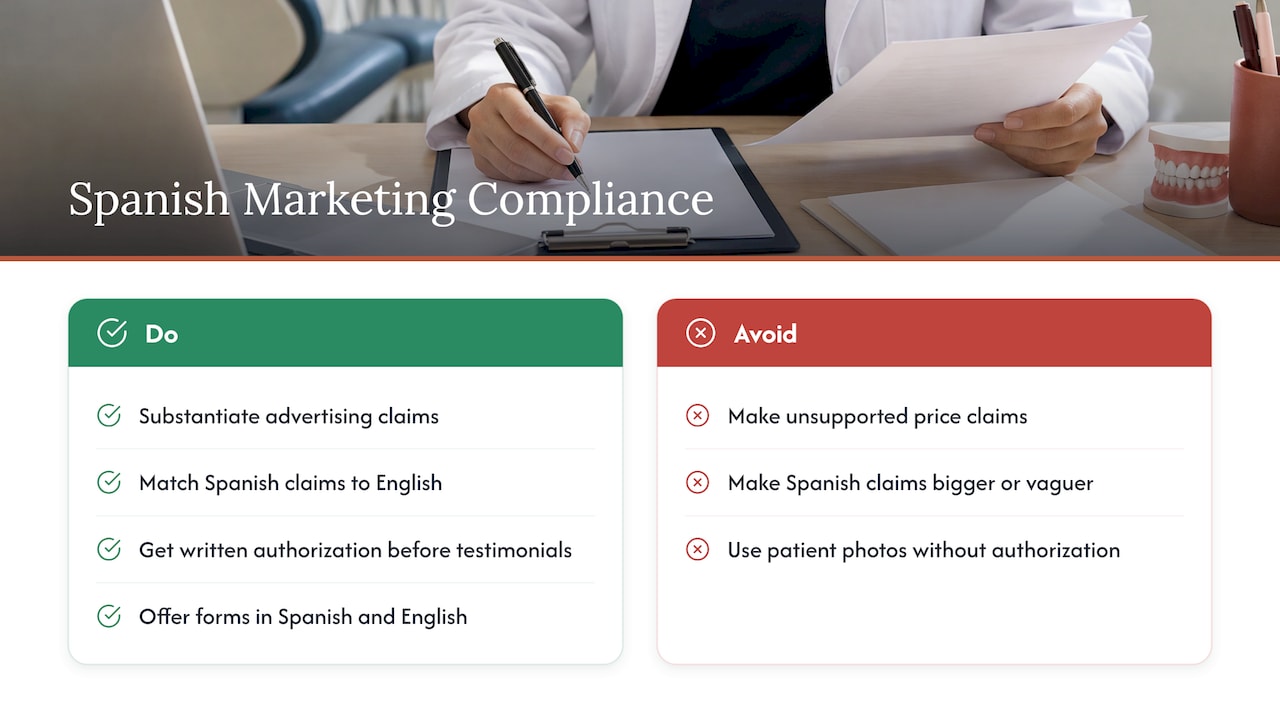
Advertising claims. According to the American Dental Association, FTC rules apply to dental advertising in every medium. Ads must be truthful and not deceptive, and you need evidence for your claims. A claim like “the lowest prices in town” needs a reliable survey of competitors’ prices behind it. Make sure your Spanish text makes the same claims as your English text, no bigger and no vaguer.
Patient photos and testimonials. Under the HIPAA Privacy Rule, using an identifiable patient’s photo or testimonial to promote your practice requires a signed written authorization first. Prepare the authorization form in Spanish as well as English, so patients understand what they are agreeing to. Your privacy counsel or compliance advisor should review it, and state rules may add requirements.
A good Spanish page does not need patient stories to work. Clear answers about treatments, costs and payment options are often more useful to the reader.
Measure whether it is working
Spanish SEO takes time to show, so decide upfront what you will look at each month.
- Google Business Profile: calls, direction requests, website clicks and booking clicks.
- Search Console: impressions and clicks for Spanish queries, and which /es/ pages receive them.
- Website analytics: organic visits to Spanish pages and the actions taken there, such as calls, forms and WhatsApp taps.
- Front desk log: ask callers how they found you, and note how many new patients are Spanish-speaking.
- Cost per booked appointment: divide what you spend on marketing by the appointments actually booked, not by clicks or leads. This shows whether the effort is paying for itself.
Write down a baseline before you start so you can compare after three and six months. For an example of how a dental practice reported its local SEO outcomes over time, see this dental SEO case study with results. If you want a month-by-month plan for a small clinic, our 30/60/90 day medical Spanish SEO plan lays one out.
A realistic first 30 days
- Week 1: collect the questions Spanish-speaking callers ask, check Search Console, and choose three treatments to cover.
- Week 2: write or commission the Spanish home page and the first service page, reviewed by a fluent person.
- Week 3: publish under /es/ with hreflang, add the insurance and contact pages, and update your Google Business Profile with a Spanish description.
- Week 4: start replying to Spanish reviews in Spanish, set up the monthly tracking sheet, and decide how after-hours calls and messages will be answered.
The last step is the one most practices skip, and it is the one where patients are most often lost. For a wider view of how the channels fit together, see our article on bilingual digital marketing strategies for practices.
What Diazluna offers dental practices
If you would rather not coordinate a website builder, a translator and an answering service, we put the bilingual front desk in one subscription. The site is set up for you, the Spanish is human-reviewed rather than machine-translated, and you can edit it yourself without technical skills.
Our plans, as published on our site:
| Plan | What it covers | Monthly | Yearly |
|---|---|---|---|
| Solo Sitio | Bilingual website | $99 per month | $990 per year |
| Sitio + María | Website plus 24/7 AI receptionist in Spanish and English | $199 per month | $1990 per year |
| Sitio + María Pro | Full-service managed package with site updates and expanded call capacity | $349 per month | $3490 per year |
There is a one-off activation fee of $399. See the plans and start on the Diazluna home page.
FAQ
How long does Spanish SEO take to work for a dental practice?
It depends on your city, your competition and how strong your existing site is. Because many markets have fewer well-written Spanish pages than English ones, early movement can come sooner than with English SEO, but plan to review results over several months. Track Spanish impressions in Search Console from the first week so you can see progress before the calls arrive.
Can I just use a translation plugin for my dental site?
A plugin that swaps text in the browser does not give Spanish pages their own URLs, so they are hard for Google to index as separate pages. It can also mistranslate clinical terms and sound unnatural to patients. Dedicated Spanish pages on their own paths, written or reviewed by a fluent person, serve both search engines and readers better.
Do I need Spanish-speaking staff to do Spanish SEO?
Your pages should only promise what your practice can deliver. If your team speaks Spanish, say so clearly on the site and on your Google profile. If not, plan how Spanish-speaking callers will be answered, since a patient who finds you in Spanish expects a reply in Spanish.
Which Spanish pages should I publish first?
Start with a Spanish home page, then one page for each of your two or three most valuable treatments, then an insurance and payment page and a contact page. Write each one around the questions patients ask most often, especially cost and coverage.
Is it legal to use patient testimonials in Spanish?
The language does not change the rule. You need the patient’s signed written authorization before using an identifiable photo or testimonial for marketing, and the form should be available in Spanish so patients understand it. Ask your compliance advisor to review your process.
Sources
- American Dental Association: Marketing and Advertising
- Pew Research Center: Latinos and Speaking Spanish report
- 15 datos sobre el perfil de los latinos en Estados Unidos