November 25, 2026
Bilingual Lead Routing: How to Get Every Spanish Inquiry
Bilingual lead routing is a set of rules that detects the language of each new inquiry, whether a call, form, chat or WhatsApp message, and sends it to someone who can answer in that language, with a deadline attached. For a dental office, law firm or clinic, the hard part is rarely the rule. It is the moments when nobody who speaks Spanish is available: lunch, after 5 p.m., a Saturday. We built Diazluna so that a Spanish-speaking prospect always meets a bilingual front desk first, and your staff then picks up a conversation that is already started, summarized and scheduled.
TL;DR
- Lead routing gives every inquiry one owner and one response deadline. Bilingual routing adds language as the first rule.
- Detect language from the channel itself: the page the person used, the language they wrote in, the number they called or the WhatsApp thread they opened.
- Always write a fallback for when the fluent person is out. Without one, the rule fails exactly when it matters.
- Measure speed to first reply, contact rate and booking rate for Spanish leads separately from English leads.
- An always-on bilingual front desk (site, AI receptionist and WhatsApp) covers the gaps that staffing schedules leave open.
Table of Contents
- What bilingual lead routing actually is
- Why a small practice feels this more than a big company
- Step 1: Detect the language of every inquiry
- Step 2: Write the routing rules, top to bottom
- Step 3: Build the fallback, because the fluent person will be away
- Step 4: Make the handoff clean
- Step 5: Keep the Spanish itself accurate
- Step 6: Measure Spanish leads on their own
- Where the website, the phone and WhatsApp fit together
- Our perspective
- Put it in place with Diazluna
- FAQ
- Sources
What bilingual lead routing actually is
A lead is anyone who reaches out about your services: a patient asking about a crown, a client asking about an immigration consultation, a parent asking about a pediatric visit. Lead routing is the set of rules that decides which person on your team gets each new lead and how fast they must respond. Rules can sort by service, town, availability, source or language.
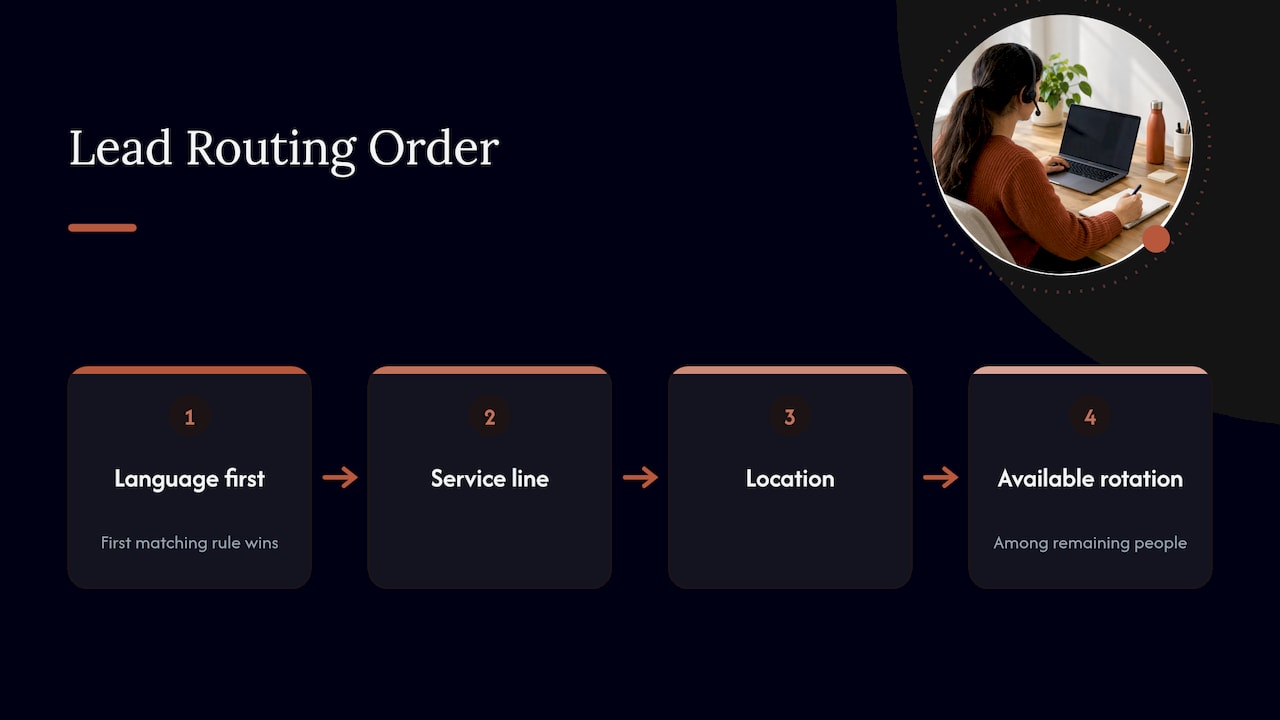
Bilingual routing simply puts language near the top of that list. A common order is language first, then service line, then location, then a rotation among whoever is left. The first rule that matches wins. A person who writes in Spanish never lands in an English-only queue where the reply will sit unread.
One glossary describes language as a mechanically simple but easily overlooked rule: if the owner of the lead cannot read the reply language, nothing else about the assignment matters. That is the whole case for bilingual routing in a sentence.
Why a small practice feels this more than a big company
A call center with 40 agents can staff a Spanish line. A practice with one bilingual hygienist, one bilingual paralegal or one bilingual medical assistant cannot. Routing by language then depends on a single person’s schedule, vacation and lunch break.
This is where leads leak. The Spanish-speaking caller reaches voicemail in English. The web form has no Spanish version, so the person leaves. The text message goes to a phone that only one employee checks. None of this feels like a decision to turn someone away, yet the result is the same.
The fix has two parts: rules that identify language correctly, and coverage that does not depend on one employee being at their desk. We take them in order.
Step 1: Detect the language of every inquiry
You rarely need to ask. Most channels already tell you.
| Channel | Where the language signal comes from | What to route on |
|---|---|---|
| Website form | Which version of the page the person submitted from (Spanish or English), plus a language field | Page language first, field second |
| Phone call | The greeting the caller chooses or the language they speak in the first sentence | Spoken language in the opening seconds |
| WhatsApp or text | The language of the first message | Message language |
| Chat widget | The page version and the first message | Both, with the message overriding |
| Ad or social DM | The language of the ad or post that triggered it | Campaign language |
Routing guides describe the same approach: language routing sends the lead to a rep who speaks the language the lead used, detected from the form, ad or message, and works best with a fallback for languages you do not support. Rules like these usually sit in your CRM or lead-capture tool and fire when a new lead is created.
Two practical details prevent most errors:
- Let the person’s own words win. If someone lands on your English page but writes in Spanish, route on the message, not the page.
- Store the preference. Once a lead is marked Spanish, every later reminder, confirmation and follow-up should go out in Spanish. A Spanish inquiry followed by an English appointment reminder undoes the first good impression.
Step 2: Write the routing rules, top to bottom
Keep the stack short enough that anyone in the office can read it. A workable order for a practice:
- Urgent? Anything that mentions pain, a deadline, a detention, a court date or a medical emergency goes to a human immediately, in the right language.
- Language. Spanish goes to the Spanish path, English to the English path.
- Service. Within each language, route by what they asked for: new patient, consultation, billing, existing case.
- Location. If you have more than one office, send to the nearest.
- Availability. If the assigned person is out, move to the next person, then to the fallback.
Give each path one owner and one clock. “Everyone sees it” means no one owns it. Decide in minutes, not hours, how long a Spanish lead can wait before it escalates.
Worked example: a three-dentist office
A Saturday at 7 p.m., a woman visits the Spanish page and writes that her son has a swollen cheek. Rule 1 flags urgency. Rule 2 marks Spanish. The system replies in Spanish right away, collects the child’s age and symptoms, offers the first open appointment, and alerts the on-call dentist with a short summary. The dentist does not need to start from zero or translate anything.
Without those rules, the same message sits in a shared inbox until Monday, and by then the family has called another office.
Step 3: Build the fallback, because the fluent person will be away
Most routing failures happen at the fallback, not the rule. Plan for these situations:
- The bilingual employee is on another call. Queue the lead and send an immediate acknowledgment in Spanish with an honest expected callback time.
- After hours and weekends. Capture the need, the contact details and the preferred language, and book or hold an appointment slot.
- Holidays and sick days. Name a backup, and make sure the backup is also bilingual or that the first response does not depend on them.
- A language you do not cover. Reply politely in English or Spanish, whichever is closest, and flag it for a human.
The point of a fallback is that the lead always receives a first answer in their own language, even when the human conversation comes later. For deeper work on follow-up once someone has replied, this explainer on lead nurturing strategies that raise conversions covers how language-matched responses and faster follow-up fit together.
Step 4: Make the handoff clean
A good handoff means the staff member who takes over never asks the person to repeat themselves. Every handoff should carry:
- The person’s name, phone number and preferred language.
- What they asked, in two or three lines.
- What has already been answered or scheduled.
- The urgency level.
- The channel they used, so the follow-up goes back through the same one.
This matters more in Spanish-speaking households, where WhatsApp is often the first and preferred channel. Moving someone from WhatsApp to a web form or an English voicemail tree adds steps and drops people.
One academic field study of a call center found that callers using natural-language routing more often reached a specific destination and the correct agent than callers using touch-tone menus. The lesson for a small practice is simple: let people say what they need in their own words instead of making them press a number for Spanish and hope.
Step 5: Keep the Spanish itself accurate
Routing gets the lead to the right place. The reply still has to sound like a person who knows the community. A machine-translated message with stiff phrasing or the wrong register can signal that the Spanish line is an afterthought.
A few habits help:
- Write key pages and templates in Spanish from the start, rather than translating English line by line.
- Have a native speaker review appointment reminders, intake language and service descriptions.
- Match formality to the audience. Usted is the safe default for first contact in a professional setting.
- Use the terms your clients use. Dental, legal and medical vocabulary varies by region and family background.
Our own approach rests on human-reviewed Spanish, not translated text, which is why we wrote about why Spanish tone matters for client retention.
Step 6: Measure Spanish leads on their own
If Spanish and English leads sit in one number, a problem in one hides behind the other. Track these separately:
| Measure | What it tells you | How to read it |
|---|---|---|
| Time to first reply | Whether the routing rule and fallback work | Compare Spanish with English, after hours included |
| Contact rate | How many leads you actually reached | A gap means leads are dropping before a human talks to them |
| Booking rate | How many became appointments or consultations | A gap points to tone, follow-up or scheduling friction |
| Abandoned calls and unanswered messages | Where the fallback is failing | Look at time of day and day of week |
| Source by language | Which channels bring Spanish speakers | Shift effort toward what works |
The measures only work if you can tell Spanish callers apart in the first place. We walk through that in tracking Spanish callers in four weeks. Review the numbers monthly, and change one rule at a time so you can see what moved the result.
Where the website, the phone and WhatsApp fit together
Routing is easier when every channel feeds the same place. A Spanish page, a phone line and a WhatsApp number that all lead into one inbox with one language tag give you one set of rules instead of three.
For law firms, the same logic applies to intake: the first conversation often decides whether a person hires you. Our guides on the Spanish legal digital front desk and on a bilingual law firm website go further. For a broader view of the options, see types of bilingual support services for professionals.
Our perspective
Most practices think of bilingual routing as a staffing problem: hire another bilingual person. But a person can only be in one place at a time, and Spanish-speaking clients write at night, on weekends and on their phones.
We think the first answer should never depend on someone’s schedule. That is why we put three things together: a bilingual website, a 24/7 receptionist that speaks Spanish and English, and WhatsApp. The receptionist handles calls, messages and appointment scheduling, sends your team a real-time summary, and transfers urgent cases to a person.
The Spanish is human-reviewed, not machine-translated, because tone is part of trust. And you can edit your site yourself without technical skills.
Routing rules matter, but the best rule is the one that means no Spanish-speaking client waits for a reply.
Francisco
Put it in place with Diazluna
Diazluna combines the pieces this article describes: a bilingual Spanish and English website, a 24/7 AI receptionist that manages calls, messages and scheduling, and WhatsApp integration. Setup of the site is free, and there is a one-time activation fee of $399.
Three plans are published:
- Solo Sitio: $99 per month or $990 per year, for the bilingual website.
- Sitio + María: $199 per month or $1,990 per year, which adds the AI receptionist.
- Sitio + María Pro: $349 per month or $3,490 per year, the full-service managed package with site updates and expanded call capacity.
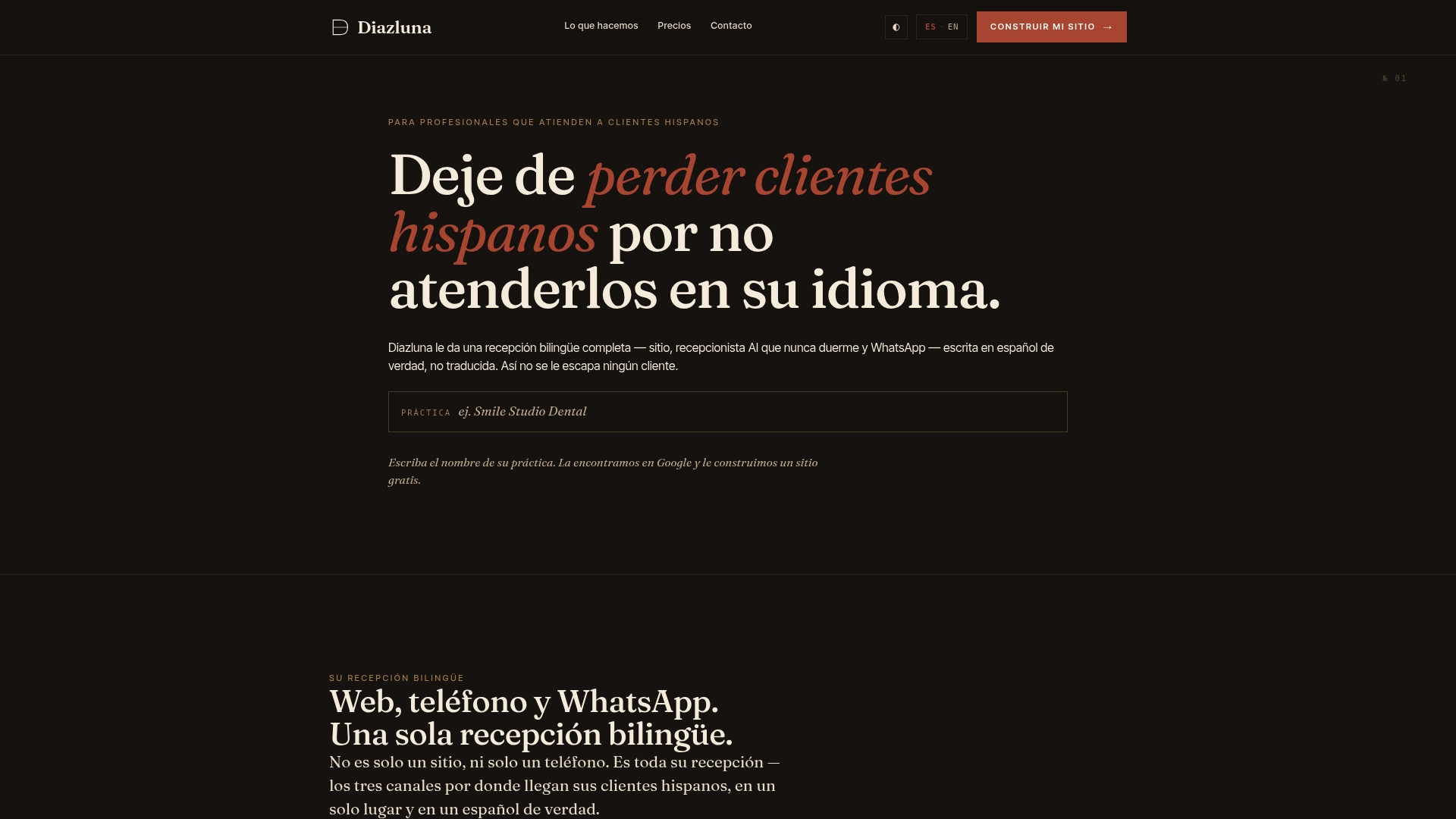
See the plans on the Diazluna home page, or, if you run a law firm, the page for firms with Spanish-speaking clients.
FAQ
What is the difference between lead routing and bilingual lead routing?
Lead routing assigns each new inquiry to one person with a response deadline. Bilingual lead routing makes language the first rule, so a Spanish-speaking lead goes to someone who can answer in Spanish. It also needs a fallback for the times that person is not available.
How do I know if a lead prefers Spanish?
Use the signals already in front of you: the language of the page they used, the language of their first message or call, and the channel, such as WhatsApp. If they conflict, follow what the person actually wrote or said. Save the preference so every later message matches.
What should happen after hours?
The lead should still get a first reply in their language, with their details captured and an appointment held or booked. Urgent cases should reach a human right away. A 24/7 bilingual receptionist is built for exactly this gap.
Which numbers show that routing is working?
Track time to first reply, contact rate and booking rate for Spanish leads separately from English leads. A gap between the two groups shows where to fix a rule, a fallback or the tone of your Spanish.
Sources
- Lead Routing Explained, AB Marketing Group
- Lead Routing: The Rules That Decide Who Owns an Inbound Lead, RevenueFlow glossary
- Lead Routing: Rules, Round Robin, and How to Get Every Lead, Inflowave
- A Comparative Study of Speech in the Call Center: Natural Language Call Routing vs. Touch-Tone Menus, ACM