November 2, 2026
Bilingual Call Tracking: How to Measure Spanish Calls
Bilingual call tracking is standard call tracking with one addition: every call is tagged with the language the caller spoke, so you can see which ads, pages and keywords bring in Spanish-speaking callers and what happened once they phoned. It matters because a practice that only counts “calls” can’t tell whether its Spanish marketing works, or whether Spanish callers reach someone who can help them.
This guide is for dentists, law firms, clinics and other practices that market to Hispanic clients in the US. It covers how attribution works, how language gets captured, which metrics are worth watching, and the privacy points to settle before you turn on transcripts.
TL;DR
- Bilingual call tracking links each phone call to its source (ad, campaign, keyword, page) and also records the caller’s language.
- Language can come from the number dialed, the landing page the caller visited, or a choice the caller makes on the call.
- Track Spanish and English calls as separate segments: volume, answer rate, booked appointments and missed calls.
- Check how your tool handles redaction in Spanish before storing transcripts, because support is not always the same across languages.
- Tracking tells you where Spanish callers come from. Someone still has to answer them in Spanish, at any hour, or the data only documents lost leads.
Table of Contents
- What bilingual call tracking actually is
- How calls get attributed to ads, campaigns and keywords
- How Spanish-speaking callers are identified and routed
- What you can track once language is tagged
- Privacy, consent and sensitive information
- Tracking is not the same as answering
- How to set up bilingual call tracking in five steps
- Where Diazluna fits
- FAQ
- Sources
What bilingual call tracking actually is
Call tracking ties an advertising source to a phone call by using unique phone numbers. CTM’s glossary also describes dynamic number insertion (DNI), where the number shown on your website switches to match a visitor’s source, location or another trigger.
The “bilingual” part adds a second question to the usual “which ad made this call?”. The new question is “in which language did this person want to be helped?” A practice can then compare Spanish-language campaigns with English ones, see whether the Spanish page generates calls, and find out whether those calls turn into booked visits.
There are three practical differences from standard call tracking:
- Language is a data field. Each call carries a language tag you can filter and report on.
- Transcripts and analysis must work in Spanish. Keyword and phrase rules written in English miss what a Spanish caller says.
- Routing depends on language. The caller who needs Spanish should never wait in an English-only queue.
The search results for this topic are mostly general call tracking guides and agency tools. Very few explain what changes when half your callers speak Spanish, which is where the useful detail sits.
How calls get attributed to ads, campaigns and keywords
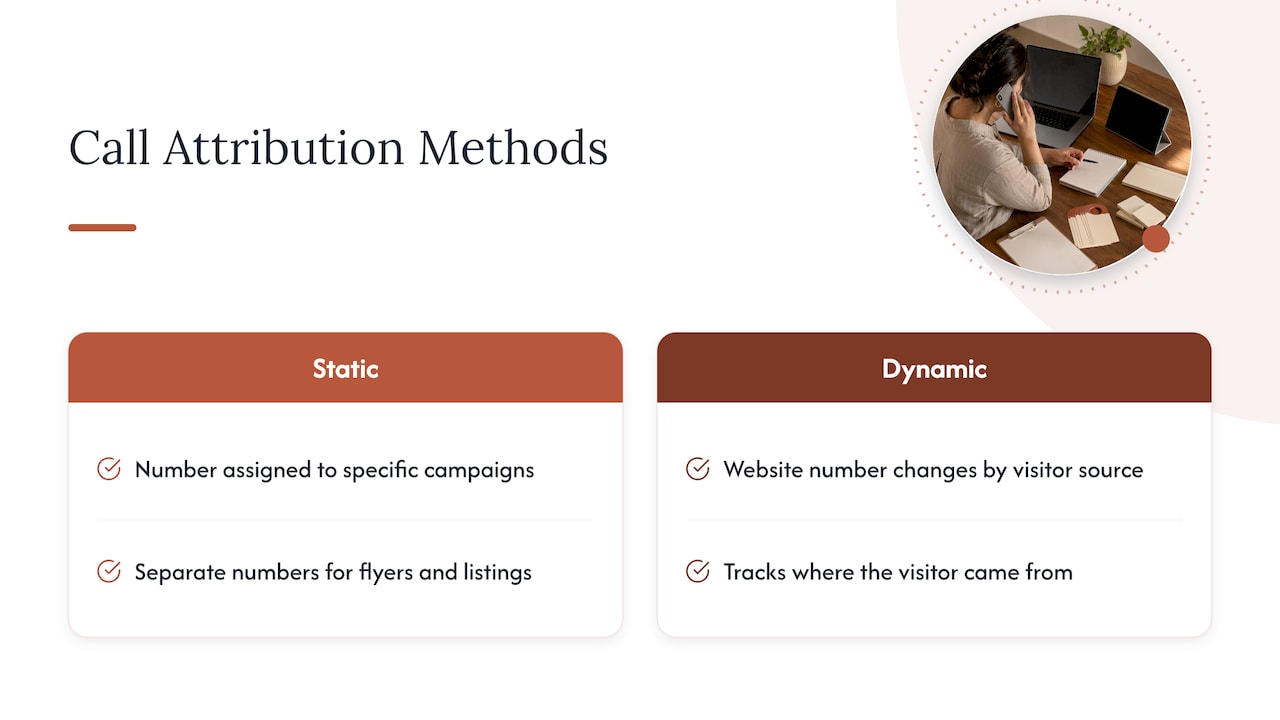
Attribution can use two approaches. Static numbers are assigned to specific advertising campaigns, such as one number on a flyer and another in a Google Business listing. Dynamic tracking swaps the number on your website depending on where the visitor came from. According to Versadial’s explanation, session-based tracking can collect source, keyword, landing page, device, location and campaign data.
Tracking depth comes in levels. Infinity’s US guide separates basic, campaign-level, session-level and visitor-level tracking, and notes that visitor-level tracking can capture sources, keywords and channels across several visits before the call. That helps with legal and dental services, where a person often researches for days before phoning.
What this looks like for a Spanish-language campaign
Suppose a dental practice runs a Spanish-language search campaign and a Spanish landing page. With a dedicated tracking number on that page, every call from it is clearly tied to the Spanish campaign. If the same practice also runs English ads, those calls land on a different number or get different session data. The two result sets can be compared on cost per call, cost per booked appointment and missed-call rate.
Without that separation, the Spanish campaign gets judged on blended numbers. It looks weak when the real problem is that Spanish callers hit voicemail at 7 p.m.
Connecting calls to Google Ads
If you buy Google Ads, calls can be measured as conversions. Google’s call measurement guide says to use imported call conversions when another system records when calls lead to sales or other conversions. Google also explains that calls can count as conversions based on a minimum duration or, when recording is on, AI analysis of recordings to identify high-quality leads.
There is more detail on the data side. Per Google’s call-details forwarding page, calls routed through a Google forwarding number can pass campaign, ad-group and click-ID information in SIP headers. That page also states the GCLID supplied with a call can support real-time lead scoring, advanced routing and offline conversion import, and that call-details data is shared only with the call-analytics provider whose tracking number was used.
For a small practice, the takeaway is simple. Tell your ads platform which calls became appointments, not just which calls lasted 60 seconds. A 90-second call in which a caller couldn’t be understood is not a lead.
Turning attribution into decisions
Attribution data only pays off when it changes budgets and follow-up. If you want a framework for how marketing sources connect to lead handling, these lead attribution models show how to match a model to the data you really have. Most single-location practices don’t have enough volume for complex multi-touch models, so start with last-click by language and add detail once the numbers justify it.
How Spanish-speaking callers are identified and routed
There are three common ways a system learns a caller’s language.
| Signal | How it works | Best for |
|---|---|---|
| Number dialed | A dedicated Spanish number routes straight to Spanish handling | Print, billboards, radio, Spanish-language listings |
| Landing page data | The page passes language through a URL parameter, cookie or JavaScript data layer | Website visitors who click to call |
| Caller’s choice | The caller picks a language in a menu or says it at the start | Shared numbers, walk-in referrals |
Invoca’s documentation confirms the second and third routes: call language can be captured automatically from landing page data or manually indicated by the caller, and a landing page can pass language through a URL parameter, cookie or data layer.
Routing is the second half. When language is known from CRM context, the dialed number or an IVR step, Retell’s multilingual agent documentation recommends routing callers to a single-language agent. Its multilingual agents detect selected languages and respond in the chosen one with matching pronunciation.
The same page carries a caution worth heeding. Multilingual speech recognition is less accurate per language than single-language models, so the documentation recommends selecting the smallest necessary language set. For a practice, that means Spanish and English only. Don’t switch on ten languages because the tool offers them.
Setting the language signal on your website
The landing page approach only works when your site declares its language clearly. Each Spanish page should be a real Spanish page, with proper language attributes and alternate-language links between versions. If you maintain the site yourself or with a developer, automating hreflang tags keeps those language signals consistent as pages change. Our own walkthrough on bilingual website navigation with the lang attribute covers the same ground for practice sites.
What you can track once language is tagged
Language tagging unlocks reports you can’t build from a standard call log. Invoca documents multilingual call analysis in English, Spanish and French, tagging each call’s language and applying language-aware analysis rules. It can also combine insights across languages, so that “sales” in English and its Spanish equivalent roll into one report, and rule-based phrase matching can spot Spanish phrases like “jueves” when a caller asks about Thursday.
For a practice, a useful dashboard answers these questions, split by language:
- Call volume by source. Which campaigns and pages generate Spanish calls?
- Answer rate. What share of Spanish calls were picked up by a person or system that could help?
- After-hours calls. How many came in when the office was closed?
- Booked appointments or consultations. The metric that pays the bills.
- Call duration and outcome. Did the caller get an answer, book, or hang up?
- Urgent calls. Pain, an arrest, a detention, an accident: which ones needed a human right away?
- Follow-up completed. Did someone get back to callers who left a message?
Transcripts add detail. NICE CXone’s documentation says analytics policies can select the transcription language, redaction rules and analytics services based on interaction and agent metadata, and that Spanish is among the supported transcription languages.
A worked example
A law firm spends money on a Spanish-language ad for immigration consultations. Over a month the ad produces 40 calls. The tracking report shows 18 arrived outside office hours, and 11 of those hung up at voicemail. Without language and time-of-day data, the ad looks like an expensive campaign with a poor close rate. With it, the problem is clearly coverage, and the fix is answering after hours, not changing the ad. The numbers here are illustrative, to show how to read a report.
For more on closing the loop after the call, see our guide to bilingual client follow-up.
Privacy, consent and sensitive information
Dental, medical and legal calls contain sensitive details: symptoms, case facts, immigration status, payment information. Treat privacy as part of setup, not a later cleanup.
Three points to settle first:
- Language handling and privacy controls belong together. NICE CXone’s policy model treats transcription, redaction and analytics as configurable scopes, and it says to make sure interactions meant for analysis are covered by a policy. The practical reading is to decide on redaction at the same time you decide on transcription language.
- Check redaction in Spanish specifically. Invoca’s foreign-language transcript guide lists English, French and Spanish campaign language settings and states that redaction for foreign-language transcripts is currently unsupported. A Spanish transcript may therefore be available for analysis while automated masking of card numbers or health details is not. Ask any provider exactly what is masked in Spanish, and test it with a sample call.
- Recording consent varies by state. Some states require every party on a call to agree to recording, so a short spoken notice at the start of the call is common practice. Practices that handle health information should also have their compliance officer or attorney review recording, storage and retention. Healthcare practices in particular should confirm how call data is covered by their HIPAA obligations, and law firms should consult their state bar’s guidance on client confidentiality.
Also keep your own data minimal. If you only need the language, source and outcome of a call, you may not need to store full audio for years.
Tracking is not the same as answering
Here is the gap most call tracking guides skip. Tracking reports what happened. It does not pick up the phone. If your Spanish campaign works, the tracking report will show you exactly how many Spanish callers reached a front desk that couldn’t help them.
Practices usually close this gap in one of four ways:
- A bilingual staff member at the front desk, which works during office hours but not after them.
- An answering service with Spanish-speaking operators, which costs per minute and varies in healthcare and legal knowledge.
- A call-forwarding setup to a bilingual owner or associate, which doesn’t scale.
- A bilingual AI receptionist that answers around the clock in both languages.
Our view on how these compare is in types of bilingual support services for professionals and bilingual AI receptionist advantages for service firms.
Perspective
We built Diazluna around one observation: a Hispanic client who can’t get a Spanish answer doesn’t complain, they call the next practice. Counting those calls is useful, but counting is the easy part.
That is why we don’t treat tracking as a separate product. A bilingual website brings the Spanish-speaking visitor in, a Spanish-fluent receptionist answers the phone and WhatsApp at any hour, and the practice gets a summary of each conversation, with urgent cases transferred to a person. When the same system holds the site, the call and the message, the language is known from the first click, and nobody has to stitch three vendors together.
We also insist on Spanish that people review, not Spanish that is machine-translated and left alone. Callers notice the difference within a sentence, and so do their families.
Francisco
How to set up bilingual call tracking in five steps
- Define what a good Spanish call is. For a dentist, it might be a new-patient booking. For a law firm, a scheduled consultation.
- Give Spanish its own entry points. A Spanish landing page with its own tracked number or language parameter, Spanish ad groups, and a Spanish version of your Google Business listing details.
- Choose the language signal. Dedicated number, landing page data, caller menu, or a combination. Keep the language set to Spanish and English only.
- Decide the privacy rules. Recording notice, redaction in Spanish, retention period, who can listen to calls.
- Review weekly for the first month. Look at answer rate, after-hours calls and bookings by language, then adjust budget and coverage.
If you want a fuller walkthrough of the first weeks, read how practices can track Spanish callers in four weeks. For the wider marketing picture, see bilingual digital marketing strategies for practices.
The website matters here too. Industry-specific guides cover the details for a bilingual law firm website and bilingual medical websites for clinics, and the broader case is in what a bilingual business website means for growth.
Where Diazluna fits
Diazluna is a bilingual digital front desk for practices that serve Hispanic clients: a bilingual website in Spanish and English, an AI receptionist that handles calls, messages and appointment scheduling around the clock, and WhatsApp integration. Each conversation comes with a real-time summary, and urgent cases are transferred. Site setup is free to start, and the pricing is published:
| Plan | Monthly | Yearly |
|---|---|---|
| Solo Sitio (website only) | $99 per month | $990 per year |
| Sitio + María (website plus AI receptionist) | $199 per month | $1,990 per year |
| Sitio + María Pro (managed, expanded call capacity) | $349 per month | $3,490 per year |
There is a one-off activation fee of $399. You can see the full plans on the Diazluna site, and dentists can go straight to the bilingual front desk for dentists.
If you already run a call tracking tool, the two work side by side: your tracking shows where Spanish demand comes from, and the front desk makes sure each of those callers is answered.
FAQ
Is bilingual call tracking a separate product from regular call tracking?
Usually not. It is regular call tracking configured to capture and report caller language, with transcription and analysis rules that work in Spanish. Check that your provider supports Spanish transcripts and ask what is and isn’t covered, such as redaction.
Do I need a separate phone number for Spanish callers?
Not always. A dedicated number is the simplest signal, especially for print and radio. For website traffic, a landing page can pass language data to the tracking tool, or the caller can choose a language at the start of the call.
Can I record Spanish calls without breaking the law?
Rules differ by state, and some require every party to consent to recording. A spoken notice at the start of the call is common practice. Have your attorney or compliance officer confirm what applies to your state and profession, especially for health or legal conversations.
What should I measure first?
Start with answer rate and booked appointments by language, plus after-hours calls. Those three show quickly whether your Spanish marketing is wasted on missed calls or on weak offers.
Does call tracking help if I only get a few Spanish calls?
Yes, but keep it simple. With low volume, a language tag and a source per call are enough to see patterns. A weekly review of a short call list often teaches more than a complex attribution model.
Sources
- The Complete Call Tracking Glossary, CTM
- What is Call Tracking Software and how does it work?, Versadial
- Call tracking: What is it and why should marketers be using it, Infinity
- Measure calls from ads, Google Ads Help
- About call details forwarding for call ads, Google Ads Help
- Configure a multilingual agent, Retell AI
- Capture Signal Insights: Multi-Language Support, Invoca
- Transcripts: Foreign Language Support Guide, Invoca
- Analytics Policies, NICE CXone