October 30, 2026
Language Access Plan for Healthcare: How to Build One

A healthcare language access plan is a written document that says how your practice gives patients with limited English proficiency (LEP) real access to care: who interprets, what gets translated, how patients are told help is free, and how you check that it works. The CMS guide to developing a plan describes it as a way to document how an organization serves people who are non-English speaking or have LEP. This article walks a small or mid-size practice through building one, step by step.
TL;DR
- A plan is not automatically required by law, but the duty to give meaningful language access is, if you receive federal financial assistance. A written plan is the clearest proof you meet it.
- Start by counting your LEP patients and mapping where they meet your practice: phone, website, front desk, exam room, billing, follow-up.
- Use qualified interpreters and translators. Do not rely on family members, minors or untrained staff.
- Post notices of language assistance on your website and in your office, and cover every channel, including texts and online forms.
- Train staff, assign an owner, and review the plan on a schedule with real data.
Table of Contents
- What a language access plan is and why it matters
- Is a language access plan required?
- Step 1: Assess who your patients are
- Step 2: Decide what the plan includes
- Step 3: Set your interpretation and translation standards
- Step 4: Cover the channels patients use before the visit
- Our perspective: a plan lives or dies at the front desk
- Step 5: Train staff and put the plan to work
- Step 6: Evaluate and update
- Common mistakes that create risk
- Where Diazluna fits
- FAQ
- Sources
What a language access plan is and why it matters
The plan answers a simple question: when a patient does not speak English well, what exactly happens at each step of their visit? Without an answer written down, the result depends on who picks up the phone that day.
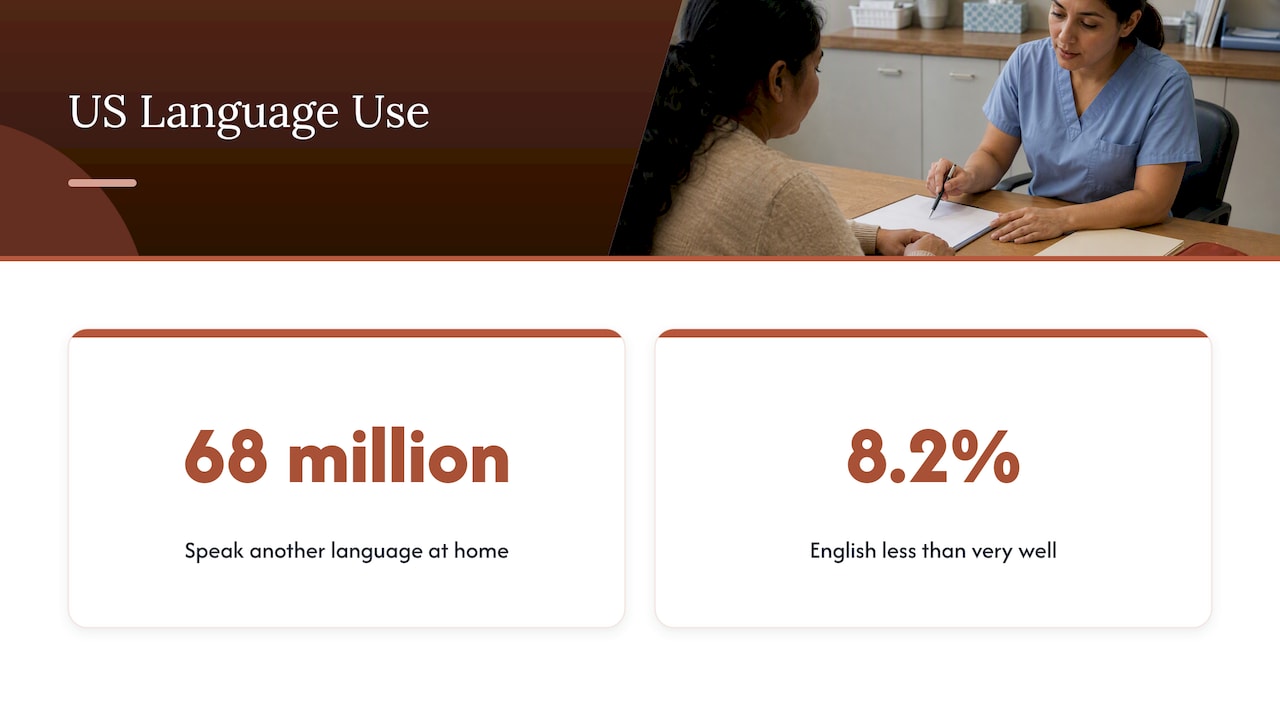
The scale is large. Roughly 68 million people in the United States speak a language other than English at home, and 8.2% of them speak English less than very well, according to the HHS Language Access Plan. For a practice in a Hispanic-majority neighborhood, that is not an edge case. It is a large share of your schedule.
The stakes are clinical and legal. CMS notes that without appropriate interpretation and translation, communication barriers can lead to liability tied to poor health outcomes, lower patient satisfaction and violations of federal anti-discrimination law. CMS also reports that language barriers are associated with lower quality of care, poor clinical outcomes, longer hospital stays and higher readmission rates.
There is a trust side too. HHS calls language access a fundamental part of building trust between provider and patient. A patient who cannot ask a question about a medication will not tell you they are skipping doses.
Is a language access plan required?
The plan itself is not mandated by law. Professional guidance puts it plainly: language access plans are not required, but they help organizations structure language services. The underlying duty is another matter.
Who has to provide language assistance
Recipients of HHS federal financial assistance, including hospitals, nursing homes, physicians and other providers, must take reasonable steps under Title VI and HHS regulations to give people with LEP meaningful access. If you accept Medicaid or Medicare payments, assume you are covered unless counsel tells you otherwise.
Under Section 1557, covered entities must provide language assistance services free of charge. Charging a patient for an interpreter, or asking them to bring their own, is the kind of practice the rule is aimed at.
What “reasonable steps” means for a small practice
The obligation is fact-dependent. HHS balances the number or proportion of LEP people you encounter, how often they contact you, the nature and importance of the service, and your resources and costs. A rural family practice with one Spanish-speaking patient a month needs a lighter setup than a dental group where a third of patients speak Spanish. The Section 1557 rule also treats its standards as flexible and context-specific, and one factor it weighs is whether an effective language access plan has been implemented.
That last point is why we recommend a written plan even where it is optional. It shows that your choices were deliberate. For your specific obligations, ask a health care attorney or your compliance officer.
Step 1: Assess who your patients are
Start with data, not assumptions. CMS advises identifying how many LEP individuals you serve, where they interact with your organization and how. For a practice, that turns into a short worksheet:
- Languages. Pull the preferred language field from your scheduling or records system. If you do not collect it, add it to intake now.
- Volume. Count patients and visits by language over the last 12 months.
- Touchpoints. List every point of contact: first call, online booking, reminder texts, check-in, exam room, consent forms, billing, prescriptions, discharge instructions, follow-up calls.
- Current practice. Note who interprets today. Bilingual staff, a phone line, a patient’s relative? Be honest.
- Gaps. Mark every touchpoint where a Spanish speaker currently gets a worse experience than an English speaker. After-hours calls and web forms are common ones.
This audit usually surprises owners. The exam room is often covered, while the website, voicemail and billing statements are English only.
Step 2: Decide what the plan includes
CMS says a plan may include a needs assessment, language services, notices, staff training, evaluation, policies and procedures, and stakeholder engagement. For a small practice, here is a workable layout:
| Plan section | What to write down | Typical owner |
|---|---|---|
| Needs assessment | Languages, volumes, touchpoints, gaps | Practice manager |
| Interpretation | How staff request an interpreter, by phone, video or on site; who qualifies | Practice manager |
| Translation | Which documents are translated, who translates, who reviews | Compliance lead |
| Notices | Where the language assistance notice appears | Front desk and web team |
| Staff training | Onboarding and yearly refreshers | Practice manager |
| Complaints | How a patient reports a language problem | Compliance lead |
| Evaluation | What you measure and how often | Practice owner |
Notices of language assistance
This is the most concrete requirement. Under 45 CFR 92.11, covered entities must give notice of language assistance in English and at least the 15 most commonly spoken LEP languages in the relevant state or states. The notice must be posted conspicuously on your website and in physical locations, and included in specified communications such as intake and consent forms. Read the regulation text itself and check it against your state’s language list.
For a deeper look at how the rule’s policy deadlines affected practices, see our piece on Section 1557 language access policies.
Step 3: Set your interpretation and translation standards
The rule is direct: covered entities must provide language assistance that is free, accurate, timely and protective of privacy, with qualified interpreters and qualified translators. Interpretation can happen remotely or on site, so a phone or video service is a legitimate option for a small office.
Who counts as qualified
The national CLAS standards tell organizations to ensure the competence of people providing language assistance through training and certification when available, and to avoid untrained individuals and minors as interpreters. In your plan, define “qualified” in writing. A bilingual receptionist is not automatically a qualified medical interpreter. If you want a staff member to interpret clinically, document how you assessed their skills and train them on medical terminology and ethics.
Treatment and consent conversations
These carry the most risk. Interpreters must convey information so that patients understand the consequences of consenting to or rejecting a proposed treatment. Write a rule that consent, informed refusal and anything involving procedures goes through a qualified interpreter and a translated form, with the interpreter’s use noted in the chart. Our guide to Spanish telemedicine consent chart items shows what to record for remote visits.
Written materials
Decide which documents are vital for your practice: intake and consent forms, privacy notices, financial policies, medication instructions, discharge papers. Translate those first, and have a qualified translator or reviewer, not a machine alone, sign off on them. We cover the clinical side in Spanish discharge instructions setup.
Keeping it private
Interpreting and translating vendors handle protected health information, so your plan should name how you vet them, including business associate agreements and security. A guide to the HIPAA Security Rule requirements is a good reference when you review any tool that touches patient conversations.
Step 4: Cover the channels patients use before the visit
Most plans stop at the exam room. Patients, though, meet your practice first on Google, on your website and on the phone. A Spanish-speaking patient who cannot book online or leaves a voicemail no one understands may never become a patient, and your plan never gets a chance to work.
Add these items to the plan:
- Website. Spanish pages written for Spanish readers, not machine-translated, with the language assistance notice visible. See bilingual medical websites for clinics and the advantages of a bilingual healthcare website.
- Forms. Contact and intake forms in both languages that work with screen readers. Our bilingual contact form examples show the structure.
- Phone and after hours. A defined path for Spanish callers at 7 p.m. as well as 10 a.m.
- Text messaging. Consent to text in the patient’s language, covered in Spanish texting consent elements.
- Accessibility. Language and disability access often overlap. See multilingual ADA steps.
Our perspective: a plan lives or dies at the front desk
We build bilingual front desks for dentists, lawyers and medical practices, so we see the same pattern again and again. A practice has a good interpreter policy on paper and a front door that still speaks only English. The Spanish-speaking caller reaches voicemail, the website offers a machine-translated page, and the patient calls the next office.
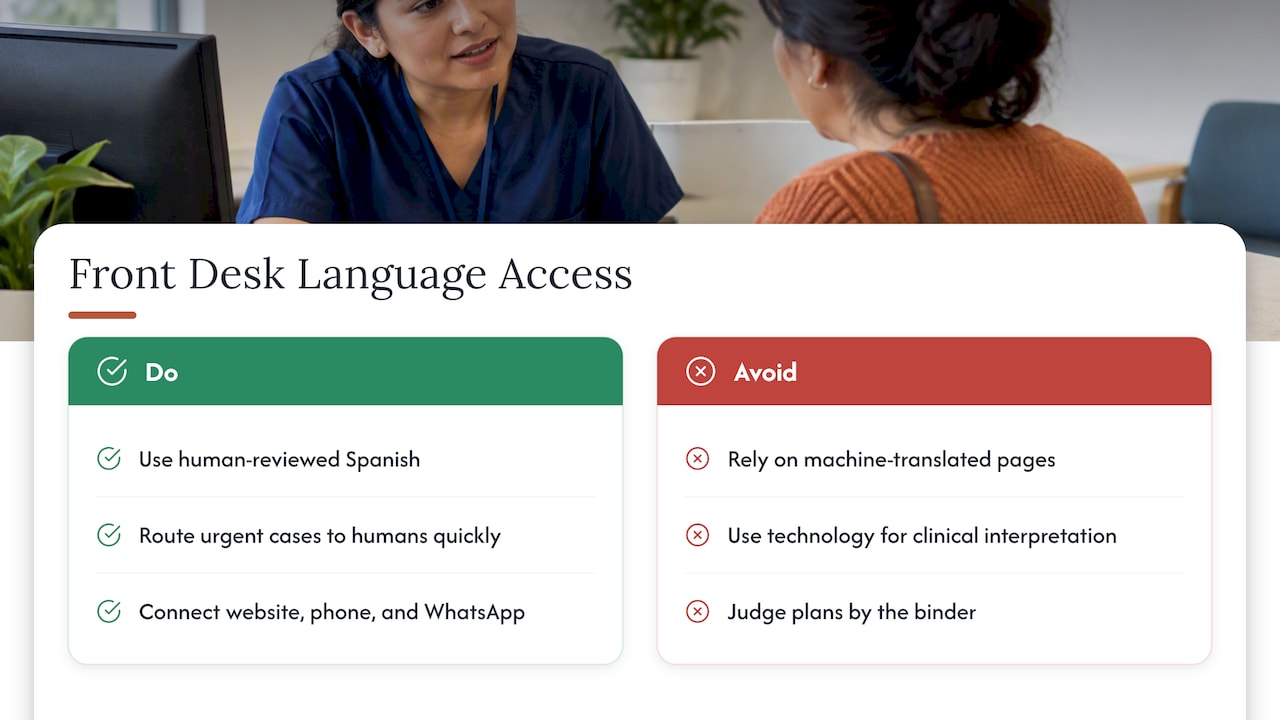
We think a plan should be judged by the first thirty seconds a patient spends with you, not by the binder. That is why we insist on human-reviewed Spanish rather than translated text, on Spanish that sounds like the community you serve, and on one system that handles the website, the phone and WhatsApp together. Cultural nuance matters as much as vocabulary, which is why we wrote a cultural nuance communication checklist.
We also want to be clear about limits. Technology at the front desk helps patients book, ask basic questions and reach the right person. It does not replace a qualified medical interpreter for a clinical conversation, and any urgent case should go to a human, fast. Build your plan so the front desk hands off cleanly to qualified interpretation.
— Francisco
Step 5: Train staff and put the plan to work
A plan that only the owner has read does nothing. The HHS LAS Implementation Workbook offers planning, implementation and evaluation worksheets covering organizational capabilities, interpreter services, written materials and language access plans. Use it as your template rather than starting from a blank page.
The rollout steps in the National Center for Farmworker Health tool are practical: meet with key leaders, finalize the plan based on their feedback and available resources, present changes to all staff, and implement. In a small practice, that means one meeting with the doctors and manager, then a staff session.
Train on these basics:
- How to ask a patient’s preferred language, and record it.
- How to request an interpreter in under a minute, and what to say while the patient waits.
- Why family members and minors should not interpret, and how to explain that kindly.
- Where the notices live and how to point to them.
- How to log a language problem or complaint.
Give one person ownership. Put their name in the plan.
Step 6: Evaluate and update
Pick a few numbers you can pull without a project: interpreter requests per month, wait time to reach an interpreter, share of Spanish-speaking patients who no-show, complaints about language, and the share of vital documents translated. Review them every quarter at first, then twice a year. Revisit the plan when your patient mix changes, when you add a service, or when rules change.
A practical test: have a Spanish-speaking friend or staff member try to book an appointment, ask about cost, and fill out your intake form without help. Fix whatever breaks.
Common mistakes that create risk
CMS names the main ones: relying on unqualified family members or staff to interpret, failing to notify patients in their own language, and using interpreters who lack medical terminology competence. The same guide notes that patients served by ad hoc interpreters or untrained support staff report lower satisfaction, and that this may also violate federal nondiscrimination law. Professional guidance adds that unqualified interpreters can lead to misunderstandings and devastating health outcomes.
A few more we see in practice:
- Translating the website but not the booking form or reminder texts.
- Posting the notice in the office but not online.
- Writing a plan, then never training new hires.
- Treating a bilingual receptionist as a free interpreter for all clinical visits.
Where Diazluna fits
If your audit shows gaps before the visit, that is what we fix. Diazluna gives practices a bilingual front desk: a Spanish and English website, an AI receptionist named María that handles calls, messages and scheduling around the clock, and WhatsApp communication, with summaries and transfer of urgent cases to your team. Plans are billed monthly: Solo Sitio is $99 per month ($990 per year), Sitio + María is $199 per month ($1990 per year), and Sitio + María Pro is $349 per month ($3490 per year). There is a one-off activation fee of $399. See the options on our plans page or the Diazluna home page.
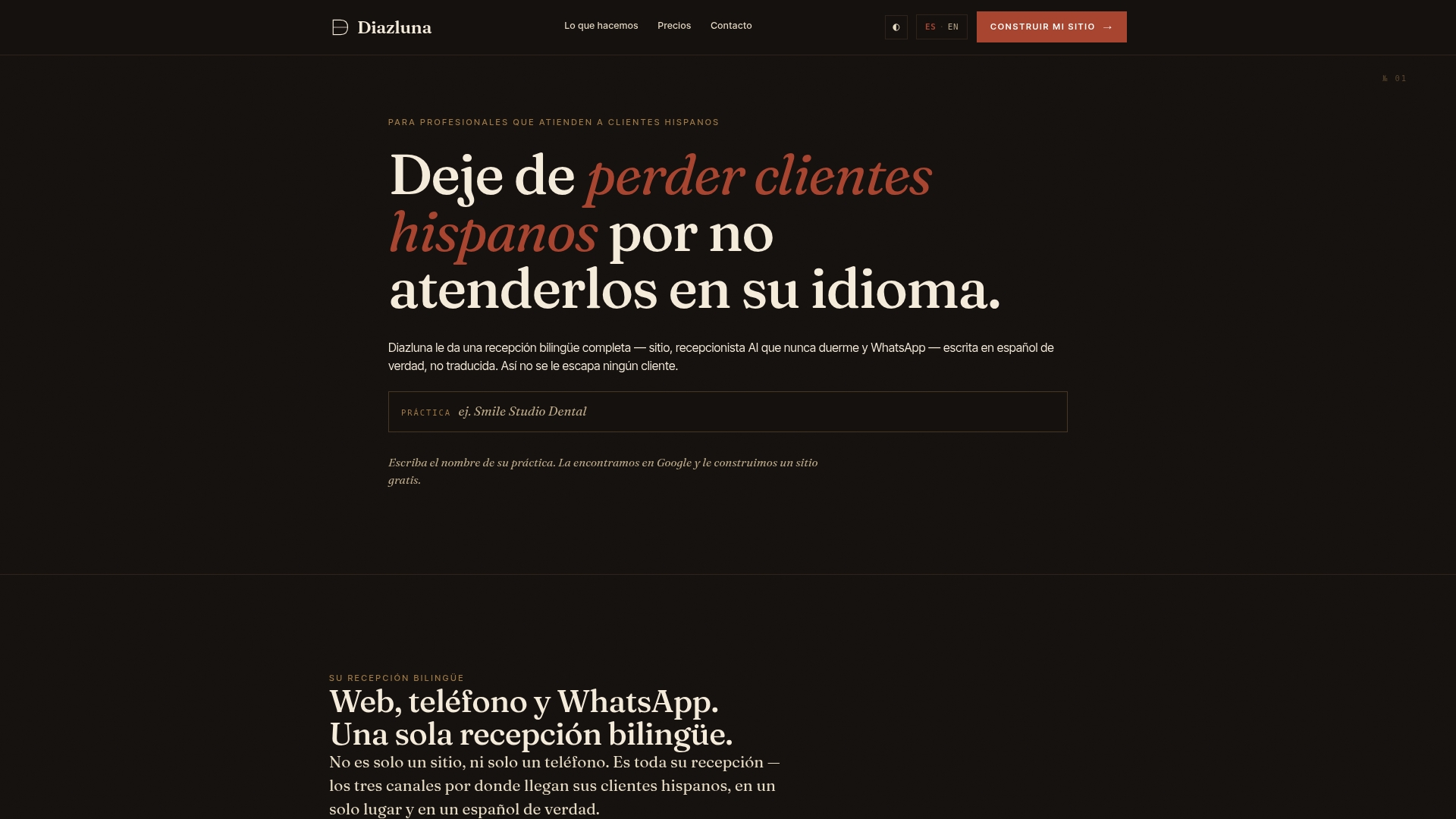
The platform supports your plan at the front door. It is not a substitute for qualified interpreters in clinical care, and your plan should still name them.
FAQ
Does my practice need a written language access plan?
No law says every practice must have a written plan. The duty to provide meaningful access applies to recipients of federal financial assistance, though, and a written plan is the best evidence of how you meet it. Ask your attorney whether your funding, such as Medicaid or Medicare participation, brings you under these rules.
Can a bilingual staff member interpret for patients?
Only if you have confirmed they are qualified. Federal guidance calls for competence shown through training and certification when available, so a staff member who speaks Spanish is not automatically ready to interpret a diagnosis or consent. Document how you assess and train them, or use a qualified interpreter by phone or video.
Can I ask a patient’s family member to interpret?
It is a risk. Relying on unqualified family members is one of the mistakes CMS lists, and minors should not interpret at all. If a patient insists on using a relative, record that choice, and still have a qualified interpreter available. Discuss the exact wording with your compliance counsel.
Do I have to translate my website?
You must post the notice of language assistance on your website, and under the rule it has to cover English and the most commonly spoken LEP languages in your state. Beyond the notice, translating the pages patients use to find you, book and fill out forms is a sound way to meet your plan’s goals.
How often should I update the plan?
Review it at least once a year, and sooner when your patient mix, services or applicable rules change. Check the numbers you track each quarter at first, so problems surface before a complaint does.
Sources
- Guide To Developing A Language Access Plan, CMS
- HHS Language Access Plan
- Providing Language Services to Diverse Populations: Lessons from the Field, CMS
- Addressing Limited English Proficiency When Providing Healthcare, AAPC
- Summary of Guidance to Federal Financial Assistance Recipients Regarding Title VI, HHS
- Language Access Provisions of the Final Rule Implementing Section 1557
- Section 1557: Ensuring Meaningful Access for Individuals with Limited English Proficiency, HHS
- 45 CFR 92.11, Notice of availability of language assistance services, eCFR
- Enhanced National CLAS Standards, HHS
- LAS Implementation Workbook, HHS
- Language Access Services Assessment and Planning Tool, NCFH