November 3, 2026
How to Reduce Missed Calls at Your Clinic
To reduce missed calls at your clinic, do four things in order: measure how many calls go unanswered and when, sort calls by type, route each type to the fastest path (a person, a text link or an automated agent), and cover the hours and languages your front desk cannot. This guide walks through each step with the evidence behind it, including the gap many clinics overlook: callers who speak Spanish.
TL;DR
- Start by measuring call abandonment, speed of answer and after-hours volume. You cannot fix a number you have never looked at.
- Sort calls into urgent, routine and administrative. Many routine requests do not need a live conversation.
- Keep phone menus short, always offer a way to reach a person, and offer the languages your patients speak.
- Spanish-speaking callers hit a wall far more often than English-speaking ones, so language coverage is part of call coverage.
- Add after-hours and overflow coverage (an AI receptionist, texting or both) so staff in the room are not also the phone line.
Table of Contents
- Why clinics miss calls in the first place
- The Spanish-language gap that most guides skip
- Step 1: Measure before you change anything
- Step 2: Sort your calls by type
- Step 3: Fix the phone menu and the first ten seconds
- Step 4: Adjust staffing and routing
- Step 5: Cover after-hours and overflow calls
- Step 6: Move simple requests to text
- Step 7: Let your website do some of the calling
- A 30-day plan you can start this week
- Our perspective: coverage beats heroics
- What Diazluna offers clinics
- FAQ
- Sources
Why clinics miss calls in the first place
Most missed calls are not a discipline problem. They are a capacity problem. One front desk person checks in a patient, verifies insurance, answers a question at the window and is also expected to pick up a ringing phone. Something loses, and it is usually the phone.
Staffing makes it worse. A cross-case analysis of high-performing primary care sites found that chronic understaffing, driven by turnover, slow hiring and regional shortages, was a major barrier to managing the telephone well. The same study noted that sites with high patient-rated access described their call center functions as well integrated with the care team’s workflow, not bolted on beside it.
The patient side is simple. People hang up. The Agency for Healthcare Research and Quality (AHRQ) treats an easy-to-reach phone system as a health literacy strategy, because patients give up when a system is confusing or too slow. A caller who cannot get through to you does not wait for a callback. They call the next practice on the list.
Typical causes worth checking in your own clinic:
- Peak-hour overload. Monday mornings and the hour after lunch stack calls on top of check-ins.
- After-hours silence. Voicemail boxes that are full, unchecked, or never mentioned on the website.
- Long menus. Callers press zero, nothing happens, and they hang up.
- Language dead ends. Nobody answers in Spanish, so the call ends in the first ten seconds.
- One person, one line. Lunch breaks, sick days and vacations leave the phone uncovered.
The Spanish-language gap that most guides skip
If your community includes Spanish-speaking patients, some of your “missed calls” are not missed at all. They are answered, then lost.
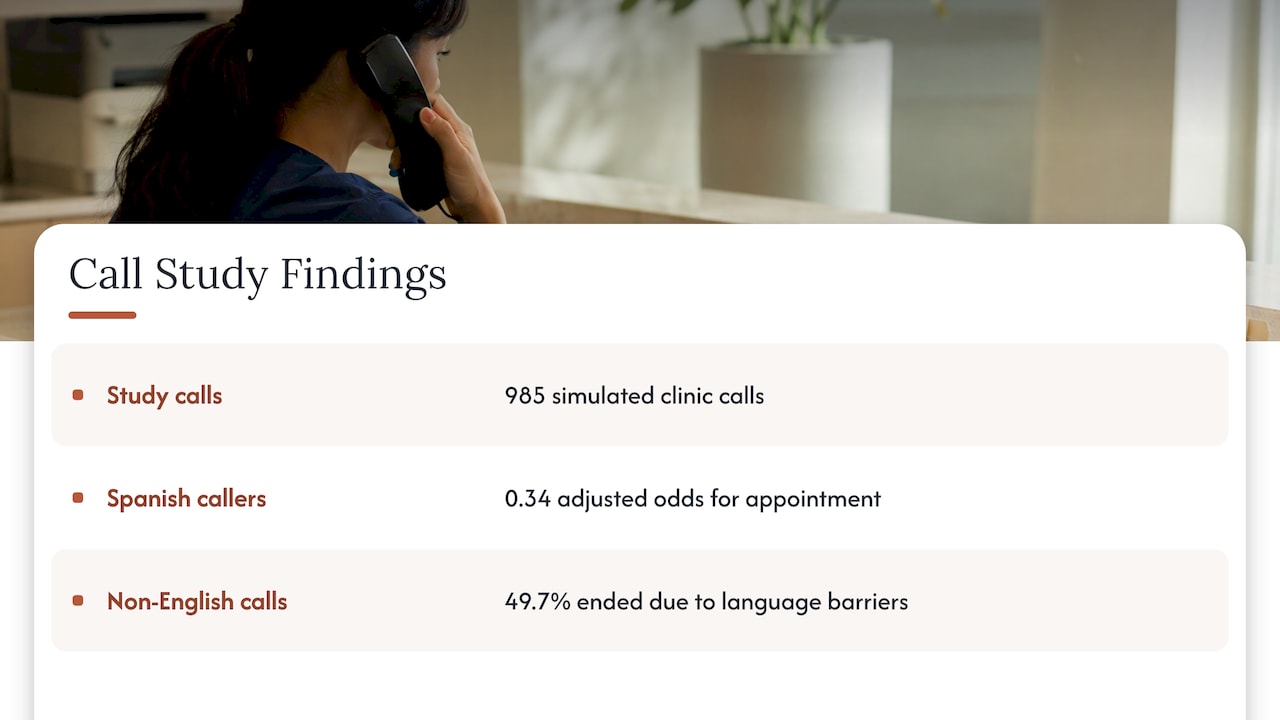
A 2024 JAMA Network Open study placed 985 simulated calls to clinics. Spanish-speaking callers had significantly lower odds of reaching a new appointment than English-speaking callers (adjusted odds ratio 0.34). Of 586 non-English calls, 49.7% ended because of language barriers: callers were hung up on after asking for Spanish, or disconnected by automated systems that gave no instructions in their language. The study looked at cancer care clinics, but the mechanism is one any practice can recognize.
The fix is not to hand every call to whoever happens to speak some Spanish. A 2007 study found that Spanish-speaking patients were equally satisfied with care whether they used a professional telephone interpreter or saw a language-concordant provider, but significantly less satisfied with family members or untrained ad hoc interpreters. And a 2010 review noted that telephone interpretation is quick to reach but best suited to simple exchanges and short appointments, not conversations that need visual cues.
For the front desk, that means a first contact that is genuinely in Spanish: greeting, scheduling, a few intake questions, then a clean handoff. If you want to train your own team for that, our guide on how to stop losing Spanish calls covers the basics, and the phone etiquette skills for HIPAA-safe Spanish calls cover what staff should and should not say.
Step 1: Measure before you change anything
Pull a month of call logs from your phone provider. You are looking for patterns, not perfection. The measures that matter, according to a navigation center implementation described by physician leaders, are call abandonment, speed of answer, one-call resolution and call transfers, tracked with real-time monitoring and scorecards.
A simple starting sheet:
| Measure | What it tells you | Where to find it |
|---|---|---|
| Abandonment rate | Share of callers who hang up before anyone answers | Phone system report |
| Answered within 60 seconds | Whether the wait is tolerable | Phone system report |
| Calls by hour and weekday | When coverage fails | Call log export |
| After-hours calls | Demand you currently ignore | Voicemail count plus log |
| Calls ending in a transfer | Handoffs that may be avoidable | Front desk tally |
| Spanish-language calls | Callers who need a language-matched first contact | Two-week tally at the desk |
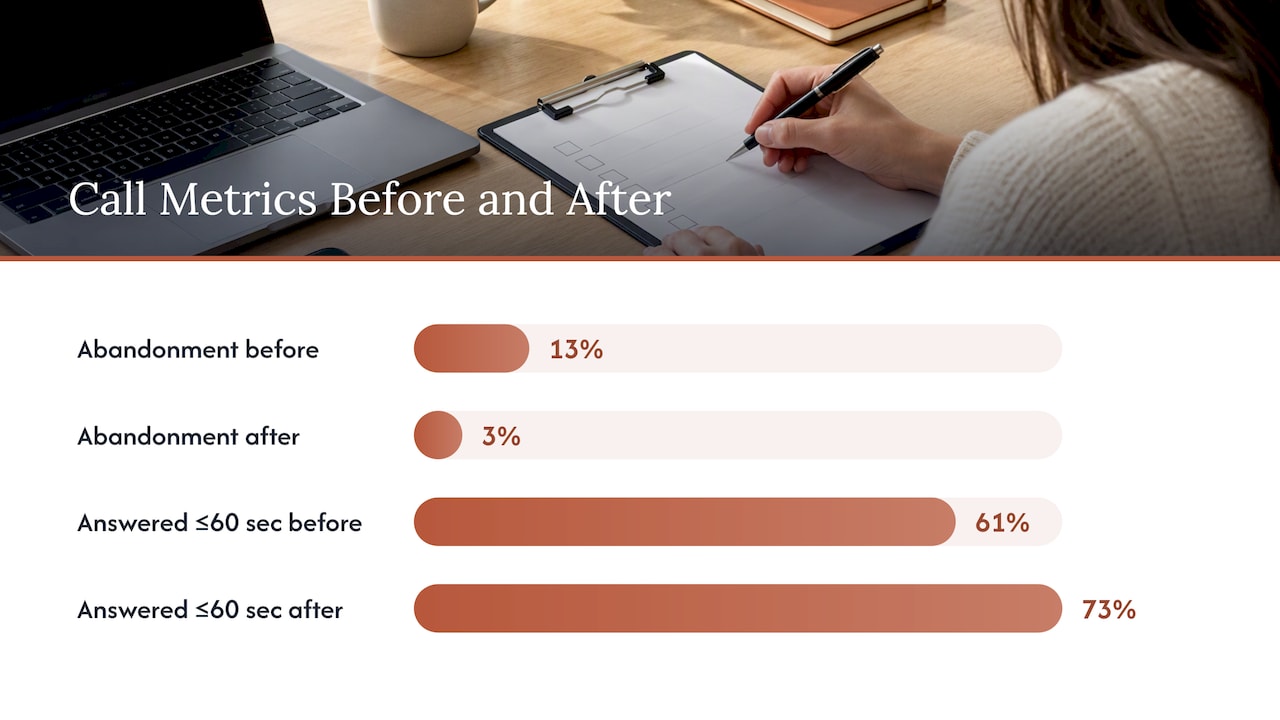
For a reference point on what improvement looks like, a community health center that installed a navigation center with phone trees and queues cut call abandonment from 13% to 3% and raised calls answered within 60 seconds from 61% to 73%. Your numbers will differ, but the direction is the goal.
If you want to translate missed calls into dollars before you decide on a budget, our missed calls cost calculator for medical practices walks through the math using your own new-patient value.
Step 2: Sort your calls by type
Not every call needs a person. Not every call can wait. A sorting scheme is the heart of any missed-call fix.
A 2017 pilot at Hershey Medical Center put in place a structured algorithm that categorized calls as nonurgent, urgent or emergent and used scripted responses to give patients realistic timeframes for having their requests fulfilled. You can borrow the idea with three buckets:
- Urgent or clinical. Pain, bleeding, a worsening symptom, a post-procedure concern. These go to a live person or on-call clinician immediately. Emergencies get a clear instruction to call 911.
- Scheduling and changes. New appointments, reschedules, cancellations, waitlist offers. These are the best candidates for automation or text links.
- Administrative. Office hours, directions, insurance accepted, forms, billing questions. Most can be answered without staff if the answer is easy to find.
Write down, for each bucket, who answers, how fast, and what the caller hears if nobody is free. Then train everyone on the same script. Standardized procedures are what the physician-leader article recommends too: an executive-supported, cross-departmental workgroup that develops standard call procedures, monitors call data and trains staff.
If urgent calls are the part that worries you most, see our guide on urgent call routing for U.S. clinics with Spanish and the overview of call triage automation for bilingual practices.
Step 3: Fix the phone menu and the first ten seconds
The first ten seconds decide whether a caller stays. AHRQ’s health literacy toolkit gives three practical rules for phone systems: no more than five menu choices, always an option to speak to a person, and choices in the languages your patient population commonly speaks.
In practice:
- Call your own main number from a cell phone, as a stranger would. Time how long until a human or a useful answer.
- Put the most common request first. If half your calls are scheduling, do not make callers sit through directions.
- Offer Spanish at the very top, in Spanish, not as an English sentence saying “for Spanish, press two.”
- Make sure pressing zero reaches someone, or a voicemail that is actually checked and returned within a stated time.
- Say your callback promise out loud and keep it. “We return messages within two business hours” works only if someone owns the list.
Step 4: Adjust staffing and routing
Hiring more people is the instinctive answer, and in many markets it is slow. The AMA noted that Medicare physician payments were 33% lower than in 2001 after inflation, which it says makes it harder to recruit and retain skilled staff. If you cannot simply add a person, redesign the work.
Three changes that cost little:
- Separate the phone from the window. Even a half-day dedicated phone role at peak hours changes abandonment. Rotate it so one person is not stuck.
- Let more of the team schedule. Intermountain Health expanded medical assistant roles to include in-room scheduling and care management in a team-based model, and the AMA reported a 20% increase in patients seen per day. Scheduling the next visit before the patient leaves the room means fewer inbound calls later.
- Create an overflow rule. After four rings or two callers in queue, the call moves to a second person, a callback queue or an automated agent. Never to a ringing phone nobody owns.
Step 5: Cover after-hours and overflow calls
Even a well-staffed desk cannot answer at 7 p.m. on a Tuesday. Yet that is when working patients, including many who work shifts and cannot call during business hours, look for an appointment. Your options fall into a few types:
| Option | Best for | Limits to plan around |
|---|---|---|
| Voicemail with a promised callback | Very small practices, low volume | Caller often hangs up and calls someone else |
| Traditional answering service | Message-taking, urgent escalation | Usually cannot book into your schedule; Spanish coverage varies by provider |
| Texting and online booking | Scheduling, reminders, simple questions | Needs a text-enabled number and a clear opt-in process |
| AI receptionist | 24/7 answering, booking, triage, Spanish and English | Needs good setup, clear escalation rules and HIPAA-conscious handling |
| Added in-house staff | Complex, high-touch calls | Cost, turnover and hiring time |
An AI receptionist answers every call, asks what the caller needs, books or routes it, and passes urgent cases to a person. Our walk-through on how an AI medical receptionist works for clinics explains the flow, and the 2026 guide to AI receptionists for Spanish-speaking patients covers the Spanish side. Dental practices can read the buyer’s guide to 24/7 Spanish dental answering.
Because calls involve patient information, ask any vendor how it handles protected health information, who can access recordings, and whether it will sign a business associate agreement. For a plain-language look at what to require, see this overview of HIPAA considerations for AI tools.
Step 6: Move simple requests to text
The cheapest missed call to fix is the one that never needs to happen. Reminders, confirmations and “can I move my appointment?” requests work well by text.
The AMA reported on a 2022 study in which a 30-day automated texting program let patients coordinate appointments or report non-urgent needs, and readmission and emergency department visit odds fell 41%. That was a post-discharge program, so treat it as proof that patients use two-way text to reach care, not as a forecast for your clinic.
For Hispanic patients, WhatsApp is often the channel they already use daily. A confirmation or a rescheduling link sent there, in natural Spanish, tends to feel less like a hurdle than a phone tree. Keep messages short, avoid putting sensitive clinical details in them, and always give a number to call for anything urgent.
Step 7: Let your website do some of the calling
Many calls exist because the website does not answer basic questions. Hours, insurance accepted, new patient forms, parking and what to bring all generate calls. A bilingual site with a booking path in both languages takes a share of that volume away from the phone. Machine-translated pages work against you here: a patient who senses awkward Spanish assumes the service will be awkward too. Our piece on bilingual medical websites for clinics covers what a good one includes, and our overview of types of bilingual support services helps you compare ways to build the whole front desk.
A 30-day plan you can start this week
| Week | Action | Result to expect |
|---|---|---|
| 1 | Export call logs, tally Spanish calls, call your own number as a stranger | A baseline for abandonment and after-hours volume |
| 2 | Write the three call buckets and scripts; shorten the phone menu to five choices or fewer | One shared way of handling calls |
| 3 | Set overflow and callback rules; add text confirmations and a booking link | Fewer calls ringing out |
| 4 | Turn on after-hours coverage in both languages; review the numbers again | A before-and-after comparison |
Keep the review going. Re-run the same scorecard monthly and share it with the team. Staff who see abandonment fall stay with the new process.
Our perspective: coverage beats heroics
Most clinic owners tell us the same story. The front desk is excellent, and still the phone loses. Nobody is failing. A person cannot greet a patient, check insurance and answer a ringing line at the same moment, and she certainly cannot do it in two languages at 8 p.m.
We built Diazluna around that reality. A bilingual website, an AI receptionist that answers around the clock in Spanish and English, and WhatsApp working together mean the patient finds you, reaches you and gets an answer without waiting for business hours. Our Spanish is reviewed by people and written for Hispanic patients, not run through a translator, because the first sentence a caller hears decides whether they trust you with a family member’s health.
We would not ask you to replace your team. We would ask you to stop making your team the only safety net. Let your staff handle the people in the room and the urgent calls that need judgment, while the system handles scheduling, simple questions and everything after hours, with real-time summaries and a clean transfer when a case cannot wait.
Francisco
What Diazluna offers clinics
Diazluna combines a bilingual website, a 24/7 AI receptionist and WhatsApp into one front desk service for practices that serve Hispanic patients. There is a one-time activation fee of $399, then a monthly plan:
- Solo Sitio: $99 per month ($990 per year), the bilingual website on its own.
- Sitio + María: $199 per month ($1990 per year), the website plus the AI receptionist.
- Sitio + María Pro: $349 per month ($3490 per year), a full-service package with site updates and expanded call capacity.
If missed calls are your main problem, the second plan is the one that answers the phone. See the plans and start on the Diazluna site, or look at the bilingual front desk for dentists if you run a dental practice.
FAQ
What is a good missed call rate for a clinic?
There is no single national target, so compare yourself with your own baseline. The community health center described above brought abandonment down from 13% to 3% after redesigning call handling. Track abandonment and the share answered within 60 seconds, and aim to improve both month over month.
Can an AI receptionist replace my front desk staff?
No, and it should not try. It covers the calls your team cannot reach, such as after-hours and overflow calls, and handles routine scheduling. Staff stay responsible for patients in the office and for urgent cases, which the system transfers to a person with a summary.
How do I handle Spanish-speaking callers if nobody on staff is fluent?
Start with a Spanish option at the top of the phone menu and a first contact that is actually in Spanish. Professional telephone interpreters are a reasonable backup for simple exchanges, and research found patients as satisfied with them as with a Spanish-speaking provider, but not with family members interpreting. For routine calls, a bilingual AI receptionist can do the first contact.
Are text messages a safe way to reach patients?
They can be, when used carefully. Keep texts to reminders, confirmations and booking links, leave out clinical details, get consent before texting, and ask your vendor or compliance advisor how the messages are stored. Urgent symptoms should always go to a phone call or 911.
Sources
- AHRQ: Be Easy To Reach, Tool 7
- AHRQ Health Literacy Universal Precautions Toolkit, Tool 7 (PDF)
- Telephone Access Management in Primary Care: Cross-Case Analysis
- JAMA Network Open: Access to New Clinic Appointments for Patients With Cancer
- Effect of Spanish Interpretation Method on Patient Satisfaction
- Use of Communication Technologies to Cost-Effectively Improve Language Access
- Implementation of a Navigation Center to Improve Patient Access
- Improving Responsiveness to Patient Phone Calls: A Pilot Study
- AMA: Medicare pay cuts and physician practices
- AMA: How Intermountain added more time with patients
- AMA: Readmission, ED-visit odds drop 41% with automated texting
- HIPAA AI Applications overview