November 22, 2026
Spanish Lead Response Time: How Fast Is Fast Enough?
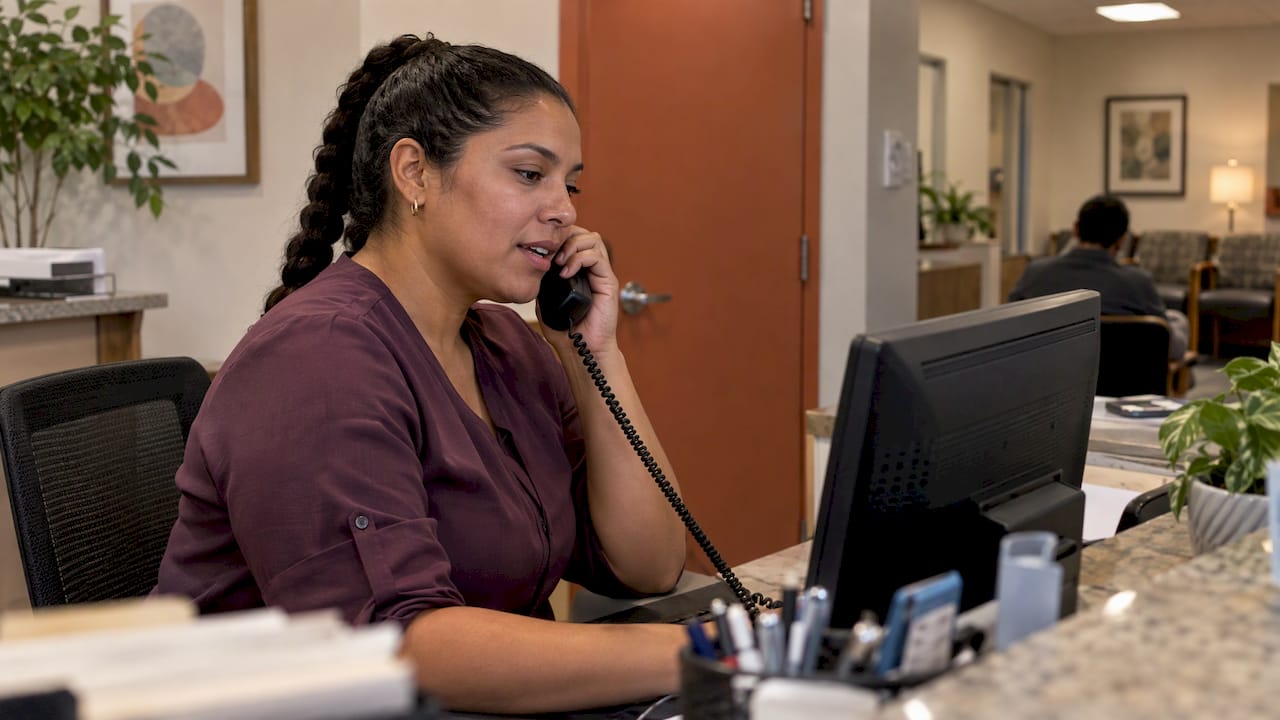
Spanish lead response time is the gap between a Spanish-speaking person reaching out (a call, a web form, a WhatsApp message) and the first reply they can actually understand and act on. That last clause is the whole point. A reply in English, or a stiff machine-translated one, does not stop the clock for that person. The fix is to answer in minutes, in natural Spanish, on the channel they used, including nights and weekends. We built Diazluna around that idea: a bilingual site, a 24/7 AI receptionist and WhatsApp working together, so no Spanish-speaking lead waits for Monday.
TL;DR
- Speed matters most in the first minutes and the first hour. The widely quoted figures come from lead-generation studies, so use them as direction, not as a promise.
- For a Spanish speaker, “response” means a reply in Spanish, not just any reply. A late or English-only answer counts as no answer.
- Most Spanish-language leads are lost outside office hours, on the phone or on WhatsApp, where a front desk is not staffed.
- Measure your own numbers: time to first Spanish reply, split by channel and by in-hours versus after-hours.
- Our plans start at $99 per month, with a one-off $399 activation fee.
Table of Contents
- What “response time” means when the lead speaks Spanish
- What the research says about speed, and what it does not
- Why Spanish-language leads slip away
- What a good first reply contains
- How to measure your Spanish response time
- Closing the after-hours gap
- What Diazluna gives a practice
- FAQ
- Sources
What “response time” means when the lead speaks Spanish
In most guides, response time is a stopwatch. A form arrives, someone calls back, you note how many minutes passed. For a Spanish-speaking lead the stopwatch has two parts.
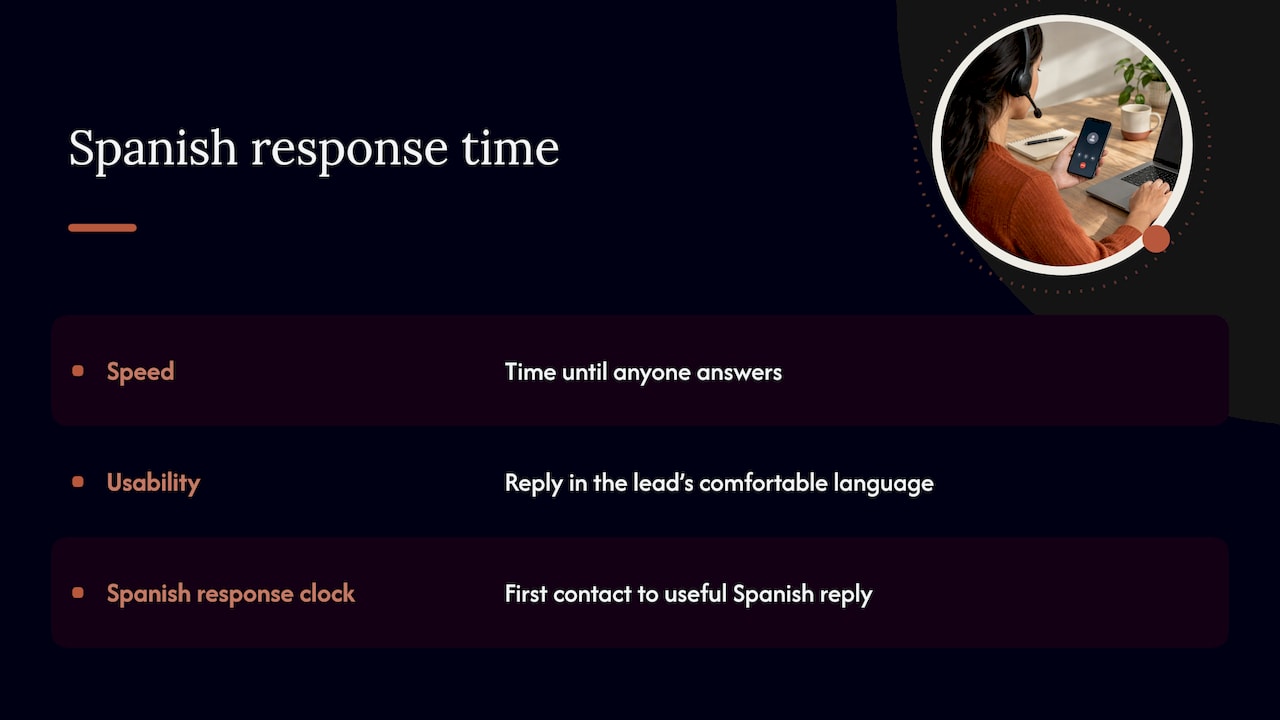
The first is speed: how long before anyone answers. The second is usability: whether the answer is in the language the person is comfortable using for something as important as a tooth, a custody hearing or a diagnosis. A voicemail greeting in English only, a form that auto-replies in English, or a front desk person who says “one moment, let me find someone” all add time that never shows up on your report.
The audience is large enough that this is not a niche problem. According to the 2024 American Community Survey, 44.9 million people aged five or older speak Spanish at home, roughly 14% of the U.S. population. If you serve a neighborhood with many Spanish-speaking households, a large share of your inquiries arrive in that language.
So define your clock this way: the time from the lead’s first contact to the first reply written or spoken in Spanish that answers what they asked. Everything below uses that definition.
What the research says about speed, and what it does not
You have probably seen “respond within five minutes and you are 100 times more likely to connect.” It is a real finding with a narrower meaning than it gets.
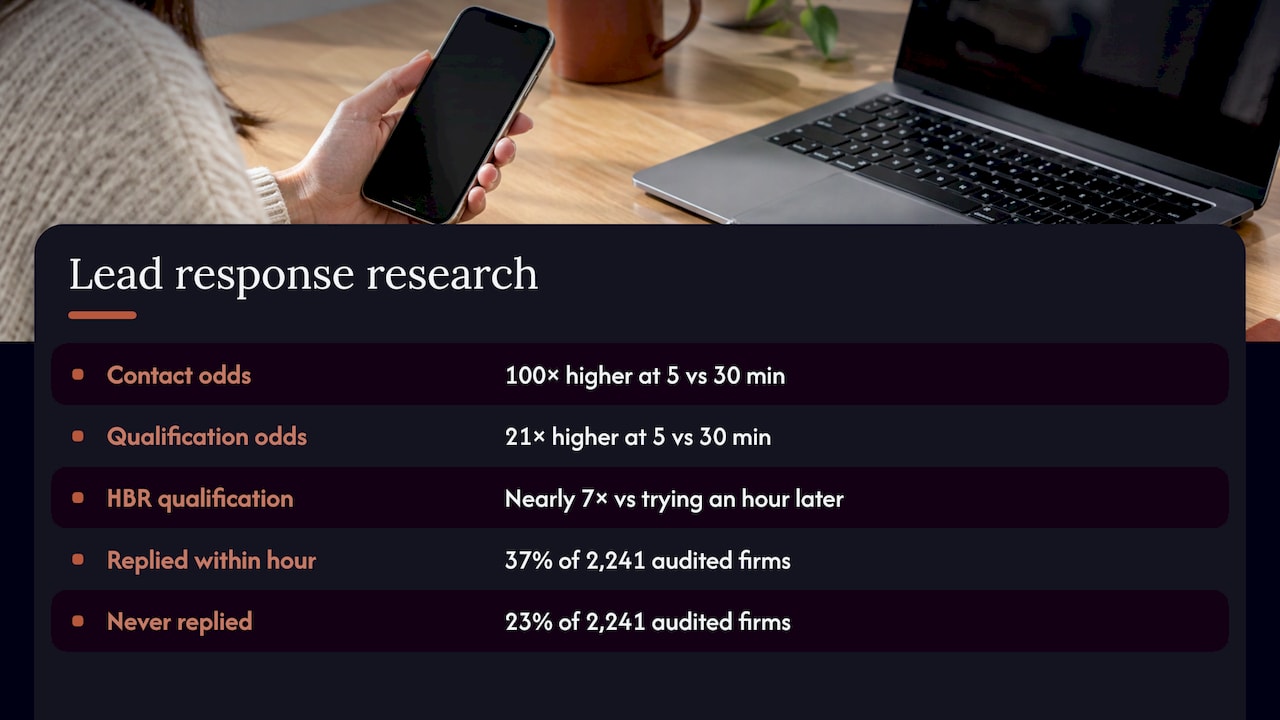
The 2007 Lead Response Management study, covering more than 15,000 leads and six companies, found that contact odds were 100 times higher at five minutes than at 30 minutes, and qualification odds 21 times higher. It came from a vendor of lead-response software, and it is often wrongly credited to Harvard Business Review.
The Harvard Business Review study of 2011 is a separate piece of work. It looked at 1.25 million leads from 42 U.S. companies and found that firms contacting a lead within an hour were nearly 7 times more likely to qualify it than firms trying an hour later. Its audit of 2,241 companies found 37% replied within an hour and 23% never replied at all. Among those that did reply within 30 days, the average took 42 hours.
A 2026 review of 14 speed-to-lead studies adds a caution: two-thirds of the statistics are more than five years old, and some well-known claims never define “conversion”. Studies of this kind measure whether a lead was reached or qualified, not whether it became a paying client. If you want to go deeper on how to move leads from first contact to booking, this guide to lead nurturing strategies covers what happens after the first reply.
What holds up across all of them is simple: the earlier you reply, the better your odds, and most businesses reply far too slowly. That gap is your opening.
What people expect
Expectations point the same direction. An InMoment survey of more than 1,200 consumers, reported by CX Dive in 2025, found about 2 in 5 customers expect a response within five minutes and 7 in 10 within an hour. Those are general consumer figures, not Spanish-specific, but they describe the standard your Spanish-speaking leads also compare you against, and they usually have more reasons to move on quickly: they are often contacting several offices at once.
Why Spanish-language leads slip away
We see the same breakdown points in dental, legal and medical practices.
After hours. Many people call or write when they are off work, in the evening or on a weekend. If nobody answers, or the greeting is English only, the next office on the list gets the call.
The phone is the primary channel. For urgent matters, a toothache, an arrest, a child with a fever, people call rather than fill in a form. A bilingual website that does not also answer the phone only solves half the problem.
WhatsApp is where the conversation happens. Many Spanish-speaking clients prefer to message. If your WhatsApp is unmonitored, or your replies wait for office hours, the lead is already gone.
English-first handoffs. The first touch is in Spanish, then the booking link, the confirmation and the intake form are all in English. The clock keeps running even if the first reply was fast.
Translated, not written, Spanish. A literal translation reads as cold or confusing, and it affects trust. We wrote more on this in why Spanish tone matters for client retention.
What a good first reply contains
Speed gets you the conversation. The content of the first message decides whether it continues. A good first response to a Spanish-speaking lead:
- Is in Spanish from the first word. Not a bilingual block with English on top.
- Uses the register the person used. If they wrote informally, do not answer like a legal notice. Use usted by default for older clients and professional settings, and match them if they switch to tú.
- Answers the actual question. If they asked about a cleaning price or a consultation, say what you can: the next step, what to bring, the address.
- Offers a concrete next step. A time slot, a callback window, or a link to book in Spanish.
- Stays on the channel they chose. A WhatsApp message gets a WhatsApp reply, not an email.
- Escalates the urgent. Pain, a detention, an emergency: these go to a person right away, with a short summary so the caller does not have to repeat the story.
We go deeper on the urgent-case side in our piece on urgent call routing for U.S. clinics.
How to measure your Spanish response time
You cannot improve a number you have never seen. A simple four-week routine is enough to start.
Step 1: Tag every Spanish inquiry
For each call, form or message in Spanish, record the channel and the time it arrived. If your phone system cannot tell you the language, note it from the call summary or the first message. Our guide on tracking Spanish callers for marketing lays out a four-week way to do it.
Step 2: Record the first useful Spanish reply
Note when someone first answered in Spanish with something relevant. An auto-acknowledgment in English does not count. A Spanish message that says only “we received your message” is a partial credit at best; record both times if you want to see the difference.
Step 3: Split by hours
Separate in-hours from after-hours. Most practices find the two numbers are very different, and the after-hours one is where the lost leads are.
Step 4: Use medians and a simple target
Averages are distorted by the one lead who waited three days. Use the median and the share answered within a set window. A sensible starting target, following the research above, is a reply within minutes for calls and messages and under an hour for everything else.
Step 5: Follow the lead to the outcome
Speed is only a proxy. For each Spanish lead, track whether they booked, showed up and became a client or patient. That tells you whether faster replies really pay off in your practice, rather than relying on someone else’s dataset.
| What to track | Why it matters |
|---|---|
| Time to first Spanish reply, by channel | Shows where the delay actually is |
| In-hours vs after-hours median | Reveals the evening and weekend gap |
| Share of leads answered in under 5 minutes | Matches the benchmark in the studies |
| Booked appointments or consultations | Connects speed to results |
| Show rate for Spanish-language bookings | Shows whether the handoff works |
Closing the after-hours gap
A practice rarely loses a Spanish-speaking lead because it was too slow at 10 a.m. on Tuesday. It loses them at 7 p.m. on Friday. Business-hours staffing cannot fix that, and hiring a bilingual night shift is out of reach for most small offices.
That is why the answer for a small practice is an always-on front desk, not a faster inbox. Our related guides cover how this plays out by field: after-hours Spanish support for practices, 24/7 Spanish dental answering, and after-hours Spanish legal reception.
What we think
We built Diazluna because we kept seeing the same thing: a good practice with Spanish-speaking neighbors, and a front door that only opened in English during office hours. The research on response time is imperfect, but the direction is clear and the common sense is stronger than any single statistic. People who contact you in Spanish want an answer they understand, soon, on the channel they picked.
That is why we put three things together instead of selling them separately. The bilingual website is human-reviewed Spanish, not translated text. The AI receptionist answers calls and messages in Spanish and English at any hour, schedules appointments and passes urgent cases to your team with a summary. WhatsApp is part of the same system, so the conversation does not split across tools.
The result we aim for is simple: a Spanish-speaking lead gets a reply in their language while they are still on the phone or still holding their phone, instead of the following Monday.
Francisco
What Diazluna gives a practice
Diazluna is a bilingual digital front desk for dentists, law firms and medical practices serving Hispanic clients. It combines a fully optimized Spanish and English website, a 24/7 AI receptionist that handles calls, messages and appointment scheduling, and WhatsApp integration with real-time summaries and transfer of urgent cases. After free site setup, you choose a plan:
| Plan | Monthly | Yearly |
|---|---|---|
| Solo Sitio (website only) | $99 | $990 |
| Sitio + María (website plus AI receptionist) | $199 | $1,990 |
| Sitio + María Pro (managed package with site updates and expanded call capacity) | $349 | $3,490 |
There is a one-off activation fee of $399. Details are on our plans page, and you can see how it looks for dental practices or law firms.
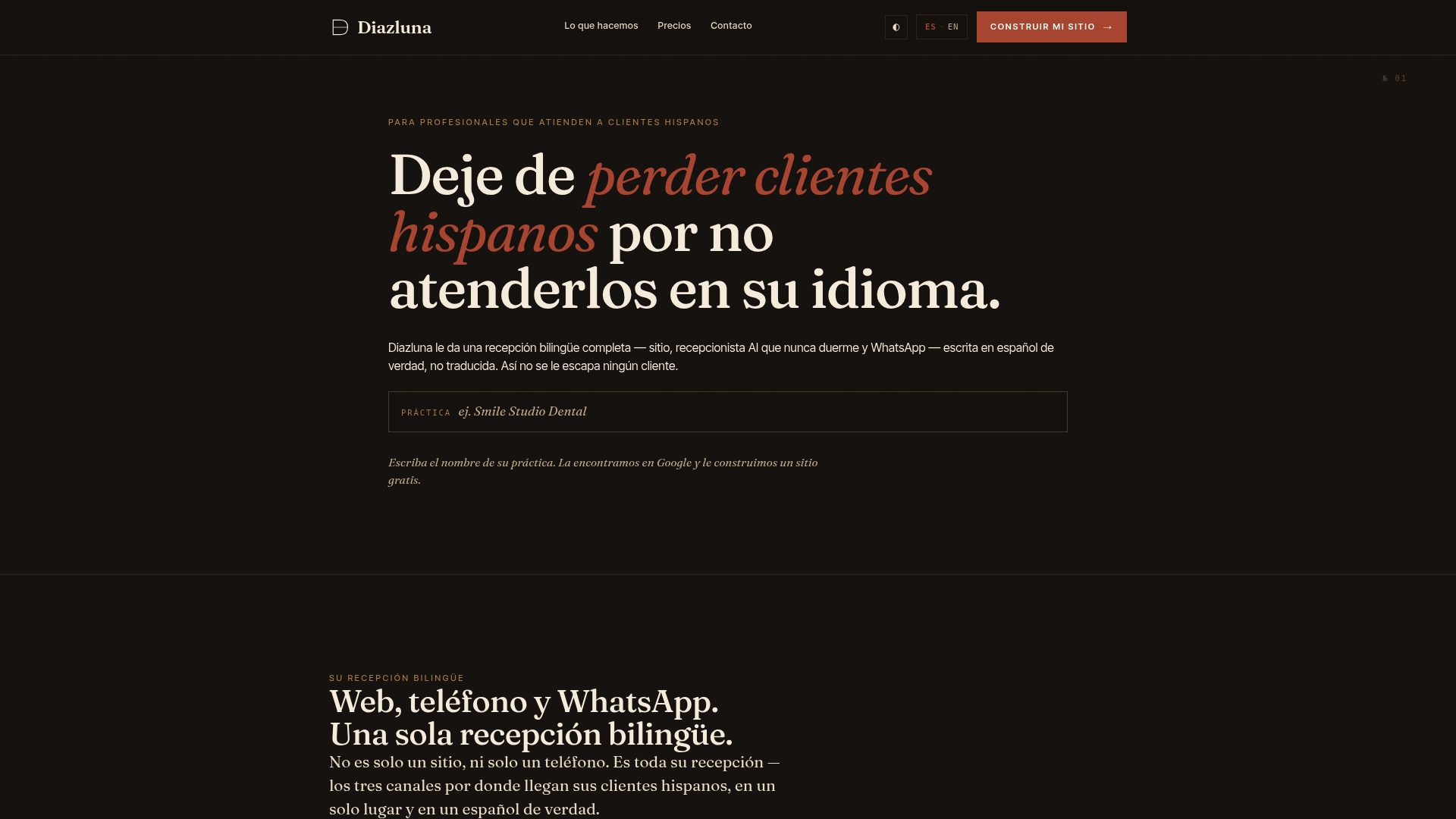
If your Spanish response time is measured in hours or days, the quickest improvement is to have every call and message answered in Spanish from the start. See how the bilingual front desk works for your practice.
FAQ
What is a good response time for a Spanish-speaking lead?
Aim for minutes, not hours. Research on lead follow-up shows odds of reaching and qualifying a lead fall steeply in the first hour, and consumer surveys show many people expect a reply within an hour or less. The reply should be in Spanish to count.
Does an automatic English confirmation count as a response?
Not for measuring Spanish response time. It confirms receipt, but it does not give a Spanish speaker an answer they can use. Count the time to the first Spanish reply that addresses their question.
Which channels should I cover first?
Start with the phone, including after hours, then WhatsApp, then your website form. Phone is where urgent inquiries come in, and WhatsApp is where many Spanish-speaking clients prefer to keep the conversation going.
Is the 100x figure reliable?
Treat it as a signal, not a guarantee. It comes from a 2007 study of contact and qualification, not of closed sales, and it is often confused with a separate Harvard Business Review study about the first hour. Your own tracking of bookings tells you what speed is worth in your practice.
Sources
- Spanish language in the United States
- Real Estate Lead Response Time: The Real Data
- The Science of Follow-Up Timing: What the Research Shows
- Speed to Lead Statistics: 14 Studies, 18 Different Clocks
- Consumers want swift customer service no matter the channel