November 21, 2026
Translation vs. Transcreation in Spanish
Translation moves your words into Spanish and keeps the meaning exact. Transcreation rebuilds a message so a Spanish-speaking reader feels what an English reader feels. A practice needs both: translation for consent forms, policies and instructions, transcreation for the pages, messages and calls that make a new Hispanic patient or client choose you. We built Diazluna around that split, with human-reviewed Spanish rather than machine-translated copy, so your front desk sounds like a native speaker wrote it.
TL;DR
- Translation protects the words. It suits content where accuracy and legal fidelity matter: consent forms, disclaimers, policies, aftercare sheets.
- Transcreation protects the intent. It suits content that has to persuade or reassure: your homepage, calls to action, reminders, ads, social posts.
- Transcreation starts from a brief and a goal, not a source text, and usually costs more because the work is more involved.
- For dentists, lawyers and clinics, the rule of thumb is simple: if a copywriter would write the English version, a bilingual copywriter should write the Spanish one.
- A bilingual website, a 24/7 receptionist and WhatsApp all need the same voice, or the patient notices the seam.
Table of Contents
- The difference in plain terms
- Translation vs. transcreation at a glance
- What belongs where in a dental, law or medical practice
- Which Spanish? The audience decides
- How the workflow differs
- What each costs
- What good transcreation looks like
- Common mistakes in practice websites
- Our perspective
- Putting it into practice with Diazluna
- FAQ
- Sources
The difference in plain terms
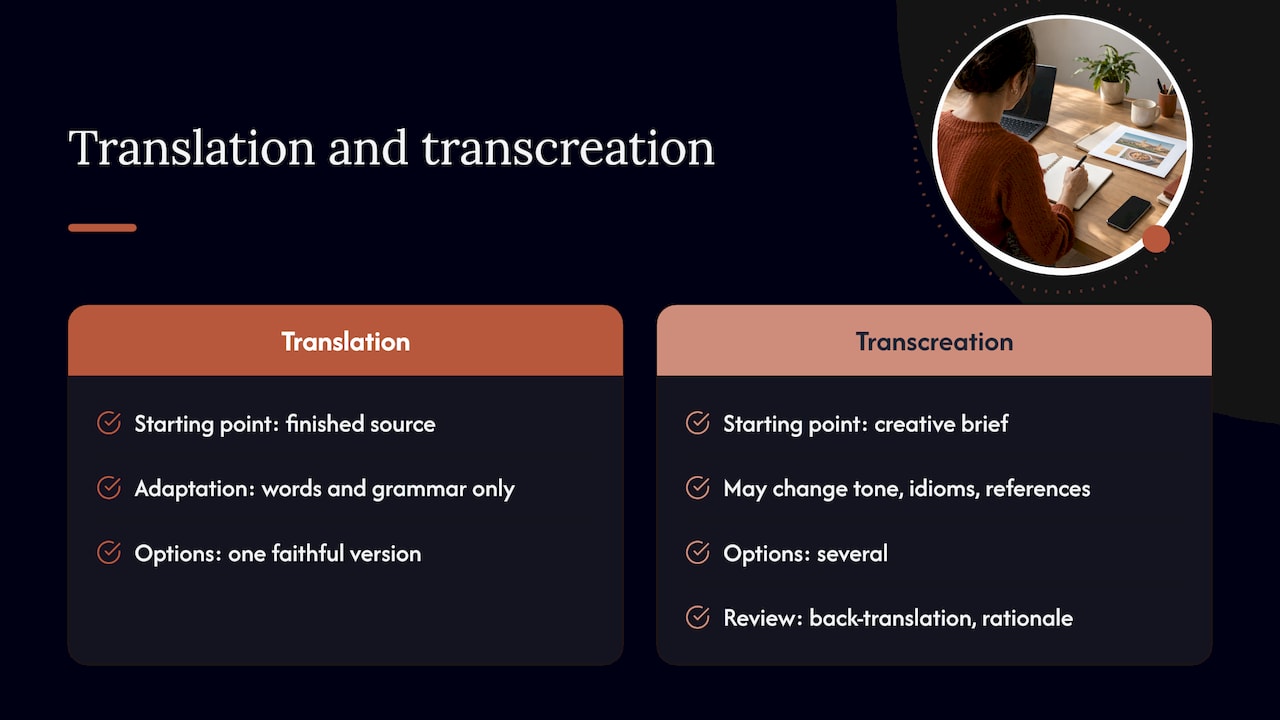
Translation takes a finished source text and renders it in another language. According to a Hispanic advertising agency’s comparison, translation aims at accuracy of meaning, changes only words and grammar, and produces one faithful version. Transcreation starts from a creative brief, may change tone, idioms, references and sometimes the concept, and typically delivers several options, often with a back-translation (the Spanish copy rendered into English again so you can see what it says) and the reasoning behind each choice.
The U.S. government describes the same idea in its own bilingual work. USAGov defines transcreation as writing a message that carries the same implications in both languages, draws the same emotions and takes cultural differences into account. It also notes that the process takes time and effort that online translation tools do not need, and that because Spanish varies by region, the team relies on bilingual glossaries, dictionaries and style guides to stay consistent.
The American Translators Association frames it as a spectrum under the ASTM F2575-14 translation standard. At one end is close adherence to the source, like a university transcript. Further along is significant adaptation, like a software interface. Transcreation sits at the far end, used for marketing material where the approach for one culture can differ substantially from another.
A short example
Take a dental homepage headline: “Your best smile starts here.” A word-for-word version is grammatically correct and reads like a brochure from a stranger. A transcreated version may drop the phrase entirely and lead with what a Spanish-dominant parent wants to hear: that the whole family is welcome, that someone will explain each step in Spanish, and that they can message on WhatsApp. The meaning of “we care about you” survives. The sentence does not.
The classic cautionary tale is the Chevrolet Nova, which is reported to have struggled in Latin America because “no va” reads as “does not work” in Spanish. Whatever the truth of the details, the lesson holds: a name or line can be perfect in English and wrong in the next language.
Translation vs. transcreation at a glance
| Translation | Transcreation | |
|---|---|---|
| Goal | Accurate meaning | Equivalent emotional impact |
| Starting point | The source text | A brief and an objective |
| What changes | Words and grammar | Words, tone, idioms, references, sometimes the concept |
| Who does it | A professional translator | A bilingual writer with cultural expertise |
| Output | One faithful version | Often several options with a rationale |
| Best for | Legal, technical, informational content | Persuasive, emotional, brand-facing content |
The table follows the comparison in this Hispanic advertising guide.
What belongs where in a dental, law or medical practice
The same guide says translation fits informational content where the reader needs exact details: terms and conditions, disclaimers, legal notices, ingredient lists, user manuals, how-to guides and functional pages. Transcreation fits slogans, headlines, video scripts, social campaigns and anything built on humor, wordplay or emotion. Applied to a practice, that gives you a working map.
Translate these
- Informed consent and treatment-plan forms. The reader must understand the same obligations and risks the English version states. Nothing should be added or softened.
- Privacy notices, billing policies and cancellation terms. These are legal in character and should be faithful to the source.
- Medication, aftercare and pre-procedure instructions. Exact doses, timings and warnings come first. Style comes second.
- Engagement letters and retainer terms for law practices. Precision matters more than warmth here, and a qualified human translator should handle them.
Our own guide to translating business documents professionally goes deeper on that side of the work.
Transcreate these
- Homepage, service pages and “about us” copy. This is where a first-time visitor decides whether you understand them.
- Calls to action. “Book now” is a command. In Spanish, a warmer and more specific invitation often works better. See our Spanish call-to-action examples.
- Appointment reminders and follow-up messages. The tone should match how your patients speak to a trusted professional. Our article on why Spanish tone matters for client retention covers this.
- Ads, social posts and review requests.
- Intake questions and phone or chat scripts. A form or a call that feels like a bureaucratic translation loses people before they book.
The in-between pieces
Slator describes a middle category called creative translation: text that is not pure legal content but not a campaign either, such as a service description or an FAQ. Those pieces need accurate facts and natural phrasing. A translator with marketing sense, or a transcreator who checks facts against the source, handles them well.
Which Spanish? The audience decides
Spanish in the U.S. is not one voice. USAGov notes that Spanish varies by region, and its team uses glossaries and style guides to keep the language consistent. A decision checklist from a translation company suggests Spanish-only content, transcreated for cultural fit, for first-generation, Spanish-dominant and older audiences, and bilingual or code-switching content for younger and second-generation readers.
For a practice, this means deciding who your typical new client is before anyone writes a word. A family-dental office in a largely Mexican-American neighborhood, an immigration lawyer serving Central American clients and a pediatric clinic with Puerto Rican families may all choose different words for the same idea. One approach we describe in our guide is a neutral Spanish base with a local polish: a clear core text that any Spanish speaker understands, then adjustments for the community you serve.
How the workflow differs
A translation job is short: send the source, receive the target, have it proofread. A transcreation job has more stages. The Hispanic advertising guide lists a typical sequence:
- Brief. You state the goal, audience, tone and anything that must stay fixed, such as your practice name or a legal phrase.
- Cultural insight. The team decides which segment of the Hispanic audience you are addressing and what resonates with it.
- Creative adaptation. Bilingual writers draft options.
- Back-translation and rationale. Each option is rendered back into English with notes on why choices were made, so you can approve something you may not read fluently.
- Review. Native reviewers from the target segment check tone and meaning.
- Testing. Where possible, options are tried with real audiences.
You will rarely run formal tests for a single-location practice, but the brief, the native review and the back-translation are worth keeping. They are what separate Spanish that sounds right from Spanish that is merely correct. USAGov adds a useful habit: its team analyzes user data weekly across social, email, website and contact-center channels, and found that Spanish-language audiences searched for different topics than English ones. Your own site search, call logs and WhatsApp questions tell you the same thing about your Spanish-speaking patients.
What each costs
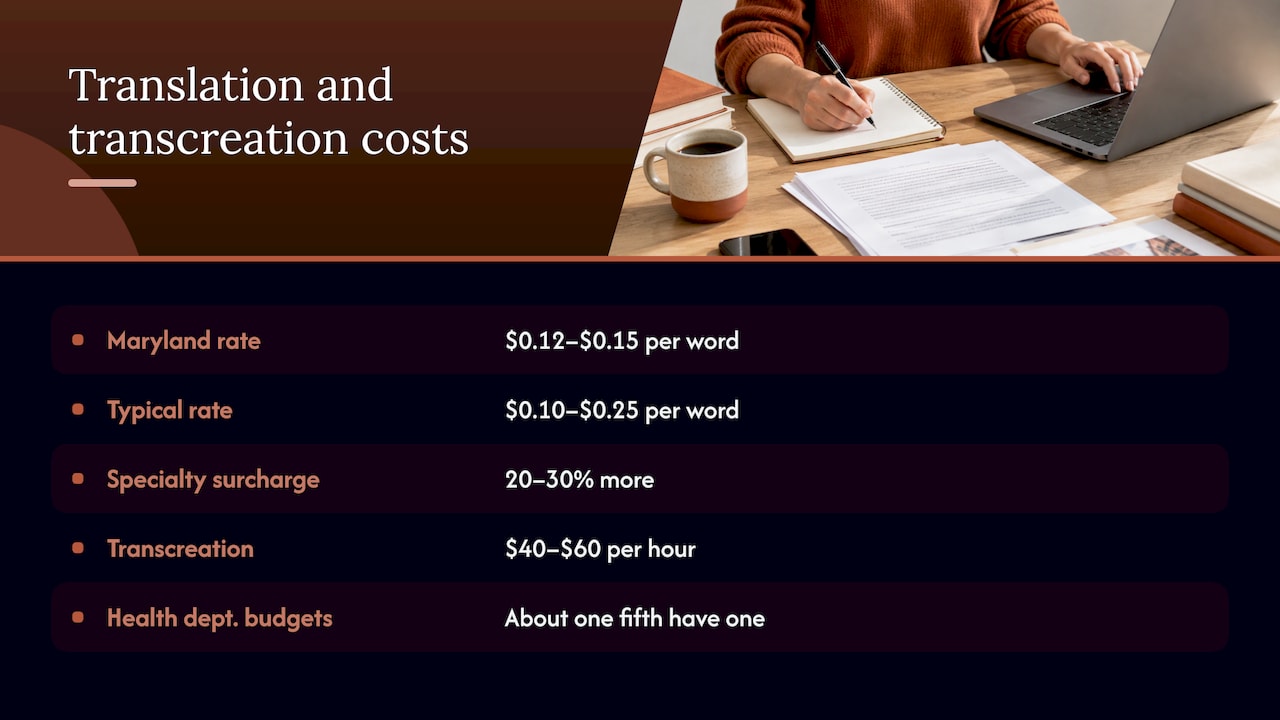
Pricing differs because the work differs. The University of Maryland’s School of Languages, Literatures, and Cultures publishes Spanish translation rates of $0.12 to $0.15 per word, with surcharges for legal, medical, technical, handwritten or rushed material. A 2025 cost guide puts typical per-word rates at $0.10 to $0.25 and says legal, medical or technical content commands a 20 to 30% increase because of the terminology involved.
Transcreation is usually quoted per project or per hour, with one 2026 guide citing $40 to $60 per hour, because the source word count says little about the creative effort. The Spanish agency literature agrees on the reason it costs more: the process is more comprehensive, with a brief, options and review. Style guides help keep it efficient.
Cost matters in healthcare especially. A peer-reviewed study of local health departments in the U.S. Northwest found that financial cost was the most-cited barrier to translation, with only about a fifth having a translation budget. Small practices face the same pressure, which is why it helps to spend on transcreation where it earns patients and on exact translation where it protects you.
What good transcreation looks like
One widely cited marketing example: the “Got Milk?” campaign was reworked for Latinx consumers as a question about whether you had given the children enough milk today, aligned with the audience’s family values rather than the English wordplay. The same source describes a payments campaign that used everyday Puerto Rican and Mexican-American phrasing and built on the insight that cash is more common in Puerto Rico.
Another example comes from consumer goods. Mondelez’s belVita team removed a scene from its Spanish creative because it clashed with Hispanic respect for authority figures, and replaced it with a moment about a postman pronouncing a Spanish last name correctly. The brand reported Hispanic dollar sales up nearly 40%, against 17.5% among non-Hispanics. Pronouncing a name correctly is something a front desk can do every day.
The lesson for a practice is that transcreation is not decoration. It starts with what your patient values: family, respect, being understood without having to ask twice. It then finds words and visuals that say so. If you are planning visuals for the Spanish pages as well, these visual storytelling tips help you adapt images and layout together with the text.
The Campaign US analysis of U.S. Hispanic marketing describes three levels of transcreation: simple language adaptation where the insight already connects both markets, language plus cultural insight where the opportunity is stronger, and a fully tailored approach where the need itself differs, as with healthcare barriers that differ between Hispanic and non-Hispanic white populations. Health and legal services often sit in that third group, which is why a plain translated homepage underperforms.
Common mistakes in practice websites
- Machine-translating the whole site. It saves a week and costs the trust of the reader who sees stiff phrasing on the page that is meant to welcome them.
- Transcreating a consent form. Creativity belongs in the invitation to sign, never in the terms.
- Using different voices on different channels. A warm Spanish homepage followed by an English-only voicemail breaks the promise. The website, the phone and the messaging app should speak alike.
- Ignoring search. Spanish pages need their own keywords and local listings. We cover this in our guides on Spanish local SEO and multilingual citations, and in Spanish SEO for lawyers.
- Skipping accessible forms. Bilingual intake forms need clear labels and accessibility in both languages; see our bilingual contact form guide for clinics.
For a wider view of what falls under the umbrella, see what bilingual business communication covers and how culturally accurate content converts clients.
Our perspective
Most practices come to us with the same problem: a Spanish page that was translated, a receptionist who cannot always answer in Spanish, and calls that go unreturned after hours. They assume the fix is more translation. It is usually a decision about voice.
Our position is that the Spanish a patient or client meets first should be written for them, not converted for them. That is why our Spanish content is human-reviewed and not simply translated. The legal and clinical documents behind it stay exact. The pages, messages and conversations in front of it get the transcreated treatment.
The second part is consistency. A bilingual website, an AI receptionist available 24/7 in Spanish and English, and WhatsApp should feel like one front desk. When all three come from one service, you do not have to brief three vendors on the same tone, and no Hispanic caller gets lost between them.
The owner should stay in control. You should be able to edit your own pages without technical skills, so a new service or a changed holiday schedule is live that day.
Francisco
Putting it into practice with Diazluna
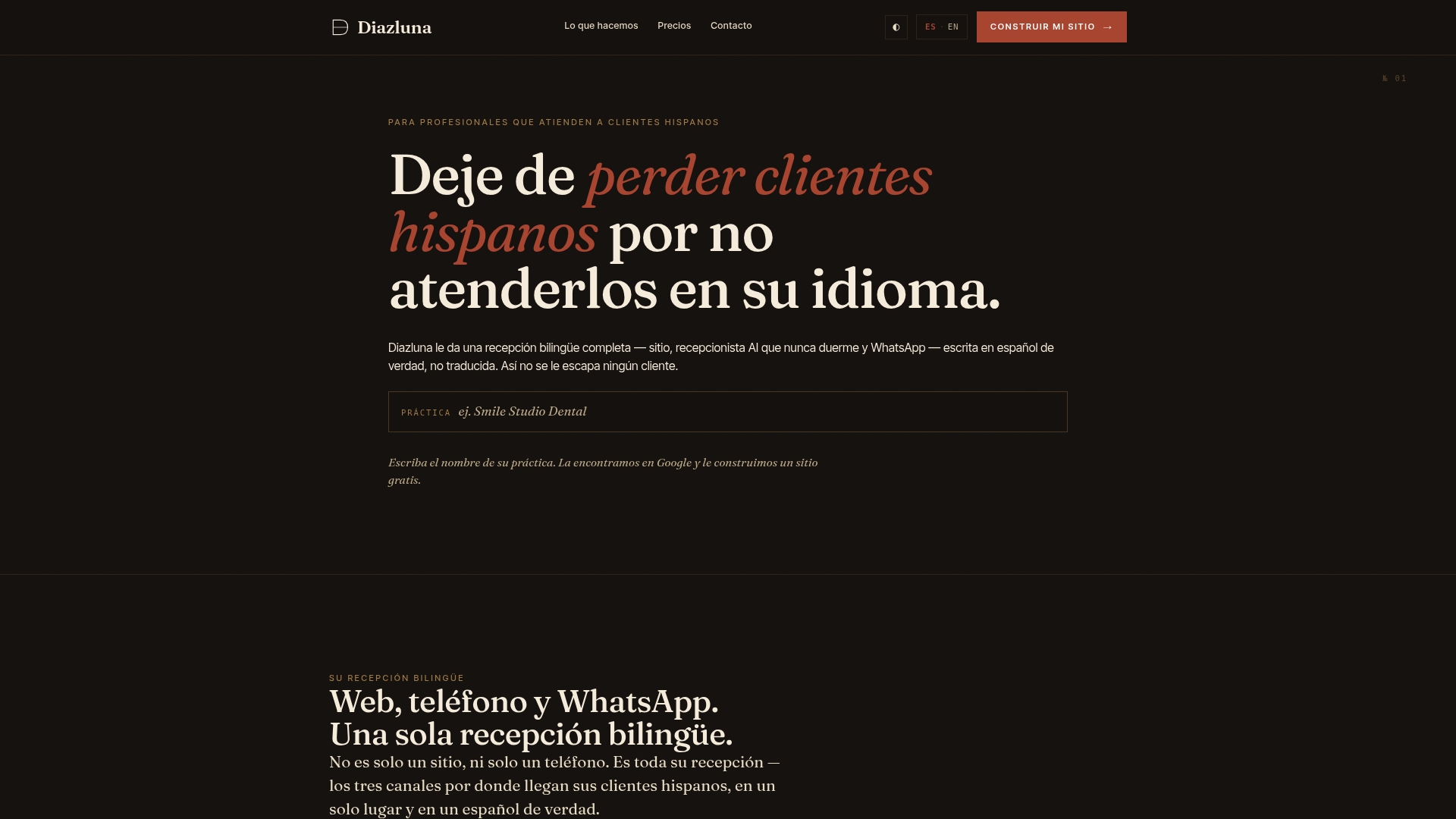
Diazluna is a bilingual digital front desk for dentists, lawyers and clinics serving Hispanic clients. It combines a fully optimized Spanish and English website, an AI receptionist (María) that handles calls, messages and scheduling around the clock, and WhatsApp communication, including real-time summaries and transfer of urgent cases. Site setup is free; activation is a one-time $399.
Plans: Solo Sitio is $99 per month or $990 per year. Sitio + María is $199 per month or $1,990 per year. Sitio + María Pro, with site updates and expanded call capacity, is $349 per month or $3,490 per year. Dentists can see how it works on our page for Hispanic-serving dental practices, and every plan is on the Diazluna site.
FAQ
Is transcreation always better than translation for Spanish?
No. They do different jobs. Translation is the right tool when exactness and legal fidelity matter, such as consent forms, policies and instructions. Transcreation is the right tool when the reader has to feel something or act, such as on a homepage, in a reminder or in an ad.
How do I know if a page needs transcreation?
Ask who would write the English version. If a copywriter wrote it to persuade, a bilingual copywriter should write the Spanish. If it states facts or obligations, translate it faithfully and have a qualified person review it.
Why does transcreation cost more?
It involves a brief, cultural research, several drafts, a back-translation and native review, so it is quoted by project or hour rather than per word. Translation is usually priced per word, with higher rates for legal or medical subject matter.
Can transcreation go from Spanish to English too?
Yes. USAGov notes that it can run in either direction and need not match the other version one to one. A Spanish message may be built around different topics than its English counterpart, because the audiences search for different things.
Sources
- Transcreation vs. Translation in Hispanic Advertising
- Speaking your language: USAGov outreach’s approach to bilingual content
- Translation or Transcreation? American Translators Association
- Spanish Translation or Spanish Transcreation?
- What Is the Difference Between Translation and Transcreation? Slator
- Why Spanish Translation for the U.S. Hispanic Market Is Essential
- Spanish Translation and Interpretation Services, University of Maryland
- Spanish Translation Costs: A Complete Guide (2025)
- How Much Does Professional Translation Cost in 2026
- Local Health Department Translation Processes
- A Marketer’s Guide to Translation, Transcreation, and Native-Language-First Campaigns
- A Breakfast Breakthrough: How a Mondelez Brand Grew Hispanic Sales
- How to use transcreation to go deeper with U.S. Hispanic audiences