November 9, 2026
Urgent Call Escalation: Build Rules Your Front Desk Can
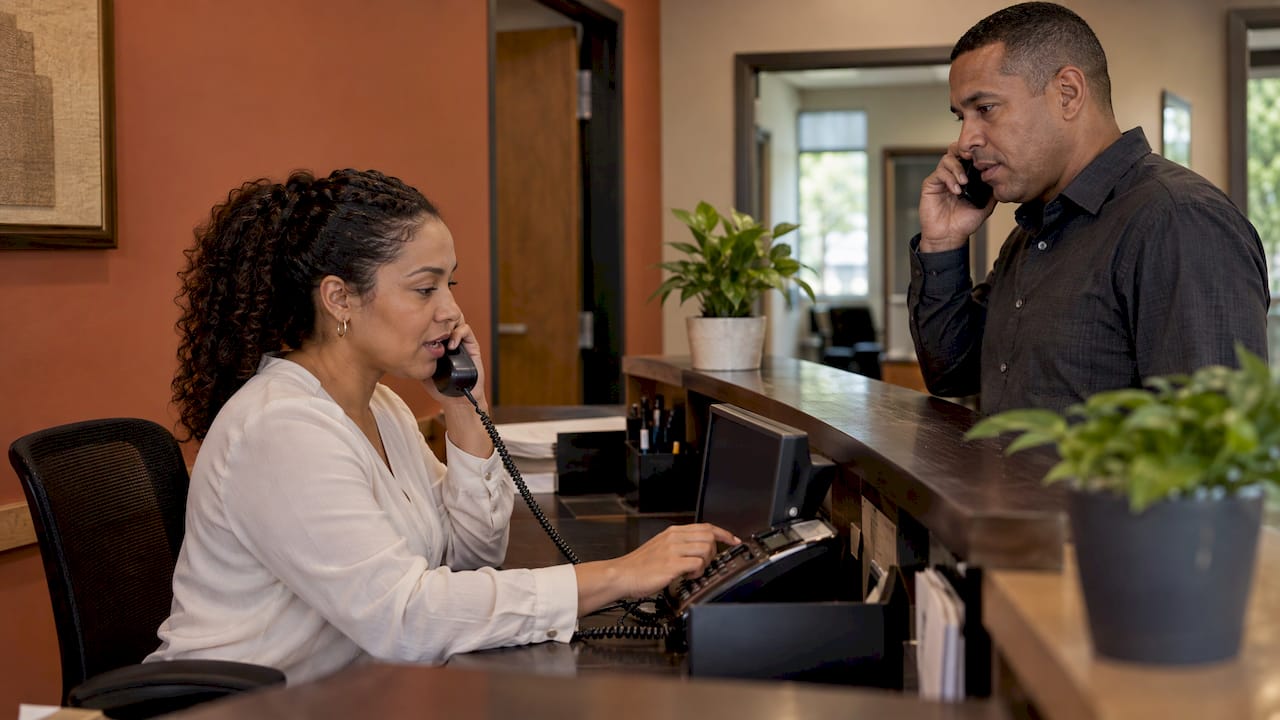
Urgent call escalation is the controlled handoff of a call from whoever answered it to a person with the authority, skill or time to resolve it, based on triggers you define in advance. A good process names the triggers, the person who receives the call, the information passed along and the record kept afterward. For a practice serving Spanish-speaking clients, it also has to work in both languages, at any hour.
This guide walks through the definition, the decision rules, the handoff script, the contact list and the documentation. It ends with a rollout plan a small dental, medical or law office can finish in a few weeks.
TL;DR
- Escalate on observable triggers: the issue is beyond the answerer’s knowledge or authority, frustration keeps rising, or there is a safety or security concern.
- Pick the escalation type that fits: hierarchical, functional, priority or automatic.
- Keep the caller informed, stay on the line until the right person picks up, and pass along a complete summary so nobody repeats the story.
- Write down who the escalation contacts are, in order, with a backup, and log every escalated call.
- If calls arrive in Spanish or after hours, the rules must cover those calls too, or your most urgent clients are the ones who fall through.
Table of Contents
- What urgent call escalation means
- The four types of escalation
- How to decide when a call must be escalated
- Handling the caller during the handoff
- Escalation contacts and what to pass to them
- Prioritizing several urgent calls at once
- Documenting every escalation
- Where bilingual practices lose urgent calls
- Our perspective
- What a bilingual front desk looks like with Diazluna
- A rollout plan you can finish in four weeks
- FAQ
- Sources
What urgent call escalation means
In customer service, an escalated call is an interaction moved from a frontline agent to a higher authority or specialized team because of its complexity, its sensitivity or the customer’s dissatisfaction with the first response. The word “urgent” adds a clock: the issue cannot wait for the normal queue, the next business day or the next available person.
In a clinic, that might be a patient describing swelling after a procedure. In a law office, it might be a client who was just served papers with a deadline. In a small business, it might be a key customer whose order is failing today. The common thread is that the person who answered cannot solve it alone, and a delay costs something real.
Escalation is not a failure of the front desk. It is a designed part of the job. The practice decides in advance who needs to know what, and how fast, so that the person answering the phone is never improvising a judgment call about a medical or legal matter.
The four types of escalation
It helps to name the kind of handoff you are making, because each has a different destination. One common breakdown lists four types:
| Type | What it means | Practice example |
|---|---|---|
| Hierarchical | The call goes to a more senior person or manager | A caller asks for the office manager or the attorney directly |
| Functional | The call goes to the team or person with the exact skill needed | A billing dispute goes to billing, a clinical question to the nurse or dentist |
| Priority | The issue is handled by urgency and moves to higher levels faster | Post-procedure pain or a court deadline jumps the line |
| Automatic | Software triggers the handoff when an issue stays unresolved past a set time | A message unanswered for 15 minutes alerts the on-call person |
Most small practices use all four without naming them. Naming them lets you write a rule for each, which is what turns habit into a process.
How to decide when a call must be escalated
A simple three-step test appears in guidance on escalated calls. Ask these questions in order:
- Is the issue beyond my knowledge or authority? If the caller needs a diagnosis, a legal opinion, a refund over your limit or an exception to policy, it is not yours to decide.
- Is the caller’s frustration rising despite my efforts to calm it? At that point, involve a supervisor.
- Is there a safety or security concern? Escalate immediately to the appropriate department or to the authorities.
The third question outranks the others. A caller who mentions chest pain, a threat, a breach of private data or a danger to a child does not get a polite queue position. For medical emergencies, your script should tell staff to direct the caller to 911, then notify the clinician.
Use triggers you can observe, not moods
The rule “escalate when the customer is angry” does not hold up. As one small-team playbook points out, some serious incidents arrive in a calm email, while some loud calls are an ordinary request the front desk can resolve. The fix is to write triggers anyone can verify:
- Specific words or topics: pain, bleeding, allergic reaction, arrest, served, deadline, court date, immigration detention, data breach.
- A time limit: the caller has been on hold or waiting for a callback longer than your standard.
- A repeat: this is the second or third contact about the same issue.
- A request: the caller asks for a named person, a manager or the owner.
- A limit: the answer requires an approval the answerer does not have.
Post these on a single page at the front desk. Review them every quarter with real calls: which ones were escalated unnecessarily, and which should have been escalated but were not?
Handling the caller during the handoff
How you hand off matters as much as when. Guidance from FINRA on handling emotional callers is practical for any office: stay calm, let the caller speak without interruption, acknowledge the emotion, paraphrase the main points, avoid trigger phrases and set limits on abuse. Then focus on resolving the issue or providing a resource. When needed, offer a supervisor transfer and stay on the line to make sure the caller reaches the right person.
A short script keeps this consistent:
- Acknowledge: “I understand this is stressful, and I want to make sure the right person helps you.”
- Paraphrase: “So the problem started Tuesday and the pain is getting worse. Is that right?”
- Explain the step: “I’m bringing in Dr. Ramirez’s team. I’ll stay with you until they pick up.”
- Confirm contact details: “If we get disconnected, is this the best number to reach you?”
- Warm transfer: introduce the caller and summarize the issue to the next person before you drop off.
The warm transfer is the part most offices skip. A cold transfer forces a worried caller to tell the story again, and that is often the moment a mild frustration becomes a complaint.
Escalation contacts and what to pass to them
An escalation contact is the named person (or role) who receives an escalated issue and has the authority to act on it. The original answerer stays responsible until another named person accepts the handoff, so the contact list needs real names, real numbers and a backup for each.
Build the list like this:
- Level 1: the on-duty clinician, attorney or manager for the day.
- Level 2: a backup who is reachable if Level 1 does not respond within your time limit (for example, 10 minutes for urgent issues).
- Level 3: the owner or partner, for anything unresolved or with legal, financial or reputational exposure.
- After hours: a separate rotation with a phone number that is actually monitored, not the office voicemail.
A well-defined process names the trigger, required information, owners, approvals, exceptions, handoffs, records and completion criteria, and gives the person who receives the issue a clear decision right: approve, reject, reroute, prioritize, assign resources or request more evidence. Tell your contacts what they are allowed to decide, so they do not bounce the call back.
The handoff summary
When you pass a case on, include these items every time:
- Caller’s full name, callback number and preferred language
- Why the call is urgent, in one sentence
- What has already been tried or said
- The deadline or time sensitivity
- Whether the caller has been told to expect a call, and by when
If the caller prefers Spanish, say so in the first line. A bilingual clinician or attorney can call back in the right language, and someone who does not speak Spanish can arrange for the right person rather than guessing.
Prioritizing several urgent calls at once
Two urgent calls at the same time is where unwritten rules fail. Ordering work by a clock is a well-established approach: help-desk documentation shows teams can sort waiting items by creation time, response-due time or resolution-due time, and ordering by response-due puts first the items closest to missing their first-response target.
For a front desk, translate that into a simple ladder:
- Safety first: any life, safety or security issue comes before everything else.
- Closest deadline next: a court filing due tomorrow beats a billing question.
- Oldest waiting next: among equals, the person who has waited longest goes first.
- Routine last: scheduling and general questions get a promised callback time.
Setting a response target for each tier is what keeps the ladder honest. If you promise to respond to urgent issues in minutes and routine ones within a business day, staff know what “on time” means. The same logic applies to leads that come in off hours, as this look at weekend lead response shows: speed of the first reply often decides who wins the client.
Our own guide to urgent call routing for clinics with Spanish goes deeper on how to sequence routing in a bilingual setting, and our piece on call triage automation covers how to sort calls before a human ever picks up.
Documenting every escalation
If it is not written down, it did not happen, and you cannot improve it. One common flow runs through identification, notification, transfer, review, resolution, communication and documentation, and the record should capture the initial issue, steps taken, resolution and follow-up actions.
For regulated settings, add more. A financial services checklist recommends noting what was tried, the reason for escalation, timestamps, who escalated, who received the case and links to supporting documents, all stored in one central place so it can be audited. Healthcare and legal offices have their own confidentiality duties, so keep records only in systems your compliance lead has approved, and follow your state’s rules and your own policies.
A minimal log has these columns:
| Field | Example |
|---|---|
| Date and time received | 11/04, 6:42 p.m. |
| Caller and language | Maria G., Spanish |
| Trigger | Safety: post-procedure bleeding |
| Escalated to | On-call dentist, Level 1 |
| Time accepted | 6:49 p.m. |
| Outcome | Callback made, appointment next morning |
| Follow-up due | Next day, 9 a.m. |
Review the log monthly. Count how many escalations reached the right person on the first try, how long acceptance took and which triggers fired most. Those three numbers tell you where the process leaks.
Where bilingual practices lose urgent calls
For a practice with Spanish-speaking clients, the standard playbook has three extra gaps.
The language gap at the first answer. If nobody on duty speaks Spanish, the caller may hang up before anyone learns the call was urgent. The trigger words in your list need Spanish equivalents: dolor, sangrado, hinchazón, citatorio, audiencia, fecha límite. Our Spanish phone etiquette guide for clinics covers how to handle these calls respectfully and with privacy in mind.
The after-hours gap. Urgent problems do not keep office hours. A voicemail box is not an escalation path. See our guides on after-hours call handling and why after-hours Spanish support matters for how to set this up.
The channel gap. Many Hispanic clients prefer to message on WhatsApp rather than call. An urgent message sent at 9 p.m. needs the same trigger list and the same contact ladder as a phone call. Otherwise your process only covers one door into the building.
Fixing these gaps also reduces the plain missed-call problem; our article on how to reduce missed calls at your clinic is a good companion.
Our perspective
We built Diazluna around one observation: the calls that matter most are often the ones a small practice is least equipped to catch. They come in Spanish, at 8 p.m., or through WhatsApp, and the person who could act on them is not at the desk.
Our approach is to treat escalation as part of the front desk, not a separate tool. Our AI receptionist, María, answers 24/7 in Spanish and English, handles calls, messages and scheduling, and is designed to pass urgent cases to a person, with a real-time summary so the caller does not have to start over.
The rules still belong to you. You decide what counts as urgent, who gets the call and in what order. We help you carry those rules out at every hour, in the language the client is most comfortable in, on a site and a WhatsApp line that match the same standards.
And because the Spanish on your site and in your messages is human-reviewed rather than machine-translated, clients hear the same authentic voice before and after the escalation. That consistency is what builds trust when someone is worried.
Francisco
What a bilingual front desk looks like with Diazluna
If you would rather not stitch together a website agency, an answering service and a messaging tool, Diazluna combines a bilingual website, a 24/7 AI receptionist and WhatsApp in one subscription. The AI receptionist manages calls, messages and appointment scheduling and provides real-time summaries and transfer of urgent cases, so your escalation list is followed outside business hours too.
Plans as published on our site:
- Solo Sitio: $99 per month or $990 per year, for the bilingual website.
- Sitio + María: $199 per month or $1990 per year, adding the AI receptionist.
- Sitio + María Pro: $349 per month or $3490 per year, a full-service managed package with site updates and expanded call capacity.
- Activación: $399, one-off.
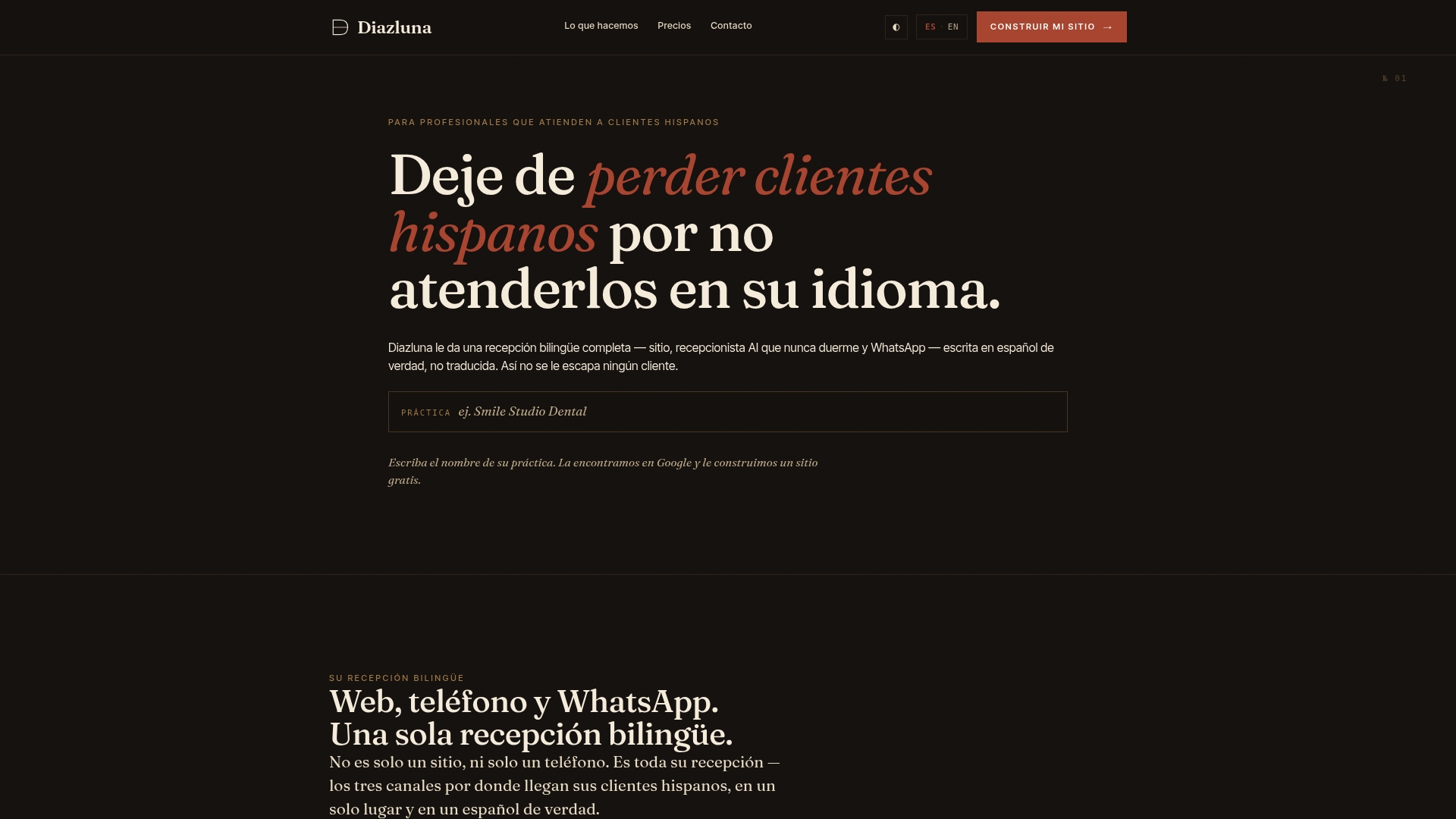
See the plans on the Diazluna home page, or if you run a law firm, the page for bilingual site, phone and WhatsApp for firms. To compare options, our article on types of bilingual support services lays out how each approach works.
A rollout plan you can finish in four weeks
Week 1: Define. List your urgent scenarios by type (clinical, legal, security, billing, VIP). For each, write the trigger, the escalation type from the table above and the target response time.
Week 2: Assign. Name Level 1, 2 and 3 contacts and an after-hours rotation. Write down what each is authorized to decide. Get their agreement in writing and confirm phone numbers.
Week 3: Script. Draft the acknowledgment, warm-transfer and summary scripts in English and Spanish. Have a native Spanish speaker review the wording so it sounds natural, not translated. Our cultural nuance checklist can help with tone.
Week 4: Practice and log. Run three or four mock calls, including one at night and one by WhatsApp. Start the log. After a month, review the numbers and adjust triggers.
Once the urgent case is resolved, the relationship work is not over. A short check-in the next day, in the client’s language, shows you took it seriously. Our guide to bilingual client follow-up shows how.
FAQ
What does urgent call escalation mean?
It means moving a call that cannot wait from the person who answered to someone with the authority, skill or time to resolve it. The handoff follows triggers set in advance, such as a safety concern, a missed time limit or a request beyond the answerer’s authority.
How do you decide when to escalate a call?
Ask three questions: is the issue beyond my knowledge or authority, is frustration rising despite my efforts, and is there a safety or security concern. A yes to any of them means escalate, and a safety concern means escalate immediately. Write the triggers down so staff do not rely on guesswork.
What are escalation contacts?
They are the named people, in order, who receive escalated issues and can decide what happens next. A good list has a primary contact, a backup and an owner-level contact, plus a separate after-hours number. Each contact should know what they are authorized to approve or reroute.
What should I tell the next person when I transfer an urgent call?
Give the caller’s name, callback number and preferred language, the reason the call is urgent, what has already been done, the deadline and what the caller was promised. Do this before you leave the call, so the caller does not have to repeat the story.
Can an AI receptionist handle escalation?
It can follow the rules you set: recognize the triggers you define, collect the details and pass urgent cases to a person with a summary. Our AI receptionist, María, is built to do this in Spanish and English at any hour. A person still makes the clinical or legal decision.
Sources
- Mastering Escalation Call Management in Contact Centers
- What is Client Call Escalation in a Call Centre?
- Customer Support Escalated Calls Fully Examined
- Customer Service Escalation Process: A Practical Playbook
- FINRA: Tips for Handling Emotional Callers
- Escalation Process: How Teams Avoid Delays
- Prioritize Ticket Queues: Freshdesk Support
- Call Center Escalation: Step-by-Step Process Flow Guide
- Financial Services Help Desk Escalation Checklist
- Weekend Lead Response for Service Businesses