November 7, 2026
Spanish Blog Topics for Healthcare Practices That Patients
The best Spanish blog topics for a healthcare practice are the ones that follow the patient’s visit: booking an appointment, describing symptoms, understanding medications, and knowing what to do after they leave. Medical Spanish courses already organize their content that way, so you can borrow that structure and turn each stage into posts your Spanish-speaking patients will actually read. Below are more than 30 topic ideas, grouped by stage, with notes on how to write them so the Spanish sounds like your clinic and not like a translation.
TL;DR
- Build your Spanish blog around the patient journey: before the visit, during the visit, medications, and after-care.
- Teaching curricula for U.S. healthcare workers list the same core topics: appointments, symptoms, medical history, medication instructions, pain, diet, testing and discharge. Each one is a post.
- Write for patients in plain, short Spanish and confirm understanding with teach-back, not only translated text.
- Posts support patients but do not replace a qualified interpreter for histories, consent, medication instructions and discharge.
- Publish a few strong posts on one bilingual site rather than many thin ones.
Table of Contents
- Why a Spanish healthcare blog is worth building
- Where the topic ideas come from
- Before the visit: topics that get patients through the door
- During the visit: symptoms, pain and history
- Medications and care instructions
- After the visit: discharge and follow-up
- Condition and family health series
- How to write each post so patients trust it
- When a blog post is not enough: interpreters and language access
- A 12-post starter calendar
- Our perspective
- Put your Spanish content to work
- FAQ
- Sources
Why a Spanish healthcare blog is worth building
About 12% of the U.S. population aged 5 or older speaks Spanish at home. For a clinic in many cities, that is a large share of the people searching for care. A Spanish blog gives those patients answers in their own language before they call, and it gives your front desk fewer repeated questions.
The topic list is the hard part. Most pages that rank for this kind of search are phrase lists written for clinicians learning Spanish. They are useful for staff training, but your blog speaks to the patient. So the approach here is to take the vocabulary that medical Spanish programs teach staff, and flip it: what would a patient want to read about that same moment?
If you want a broader plan for how Spanish pages get found, our guide to Spanish keyword research for U.S. clinics covers how to match topics to searches.
Where the topic ideas come from
We did not guess the topics. A university medical Spanish syllabus lists greeting patients, negotiating appointment dates, telephone messages, symptoms and medical history, medication instructions, vital signs, pain, diet, testing, activities of daily living and discharge planning. A community college course for healthcare professions adds food allergies, prescriptions, routine blood tests, mammograms, colonoscopy, pap smears, infant growth and development. Those are the conversations that happen every day in U.S. clinics, so they are also the questions patients carry.
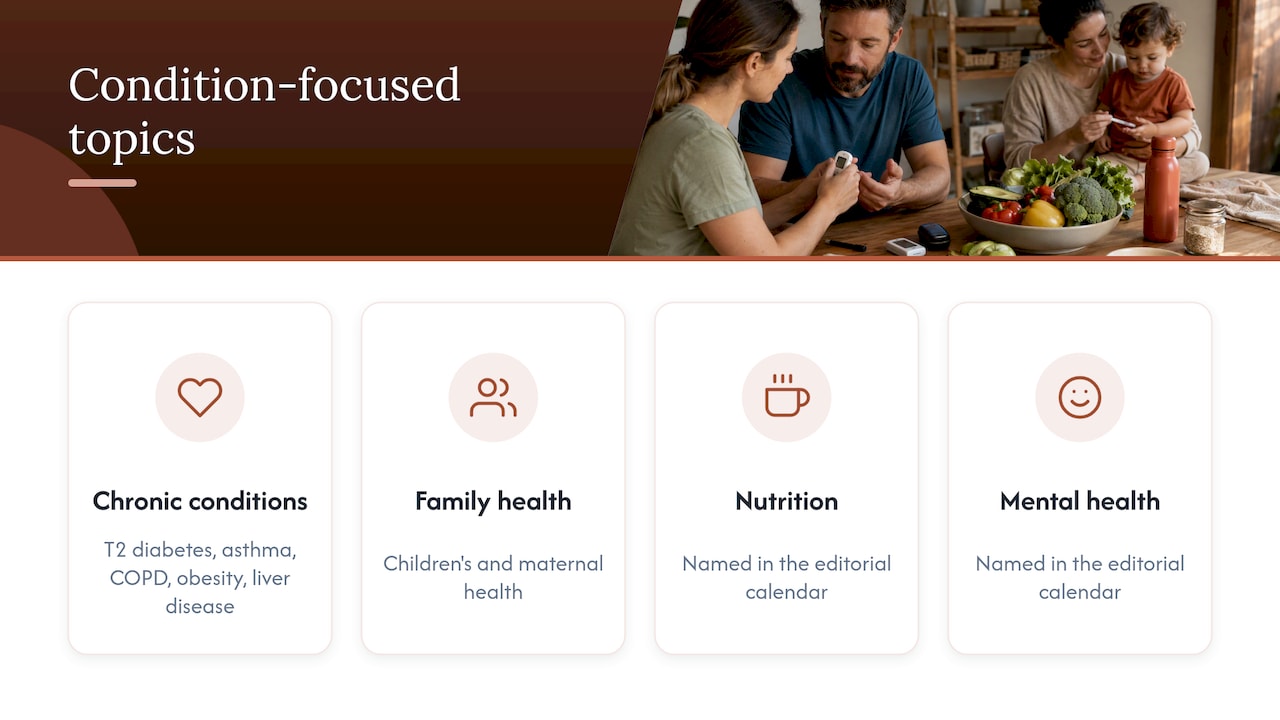
An intermediate textbook goes further and covers health concerns affecting the Hispanic population such as type 2 diabetes, asthma, COPD, obesity and liver disease, plus children’s health, maternal health, nutrition and mental health. That list is a ready-made editorial calendar for condition-focused posts.
Before the visit: topics that get patients through the door
These posts answer the questions patients have before they call. They also double as content your phone staff can send by text.
- Cómo hacer una cita en nuestra clínica. Explain the steps: call, text, WhatsApp or the website. State your hours and which languages you offer at each channel.
- Qué llevar a su primera visita. ID, insurance card, medication list, past records.
- Qué esperar en su primera consulta. Walk through check-in, vitals, the conversation with the clinician, and any tests.
- Cómo cambiar o cancelar una cita. Short, clear, with a number and a text option.
- Opciones de pago y seguro. Only state what your practice actually offers.
- Cómo hablar con la clínica por teléfono. Phone etiquette matters: see our post on HIPAA-safe Spanish phone skills for what front desk staff should say.
- Qué hacer si tiene una urgencia. When to call the office, when to go to the emergency room, when to call 911.
- Cómo pedir un intérprete o ayuda en su idioma. Patients should know they can ask for language help.
The appointment topic is not minor. Command Spanish’s physician’s office manual treats front office etiquette, registration, making appointments and office dismissal as core vocabulary, because the front desk is where the visit starts.
During the visit: symptoms, pain and history
Patients search for how to describe what they feel. Posts that teach them the words, and teach them in the way they naturally say them, build trust.
Symptoms
Patients describe symptoms with a few common structures: “Tengo” plus a symptom, “Me siento” plus a symptom, and “Me duele” or “Me duelen”. Questions staff ask often include ¿Cuándo empezó?, ¿Tiene fiebre o tos? and ¿Le falta el aire? A post that mirrors those sentences feels natural to the reader.
Topic ideas:
- Cómo describir el dolor al médico (where, since when, how strong, what makes it better or worse)
- Fiebre, tos y gripe: cuándo consultar
- Mareos y náuseas: qué decirle a su médico
- Dolor de pecho y falta de aire: señales de alerta
- Cómo prepararse para hablar de sus síntomas
For the pain post, borrow the logic of a structured history. The OPQRST framework for pain and a 1 to 10 intensity scale are what clinicians use, and a patient who knows to expect those questions answers faster. The University of Valencia’s history template similarly covers location, intensity on a 1 to 10 scale, what relieves or worsens pain and the effect on sleep.
Medical history
Typical questions patients hear include whether they have high blood pressure, diabetes or high cholesterol, and which medicines they take, including herbs or home remedies. That last detail is a strong blog angle: many patients do not think of teas or supplements as medicine, so a post explaining why you ask protects them.
Topic ideas:
- Su historial médico: qué información necesitamos y por qué
- Cómo preparar su lista de medicamentos, vitaminas y remedios caseros
- Alergias: qué decir y cómo recordarlas
- Vacunas: cómo llevar su registro
- Antecedentes familiares: por qué importan
Exams and vital signs
Patients feel calmer when they know what the clinician will say. Common exam phrases include “Voy a medir su presión arterial” and “Por favor, respire profundo”. A post titled “Qué significan las frases que escuchará durante su examen” is simple and reassuring. Related ideas: presión arterial, temperatura, peso y talla, análisis de sangre, mamografía, colonoscopia.
Our own list of shift-ready medical Spanish terms and our clinic Spanish phrase guide can help your staff check that the vocabulary on the blog matches what they say at the desk. For dental practices, there is a Spanish dental terms list.
Mobility and daily living
This topic is easy to overlook, and it matters most for older patients and their families. Useful questions include whether the patient can get up alone, has fallen recently, or needs help walking, dressing or bathing. Vocabulary such as equilibrio (balance), caída (fall), ayuda para caminar (walking aid) and bañarse (to bathe) appears in geriatric Spanish guides for senior care. Post ideas:
- Cómo prevenir caídas en casa
- Cómo hablar con el médico sobre su independencia
- Qué ayuda existe para bañarse, vestirse y moverse
- Cuándo manejar ya no es seguro: cómo conversarlo en familia
Medications and care instructions
This is where clear writing has the most effect. In a randomized study of limited-English-proficiency adults, prescription labels that tied dosing to morning, noon, evening and bedtime, used simpler words and numerals improved understanding and dosing compared with standard instructions. The lesson for a blog: use the same concrete, time-anchored language.
Topic ideas:
- Cómo leer la etiqueta de su receta
- Cuándo tomar sus pastillas: mañana, mediodía, tarde y noche
- Qué hacer si olvida una dosis (confirm the answer with your clinician or pharmacist before publishing)
- Antibióticos: por qué terminar el tratamiento solo si su médico lo indica
- Cómo guardar sus medicinas
- Preguntas para hacerle al farmacéutico
Plain language beats literal translation. One healthcare communication guide recommends starting with what the patient needs to know: diagnosis, next step, medication plan and warning signs, using familiar words and short, active sentences. Apply that to every post. For a readability review of existing pages, use our Spanish readability checklist for clinics.
After the visit: discharge and follow-up
Discharge planning appears in nearly every medical Spanish syllabus, which makes it a reliable blog category. Ideas:
- Qué significan las instrucciones de alta
- Señales de alarma después de un procedimiento: cuándo llamar
- Cómo agendar su cita de seguimiento
- Cómo pedir sus resultados
- Dieta después de su visita o cirugía
Our guide to setting up Spanish discharge instructions shows how to build these as repeatable, reviewed templates. A post can explain the process, but a patient’s individual instructions still come from their clinician.
Condition and family health series
Once the visit-based posts exist, add a rolling series from the condition list in the textbook above:
- Diabetes tipo 2: alimentación, medicinas, chequeos
- Presión alta: cómo medirla en casa
- Asma y EPOC: cómo usar el inhalador
- Obesidad y nutrición: planes realistas
- Salud del hígado
- Salud infantil: crecimiento y desarrollo, vacunas
- Embarazo y salud reproductiva
- Salud mental: cómo pedir ayuda sin pena
Each condition post should be reviewed by a clinician in your practice before publishing, and should name your practice’s specific services, not general advice.
How to write each post so patients trust it
- Start with the answer. The first two sentences tell the patient what to do.
- Use short, repeatable sentences. Language guidance for clinicians suggests keeping phrases short, repeatable and polite, and the same applies to written Spanish.
- Use natural vocabulary. Write the way your patients speak, then mention the medical term once.
- Add a teach-back line. Close with a question the reader can ask themselves or you, such as how they will take the medicine at home. The AHRQ describes teach-back as an evidence-based health literacy technique that supports engagement, safety and adherence.
- Have a Spanish speaker review it. Machine output alone often misses tone and regional wording.
- End with a clear next step: a phone number, a WhatsApp link, a booking option.
For how these posts fit on your site, see our notes on Spanish clinic website content and a 30/60/90 day Spanish SEO plan.
When a blog post is not enough: interpreters and language access
Blog content informs. It does not replace live language assistance when the conversation carries clinical weight. Under the Section 1557 final rule, covered entities must take reasonable steps to give meaningful access to people with limited English proficiency, and language assistance must be free, accurate, timely and protect privacy.
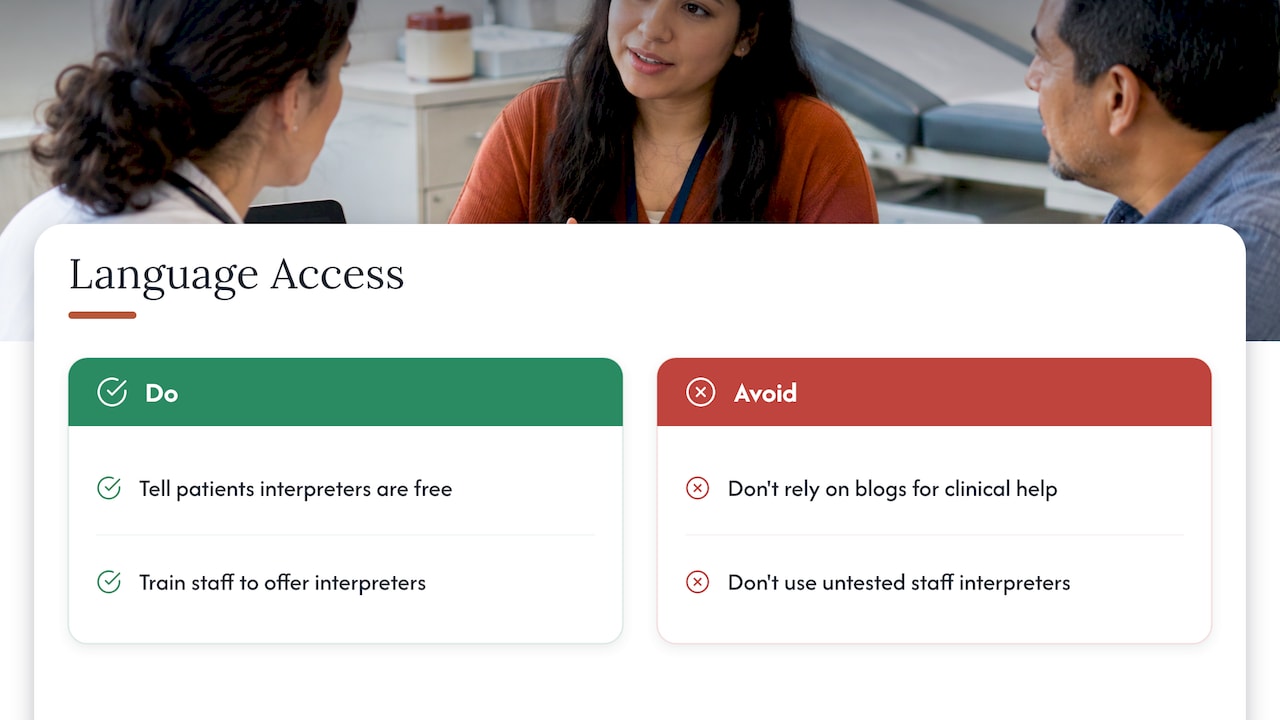
A qualified interpreter must be proficient in both languages, interpret accurately and impartially with specialized vocabulary, and preserve tone and sentiment. Some health systems set the rule plainly: one hospital policy requires a qualified interpreter for medical histories, diagnoses and treatment plans, informed consent, medication instructions and discharge plans, even when staff speak the language but have not been tested. Add a short post telling patients they can ask for an interpreter at no cost, and train staff to offer one for those moments.
Tools can support that workflow. If you are weighing how automation fits in, read about AI in patient communication, and see our comparison of patient communication tools for Spanish-speaking patients.
A 12-post starter calendar
| Month | Post | Stage |
|---|---|---|
| 1 | Cómo hacer una cita | Before the visit |
| 1 | Qué llevar a su primera visita | Before the visit |
| 1 | Qué hacer en una urgencia | Before the visit |
| 2 | Cómo describir el dolor | During the visit |
| 2 | Su lista de medicamentos y remedios caseros | During the visit |
| 2 | Frases que escuchará en su examen | During the visit |
| 3 | Cómo leer la etiqueta de su receta | Medications |
| 3 | Cuándo tomar sus pastillas | Medications |
| 3 | Preguntas para el farmacéutico | Medications |
| 4 | Instrucciones de alta explicadas | After the visit |
| 4 | Señales de alarma: cuándo llamar | After the visit |
| 4 | Cómo pedir ayuda en su idioma | Language access |
Our perspective
We see the same pattern in practices that serve Hispanic patients: the blog is good, but the patient who reads it then calls at 8 p.m., or sends a WhatsApp message, and nobody answers in Spanish. A Spanish post is only half of the experience.
That is why we build the website, the receptionist and WhatsApp as one front desk. Our Spanish is human-reviewed and not translated, so a post about medications reads the way your patients speak. When the reader is ready to book, our AI receptionist, María, is designed to handle calls, messages and scheduling in Spanish and English, summarize the conversation and pass urgent cases to your team.
Start small: a dozen posts that follow the patient’s visit, on a site you can edit yourself, with a front desk that answers in the same voice.
Francisco
Put your Spanish content to work
Diazluna is a bilingual front desk for practices serving Hispanic patients: a bilingual website, a 24/7 AI receptionist and WhatsApp in one subscription. Solo Sitio is $99 per month (or $990 per year) for the website. Sitio + María is $199 per month ($1990 per year) and adds the AI receptionist. Sitio + María Pro is $349 per month ($3490 per year) and adds managed site updates and expanded call capacity. Activation is a one-off $399. See the plans on our bilingual front desk page.
If you already have your topic list, the site is where it goes. You can also start from the Diazluna home page.
FAQ
How many Spanish blog posts does a healthcare practice need?
Start with 10 to 12 posts that cover the patient journey, from booking to discharge. A small set of reviewed, useful posts serves patients better than dozens of thin ones. Add a new post each month from the condition list.
Can I translate my English posts into Spanish?
You can use them as a starting point, but rewrite for how your patients speak and have a Spanish speaker review each post. Plain, short sentences and familiar words work better than literal translation. Check medical details with a clinician before you publish.
Do Spanish blog posts replace interpreters?
No. Posts help patients prepare and follow up. For medical histories, consent, medication instructions and discharge plans, use a qualified medical interpreter, as covered by Section 1557 language-access requirements.
What is the easiest first topic to write?
Start with “Cómo hacer una cita” and “Qué llevar a su primera visita.” Your front desk already answers these questions daily, so you can write them accurately and quickly, and patients will find them useful right away.
Sources
- Drexel University College of Medicine, Spanish for Medical Professionals syllabus
- Spanish for the Pharmacy Professional, PharmacyLibrary
- SPAN G161: Spanish for Healthcare Professions
- Intermediate Medical Spanish, library catalog record
- Command Spanish: Spanish for the Physician’s Office
- Common Medical Symptoms Vocabulary in Spanish
- Medical Spanish for the history and physical
- Guía de anamnesis para estudiantes de medicina, University of Valencia
- Essential medical Spanish phrases
- Essential Geriatric Spanish phrases
- Evaluation of Language Concordant, Patient-Centered Drug Label Instructions
- Plain Language vs. Translation in Healthcare
- Spanish for Healthcare Professionals: Practical Phrases
- AHRQ Tool: Teach-Back
- HHS: Language Access Provisions of the Section 1557 Final Rule
- Title VI and Section 1557 explainer, National Health Law Program
- Kaweah Health interpreter services policy
- The Role of AI in Patient Communication: 2026 Guide